

Time Limit
3 years
from the date of the accident
Legal Basis
1957 Act
Occupiers' Liability Act
Typical Timescale
4 – 12
months (varies by case)
Upfront Cost
£0
on eligible No Win No Fee claims

Personal Injury Solicitor at Claim Time Solicitors, Birmingham. Handling personal injury and child injury claims across England and Wales on a No Win No Fee basis.
Every guide we publish is checked against current UK law before it goes live.
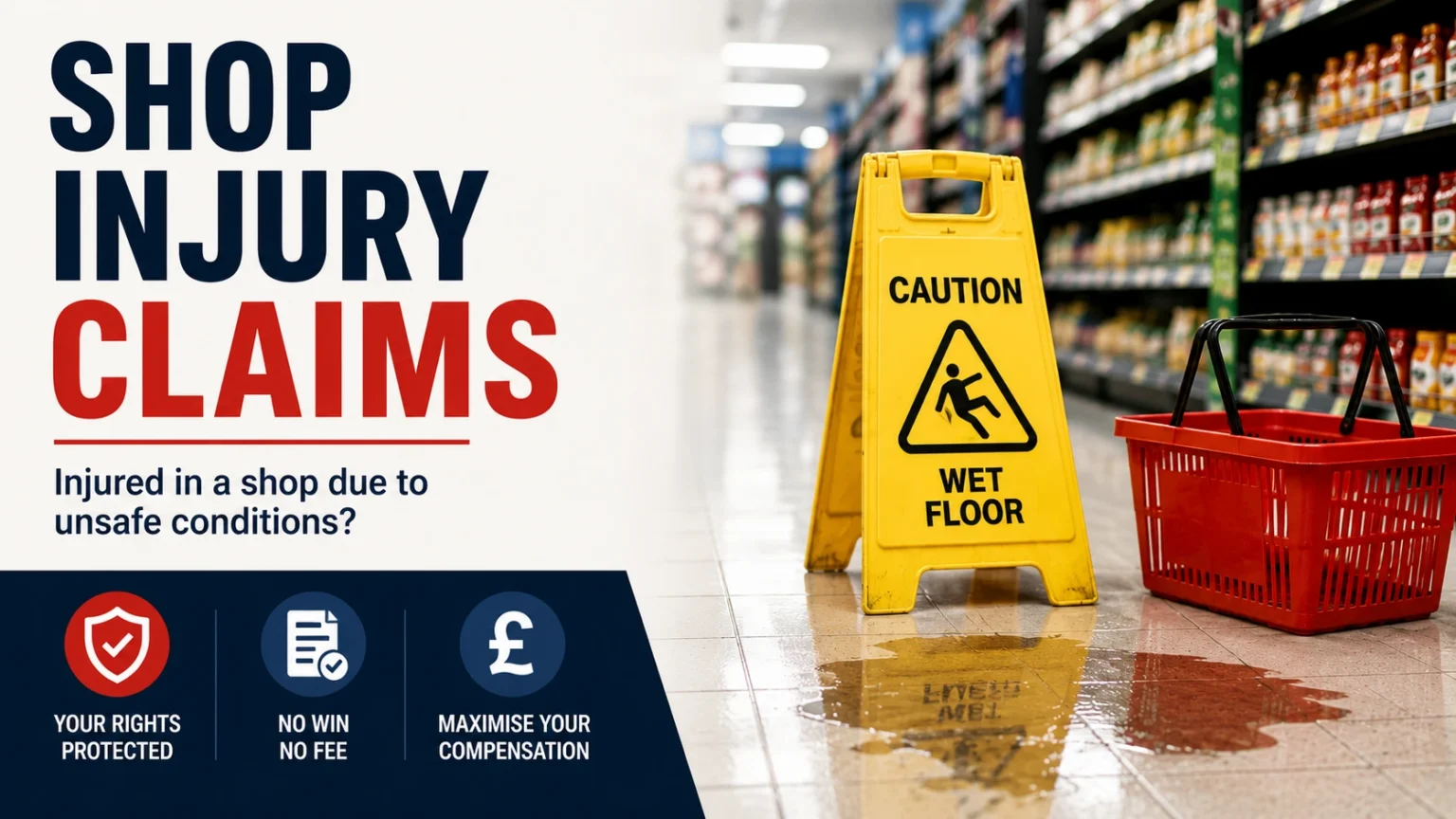
If you were injured in a shop or supermarket because the premises were not kept reasonably safe, you may be eligible to make a shop injury claim. Retailers have a legal duty under the Occupiers’ Liability Act 1957 to take reasonable care to protect visitors from avoidable harm.
For successful shop injury claims, you will usually need to show that the retailer knew, or should reasonably have known, about the hazard and failed to remove it, repair it or provide an adequate warning. In most cases, you have three years from the date of the accident to begin a claim, and your case may be handled on a No Win No Fee basis.
A trip over a trailing cable, a slip on a spill that was never signed or cleaned, a display that topples as you reach for a shelf. Accidents in shops and supermarkets happen more often than people think, and many of them were avoidable. In 2023/24, 58,933 public liability claims were registered with the Compensation Recovery Unit, the government body that records personal injury claims in the UK.[1]
If a shop’s failure to keep its premises safe left you injured, you have the right to ask whether you can claim. This guide explains when a shop is liable, how compensation is worked out, and the practical steps to take next. It is written for people deciding whether a claim is worth pursuing, so it stays clear and honest about what is and is not likely to succeed.
What are shop or supermarket accident claims?
A personal injury claim against a shop, supermarket or its occupier when unsafe conditions on the premises cause you harm.
Definition
Occupiers’ liability
The legal duty on whoever controls a premises to take reasonable care that lawful visitors are reasonably safe. For shops and supermarkets this duty sits under the Occupiers’ Liability Act 1957
Shop or supermarket accident claims are a type of public liability claim. It covers injuries suffered by customers, and sometimes visitors and delivery drivers, when a retailer does not keep its floors, aisles, car parks or fittings reasonably safe. The shop does not have to guarantee your safety. It has to take reasonable steps to prevent foreseeable harm.
Common causes we see include:
- Wet or slippery floors from spills, cleaning or wet weather brought in at the entrance, with no warning sign in place
- Items left in aisles such as stock cages, boxes, roll cages or trailing cables
- Falling stock from shelves that are overloaded or poorly stacked
- Damaged flooring, loose mats, worn tiles or unmarked steps
- Poor lighting in stairwells, storerooms or car parks
Proving the shop was negligent
You need to show the shop owed you a duty of care, breached it by failing to act reasonably, and that the breach caused your injury.
Winning the majority of shop injury claims come down to negligence. Being hurt in a shop is not enough on its own. The question is whether the shop fell short of the care it reasonably owed you. There are three parts to this:
- Duty of care. A shop open to the public owes its customers a duty under the Occupiers’ Liability Act 1957. This part is usually straightforward.
- Breach of that duty. This is the heart of most cases. Did the shop know, or should it reasonably have known, about the hazard, and did it fail to deal with it in a reasonable time? A spill left for an hour with no sign points to a breach. A spill you slipped on seconds after another customer dropped it may not.
- Causation. The breach has to be what caused your injury. Medical evidence links the accident to the harm you suffered.
What helps prove a breach:
Retailers are expected to have systems for spotting and clearing hazards, such as regular floor-walk checks and cleaning logs. Where those systems are missing, ignored, or poorly recorded, that often supports a claim. Evidence that tends to help includes:
- Photos or video of the hazard and the surrounding area, taken as soon as possible
- The shop’s accident book entry, with a copy for you
- CCTV footage, which you or your solicitor can request
- Names and contact details of any witnesses or staff present
- The shop’s cleaning or inspection records, obtained during the claim
The strongest shop accident claims are built on evidence gathered early. Report the accident before you leave, ask for the incident to be logged, and photograph the hazard if you safely can. CCTV is often overwritten within weeks, so acting quickly matters.
Can you make a claim?
You may be able to claim if you were injured in the last three years by a hazard the shop should reasonably have dealt with, and you were not mainly at fault.
You may be eligible if:
- You were injured on shop or supermarket premises, inside or in the car park
- The injury was caused by a hazard the retailer should reasonably have managed
- The accident happened within the last three years
- You have, or can obtain, some evidence of what happened
| Scenario | Claim May Apply? | What Usually Matters |
|---|---|---|
| Slipped on an unmarked spill | Often yes | How long the spill was there, cleaning records |
| Tripped over a stock cage in an aisle | Often yes | Whether it was left unattended and unmarked |
| Hit by falling stock | Often yes | How the shelving was stacked and maintained |
| Slipped on a spill that had just happened | Depends | Whether staff had any reasonable chance to act |
| Injured while ignoring a clear warning sign | Harder | Your own care may reduce or defeat the claim |
This table is a general guide only. Every claim turns on its own facts, and only a review of your circumstances can tell you where you stand.
“Most people worry they are making a fuss. They are not. Occupiers’ liability exists precisely so that a shop’s failure to keep you safe does not become your problem to carry alone.”
How the claim process works
A free case check, then evidence gathering, a formal claim to the shop’s insurer, medical evidence, and settlement. Most claims settle without going to court.
Knowing what happens next takes a lot of the worry out of starting a claim. Here is the usual path, though timescales vary with the injury and whether the shop accepts responsibility.
- 1Free Case Check Week 1
We listen to what happened, explain your options, and tell you honestly whether you have a claim worth pursuing.
- 2Evidence & Agreement Week 1 – 3
If you go ahead, we set up a No Win No Fee agreement and start gathering evidence, including CCTV and accident records.
- 3Claim to the Insurer Month 1 – 2
A formal letter of claim goes to the shop or its insurer, who then has time to investigate and respond on liability.
- 4Medical Evidence Month 2 – 6
An independent medical expert assesses your injury and recovery, which helps value the claim fairly.
- 5Negotiation & Settlement Month 4 – 12
We negotiate a settlement. If a fair figure cannot be agreed, court is an option, though most claims settle before that stage.
How much compensation could you receive?
It depends on the injury and your financial losses. Compensation has two parts: general damages for the injury itself, and special damages for money you have lost or spent.
Definition
General vs. special damages
General damages cover the pain, suffering and loss of amenity from the injury.
Special damages cover financial losses you can evidence, such as lost earnings, treatment costs and travel to appointments.
There is no fixed price for an injury. Courts and insurers use the Judicial College Guidelines, which set out broad ranges for different injuries, alongside your documented financial losses. The figures below are broad, indicative ranges to show the kind of amounts involved. They are not a valuation of your claim, and every case is assessed on its own facts and up-to-date guidance.
| Injury Type | Severity | Indicative Range |
|---|---|---|
| Minor soft-tissue injury | Full recovery within about a year | Up to around £1,400 |
| Wrist injury | Recovering | Around £3,900 – £12,000 |
| Shoulder injury | Moderate | Around £7,900 – £12,200 |
| Ankle injury | Moderate | Around £13,700 – £26,500 |
| Back injury | Moderate | Around £12,500 – £27,000 |
| Financial losses | Special damages | Evidenced loss, for example lost pay |
Figures are broad indicative ranges only, drawn from the Judicial College Guidelines, and must be checked against the current edition before use. They are not a promise or estimate of what any individual claim is worth.
Do you have a valid shop injury claim?
Not every accident in a shop or supermarket results in a valid claim.
Our free Claim Checker helps you quickly assess whether you may be eligible for compensation before speaking to a solicitor.
Answer four quick questions to receive clear guidance based on your circumstances.
If you did not report it at the time
You may still be able to claim. A missing accident report makes a claim harder, not automatically impossible, if other evidence supports what happened.
Many people leave a shop shaken, assume they are fine, and only feel the injury later. Not reporting the accident on the day does not end your claim. It does mean other evidence has to do more work. CCTV, a receipt showing you were there, a witness, a bank record, or medical notes from when you sought treatment can all help establish what happened and when.
If you are still within the three-year time limit and can show the shop was at fault, it is worth having your situation reviewed. The sooner you do, the more evidence is likely to still be available.
Summary
An accident in a shop or supermarket does not automatically mean you can claim, but if the retailer failed to keep the premises reasonably safe and that caused your injury, you may have a strong case.
The law that matters here is the Occupiers’ Liability Act 1957, and the question at the centre of most claims is whether the shop knew, or should have known, about the hazard and had a fair chance to deal with it.
The practical steps matter as much as the legal ones. Report the accident before you leave, get any injury checked so it is on your medical record, and gather what evidence you can while it is fresh. You normally have three years from the date of the accident to act, and most claims can be run on a No Win No Fee basis.
Key takeaways
- Shops and supermarkets owe customers a duty under the Occupiers’ Liability Act 1957 to take reasonable care for their safety.
- Most claims turn on whether the shop had a reasonable chance to spot and clear the hazard before your accident.
- You normally have three years from the date of the accident to start a claim.
- Compensation covers the injury itself plus financial losses you can evidence, and the amount varies from case to case.
- Reporting the accident late makes a claim harder, not automatically impossible, if other evidence supports what happened.
Sources & References
- Compensation Recovery Unit performance data, GOV.UK. Public liability cases registered: 58,933 in 2023/24 and 53,403 in 2022/23.
- Occupiers’ Liability Act 1957, legislation.gov.uk. Duty of care owed by occupiers to lawful visitors.
- Limitation Act 1980, s.11. Three-year time limit for personal injury claims.
Frequently Asked Questions
How much compensation can I get for an accident in a shop?
Can I claim compensation after slipping in a supermarket?
How long does a supermarket accident claim take?
Do I have to pay anything upfront?
Most shop and supermarket accident claims can be run on a No Win No Fee basis. That means there is nothing to pay upfront, and if the claim is not successful and you have kept to the agreement, you do not pay us for our work. A success fee is deducted from your compensation only if the claim wins. We explain the terms clearly before you sign anything
Who is responsible when you are injured in a shop?
Usually it is the business that occupies and controls the premises, such as the retailer running the store. In some cases a landlord, a cleaning contractor or a maintenance company may share responsibility. Part of a solicitor’s job is to identify the right party and the correct insurer, so you do not have to work that out yourself.
Glossary of Key Terms
The law setting out a shop's duty to take reasonable care for the safety of its visitors.
A claim against a business or individual whose failure to keep a place safe injures a member of the public.
A legal responsibility to take reasonable steps to avoid causing foreseeable harm to others.
Compensation for the injury itself: the pain, suffering and effect on your daily life.
Compensation for financial losses you can evidence, such as lost earnings and treatment costs.
A Conditional Fee Agreement where you pay nothing upfront and no fee for our work if the claim does not succeed.
Where your own lack of care contributed to the accident, which can reduce the compensation.
The time limit for starting a claim, normally three years from the date of the accident.
Disclaimer: The information on this page is for general guidance only and does not constitute legal advice. Compensation outcomes vary by individual case and depend on the specific facts and evidence. Claim Time Solicitors is authorised and regulated by the Solicitors Regulation Authority (ID No. 444171) and accredited by The Law Society . No Win No Fee refers to a Conditional Fee Agreement; the solicitor’s success fee is capped at 25% of compensation recovered. Terms apply.


