

Time Limit
3 years from date of accident
Typical Award
£1,200 – £24,000+
Settlement Time
6 – 14 months
Upfront Cost
£0 · No Win No Fee
Written by

Azhar Ali
Every guide we publish is verified against UK statute and current case law before release.
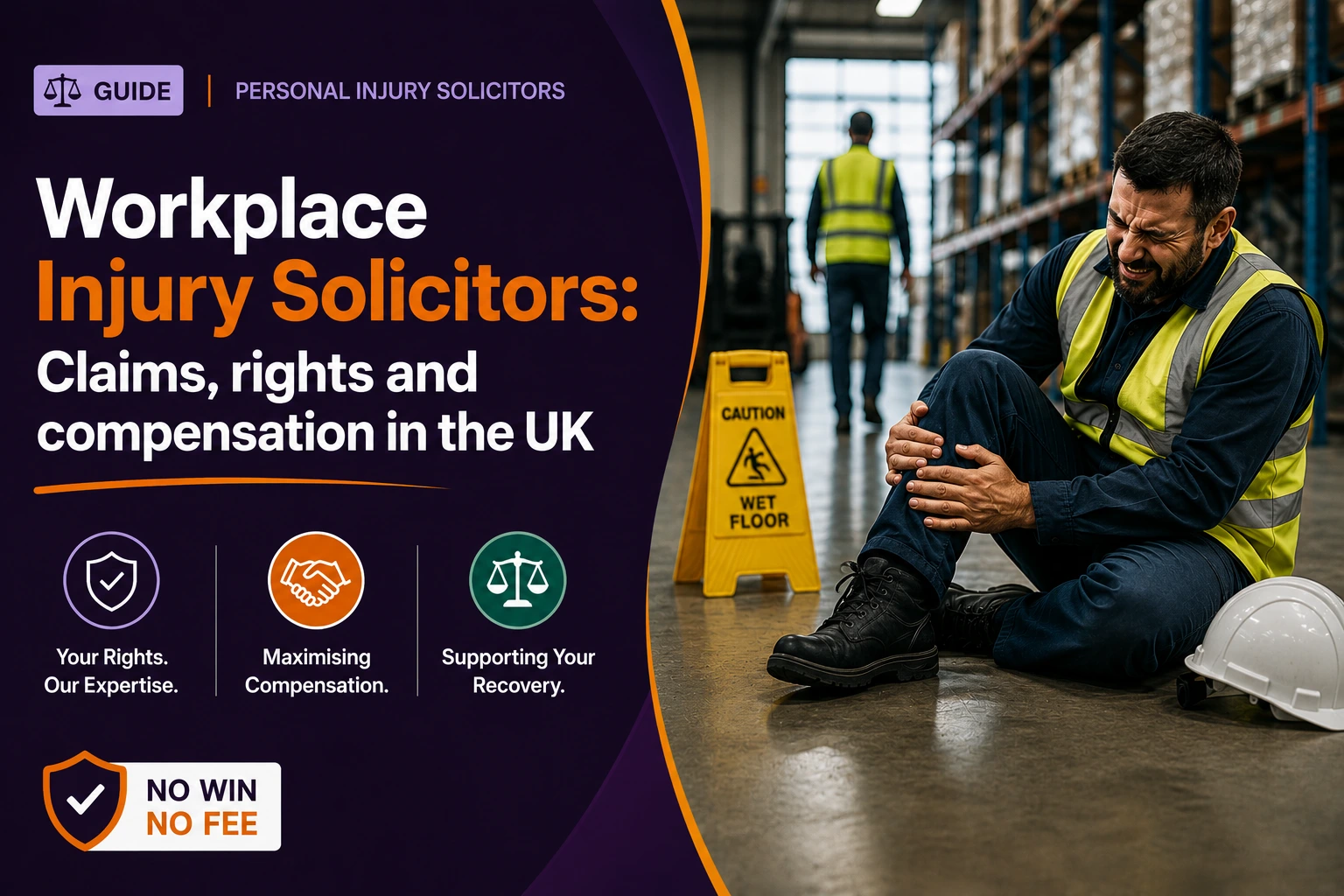
If you have been injured at work because of your employer’s negligence or unsafe conditions, you may be entitled to claim compensation for your injuries, financial losses, and time off work. Workplace injury solicitors handle every part of the process, from assessing your claim to negotiating a settlement, on a No Win No Fee basis. The time limit is three years from the date of injury, so acting promptly helps protect your position.
A workplace injury can disrupt every part of your life. Whether you slipped on an unmarked wet floor, developed a musculoskeletal condition through years of manual handling, or suffered harm because safety equipment was not provided, the law places a clear duty of care on your employer.
Understanding what a workplace injury solicitor does, when you have a valid claim, and what the process involves can help you make an informed decision about your next steps.
This guide walks through everything you need to know, from the legal foundations to the practical steps after an accident. Stats cited come from the HSE’s 2024/25 annual statistics, the UK’s authoritative source on workplace injury data.
What do workplace injury solicitors do?
Workplace injury solicitors assess whether your employer was negligent, gather evidence, manage your claim, and negotiate compensation, without you paying anything unless you win.
Definition
Employer's duty of care
Under the Health and Safety at Work Act 1974, employers are legally required to provide a safe working environment, adequate training, and suitable equipment. Where that duty is breached and injury results, the injured worker may have grounds to claim.[1]
When you instruct a workplace injury solicitor, they take on the legal side of your claim so you can focus on recovery. Their role typically covers:
- Claim assessment: reviewing the circumstances to confirm whether negligence is arguable. What solicitors look for before taking on a claim is worth understanding before you apply.
- Evidence gathering: medical records, accident reports, witness statements, site photographs, CCTV, RIDDOR data
- Legal correspondence: managing all contact with your employer and their insurer
- Medical referrals: arranging an independent expert to document and prognose your injuries
- Settlement negotiation: pushing for fair compensation without unnecessary delay
- Court representation: if liability is disputed and the claim proceeds to litigation
Most claims are resolved through negotiation and never reach a courtroom. A solicitor’s presence changes the dynamic from day one, insurers respond differently when they know a claimant is legally represented.
Why you may need a workplace injury solicitor
Without legal representation, injured workers often accept early settlements well below the full value of their claim. A solicitor ensures you understand your rights and recover every loss you are entitled to.
The HSE reported that an estimated 680,000 workers sustained a non-fatal workplace injury in 2024/25, up from 613,000 the previous year. Many of those people face the same pressures: medical bills, lost income, and uncertainty about whether making a claim will affect their employment.
A solicitor helps in several practical ways:
- Reducing stress by handling legal paperwork, letters, and insurer contact on your behalf
- Valuing the full impact of your claim, including future losses that are easy to underestimate
- Protecting you from premature settlement offers, which are frequently below true claim value
- Advising on employment rights, so you understand the legal protections in place if your employer reacts badly
Making a claim does not put your job at risk. Dismissing or penalising an employee for pursuing a workplace injury claim is automatically unfair dismissal under the Employment Rights Act 1996. Your solicitor can advise on this protection from the outset.
Even strong claims can be weakened by small missteps in the first few weeks. Watch out for these recurring issues we see on intake.
Common causes of workplace injury claims
Slips, trips and falls account for 30% of all RIDDOR-reported non-fatal injuries in the UK. Manual handling injuries, machinery accidents, and work-related mental health conditions are also among the most common bases for claims.
Understanding what typically leads to a valid claim can help you assess your own situation. Many accidents are not isolated events, they reflect a pattern of poor safety standards, missed risk assessments, or inadequate training.
Physical causes
| Cause | Share of RIDDOR Reports | Typical Injury |
|---|---|---|
| Slips, trips and falls (same level) | 30% | Fractures, soft tissue injury, head injury |
| Manual handling | 17% | Back, shoulder, and musculoskeletal injury |
| Struck by moving object | 10% | Head injury, fractures, lacerations |
| Acts of violence | 10% | Physical and psychological injury |
| Falls from height | 8% | Serious fractures, spinal injury |
| Machinery / equipment | Remaining | Crush injuries, amputations, lacerations |
Source: HSE RIDDOR non-fatal injury data 2024/25. Figures are indicative percentages.
Work-related mental health conditions
Workplace stress, anxiety, and depression affected an estimated 964,000 workers in 2024/25, resulting in around one million lost working days. Where an employer has been made aware of a mental health risk and failed to act, a claim may be possible. We explain how claims for stress and psychological harm at work are assessed in a dedicated guide.
- Excessive workload: unreasonable hours or targets without adequate support
- Workplace harassment or bullying: where it is reported and not addressed
- Trauma following a serious incident: PTSD arising from a witnessed accident
- Burnout from prolonged unsafe conditions: where risk assessments were absent or ignored
Who can make a workplace injury claim?
The five most damaging errors: admitting fault verbally, accepting an early settlement, posting on social media, skipping medical follow-ups, and discarding receipts.
Any worker injured in the last three years because of employer negligence may be eligible, including full-time employees, part-time workers, agency staff, and self-employed contractors in certain circumstances.
| Cause | Share of RIDDOR Reports | Typical Injury |
|---|---|---|
| Slips, trips and falls (same level) | 30% | Fractures, soft tissue injury, head injury |
| Manual handling | 17% | Back, shoulder, and musculoskeletal injury |
| Struck by moving object | 10% | Head injury, fractures, lacerations |
| Acts of violence | 10% | Physical and psychological injury |
| Falls from height | 8% | Serious fractures, spinal injury |
| Machinery / equipment | Remaining | Crush injuries, amputations, lacerations |
How employers and insurers try to avoid liability
Most resistance to a workplace injury claim comes from the insurer rather than the employer, and it follows a predictable set of arguments. Recognising them early is the difference between a claim that is properly valued and one that is quietly abandoned.
The first thing to understand is who is actually paying. Under the Employers’ Liability (Compulsory Insurance) Act 1969, almost every UK employer must hold employers’ liability insurance precisely so that injured staff can be compensated. Your claim is met by that policy, not out of the business account and not out of anyone’s wages. The insurer, however, has its own interest in paying as little as possible, and it is the insurer that runs the arguments below.
| The argument | What it means in practice | What answers it |
|---|---|---|
| "It was your own fault" | Contributory negligence pitched far higher than the evidence supports. | Evidence of what training, equipment and supervision were actually provided. |
| "We gave you training" | Training asserted but never evidenced with dated records or signed attendance. | Request the training records through disclosure. Absence is telling. |
| "There was a risk assessment" | A document produced after the accident, or generic and never applied to the task. | Check the version date and whether it addresses the specific activity. |
| "You were not doing your job properly" | An attempt to argue you were acting outside the course of your employment. | Job description, rota, instructions given on the day, custom and practice. |
| "The injury was pre-existing" | Existing medical history used to argue the accident caused nothing new. | Medical evidence distinguishing acceleration or exacerbation from natural progression. |
| "It was not reported at the time" | Absence of an accident book entry used to question whether it happened. | Witnesses, messages sent the same day, GP records, colleagues who saw it. |
| "That is not reportable" | Avoiding a RIDDOR report, which reduces the paper trail. | Reportability is set by the regulations, not by the employer's preference. |
Two of these deserve particular attention because they are the ones most often accepted at face value by claimants.
Missing paperwork works against the employer, not you. The Management of Health and Safety at Work Regulations 1999 require employers to carry out suitable and sufficient risk assessments. An employer who cannot produce one, or who produces a generic document that plainly was not applied to the task you were doing, has a problem. So does one who asserts that training was given but cannot evidence when, by whom, or to what standard. Your solicitor obtains these documents through disclosure. Their absence is not a dead end. It is often the case.
An accident book entry is not a legal finding. Employers sometimes complete the entry themselves and record the cause as employee error. That is one party’s account written shortly after the event, frequently by someone with an interest in the outcome. It carries no more weight than any other piece of evidence and can be contradicted by witnesses, photographs, and the surrounding documentation. If the entry does not match what happened, say so in writing at the time, and keep a copy of what you sent.
Slow responses, requests for information you have already supplied, and disclosure produced late all serve the same purpose. Evidence degrades, CCTV is overwritten, witnesses leave the business, and claimants become discouraged. This is one of the clearest practical reasons to instruct a solicitor early, because pre-action correspondence runs to a protocol with timescales rather than to the insurer’s convenience.
What if your employer says the accident was your fault?
Your employer does not decide liability. If they were also in breach of their duties, the claim proceeds, and any share of responsibility attributed to you reduces the compensation rather than removing it. Being blamed is not the same as being at fault, and neither is the same as having no claim.
This is one of the most common reasons people abandon a viable claim. A manager says it was your own doing, the accident book records it that way, and the matter feels closed before it has started. It is not.
Liability is determined by evidence, assessed between solicitors and insurers and, if necessary, by a court. An employer’s opinion is a starting position in a negotiation, and it is frequently pitched to discourage a claim rather than to reflect what the evidence shows.
Even where you did contribute, the effect is proportional. Under the Law Reform (Contributory Negligence) Act 1945 the compensation is reduced by your share of responsibility and the balance is paid. A finding of 20 per cent means you receive 80 per cent, not nothing. Our guide on claiming when the accident was partly your fault sets out how those percentages are arrived at.
The more important question is usually the one the blame is designed to stop you asking:
was the employer also in breach? A worker who lifted something awkwardly may have made a mistake. If no manual handling training was ever given, no risk assessment covered the task, and no lifting equipment was available, the mistake happened inside a system the employer was legally required to make safe. Both things can be true at once, and the law accounts for that.
If you have been blamed, do this
- Put your account in writing. Email your manager or HR the same day setting out what happened in your own words. It creates a dated record you control.
- Check the accident book entry. If it does not match your account, say so in writing. Do not sign anything you disagree with, and keep a copy of whatever you do sign.
- Do not accept a characterisation you disagree with in a meeting or a phone call. Ask for anything significant to be confirmed in writing.
- Note what was and was not provided: training, equipment, supervision, warnings, and whether the same task had caused problems before.
- Speak to a solicitor before responding to the insurer. The first written account often shapes the whole claim.
If you are treated differently after raising the injury, through reduced hours, exclusion, or pressure to drop the matter, record it with dates and tell your solicitor. Employees are protected from dismissal for health and safety reasons under section 100 of the Employment Rights Act 1996, with no minimum service requirement, and protection from detriment under section 44 has extended to workers as well as employees since 31 May 2021.
The claims process step by step
Report the accident formally, get medical attention, preserve evidence, and instruct a solicitor before engaging with your employer’s insurer. Acting in the first week makes a significant difference to the strength of your claim.
“You are not asking for a favour. Employers carry liability insurance precisely for situations like this, and exercising your legal rights does not put your job at risk.”
How compensation is calculated
Compensation is split into general damages (pain, suffering, and loss of amenity) and special damages (financial losses). Amounts are assessed against the Judicial College Guidelines, with severity and impact on your life being the key factors.
Definition
General vs. special damages
General damages compensate for the injury itself, pain, suffering, and the effect on your quality of life.
Special damages cover financial losses you can evidence, including lost earnings, medical treatment costs, travel to appointments, and future care needs.
The amount you may receive depends on the severity of your injuries, your prognosis, whether you have been unable to work, and any ongoing financial impact. Every claim is assessed on its individual circumstances, there is no single standard figure.
Minor soft tissue injuries
Moderate back injury
Severe spinal injury
| Injury Type | Severity | Indicative Range |
|---|---|---|
| Soft tissue / minor injuries | Minor | £1,000 – £3,000 |
| Back injury | Moderate | £12,510 – £27,760 |
| Shoulder injury | Moderate | £7,890 – £12,240 |
| Psychiatric injury | Moderate | £5,860 – £19,070 |
| Serious spinal injury | Severe | Up to £300,000+ |
| Lost earnings / financial losses | Variable | 100% of evidenced net loss |
All figures are indicative and based on the 16th edition of the Judicial College Guidelines. Every claim is assessed on its own facts. These are not guarantees of outcome.
A stronger claim is built on demonstrated impact, not just injury. The more clearly you can show how the injury has affected your work capacity, daily life, and finances, the more accurately it can be valued. Medical records, wage slips, receipts, and a clear account of events all contribute to a well-evidenced case.
Keep every receipt related to your injury, including travel to appointments, private prescriptions, and any aids or adaptations. These form your special damages schedule and are often overlooked, yet can represent a meaningful addition to your final settlement.
How long does a workplace injury claim take?
Most straightforward workplace injury claims settle in 6 to 12 months. Complex cases involving serious injury, disputed liability, or occupational disease can take longer, sometimes into a second year.
Settlement timelines depend on the nature of the injury, how quickly liability is accepted, and how long it takes to obtain a final medical prognosis. Cases where full recovery has not occurred are often kept open until the prognosis is clear — settling too early can mean future losses are not properly accounted for.
- Simple soft tissue claims: often 3 to 6 months once medical evidence is available
- Moderate injuries with recovery: typically 6 to 12 months
- Serious injuries or disputed liability: 12 to 24+ months, depending on complexity
- Occupational disease claims: may take longer due to the need for specialist medical evidence.
This applies to conditions that develop over years of workplace exposure, which can be claimed even after you have left the job or retired
Early legal advice is the single most effective way to keep your claim on track. Evidence is strongest when gathered quickly, and having a solicitor in place from the outset means liability investigations begin without delay.
Frequently asked questions
Can i claim compensation for a workplace injury?
How long do i have to make a claim?
Will making a claim affect my job?
What if i was partly responsible for my injury?
Can i claim if my injury developed gradually over time?
What if my employer says the accident was my fault?
My employer says they provided training. They did not. What now?
Summary
The UK recorded 680,000 non-fatal workplace injuries in 2024/25 alone a reminder that accidents at work remain a real and significant risk across every sector. When an injury happens because of employer negligence or inadequate safety standards, the law gives workers a clear right to seek compensation.
Workplace injury solicitors exist to manage that process fairly and professionally, handling the legal side while you recover. The most important things you can do immediately after an injury are to get medical attention, report the accident formally in writing, and preserve any available evidence. From there, early legal advice will protect your position and give you the clearest picture of what you may be entitled to.
Key takeaways
- Your employer has a legal duty to provide a safe working environment under the Health and Safety at Work Act 1974
- You have three years from the date of injury, or date of knowledge, to bring a claim
- Making a claim does not put your employment at risk; statutory protections are in place
- Compensation covers both the injury itself and any financial losses you can evidence
- Most claims settle without going to court, through solicitor-led negotiation with the employer's insurer
What you should do next
- Seek medical attention: attend a GP or A&E and keep all records. Your health is the priority, and medical evidence is central to any claim.
- Report the accident in writing: notify your manager and HR by email, and confirm the accident book entry has been made.
- Preserve evidence: photographs, witness details, correspondence, and expense receipts from the outset.
- Speak to a solicitor before responding to your employer’s insurer: early advice protects your position and helps you avoid accepting a settlement before the full picture is clear
Sources & References
- Health and Safety at Work Act 1974, primary legislation governing employer duties of care in Great Britain
- HSE Annual Workplace Safety Statistics 2024/25, Health and Safety Executive, November 2025.
- Judicial College Guidelines for the Assessment of General Damages in Personal Injury Cases, 16th Edition
- Limitation Act 1980, s.11, three-year limitation period for personal injury claims
- Employment Rights Act 1996, unfair dismissal protections for workers exercising statutory rights.
Disclaimer: This article provides general legal information about UK personal injury law and is not a substitute for tailored legal advice. Outcomes depend on the facts of each case. For advice on your specific circumstances, please contact a member of our team. Information correct as of 12 May 2026.


