
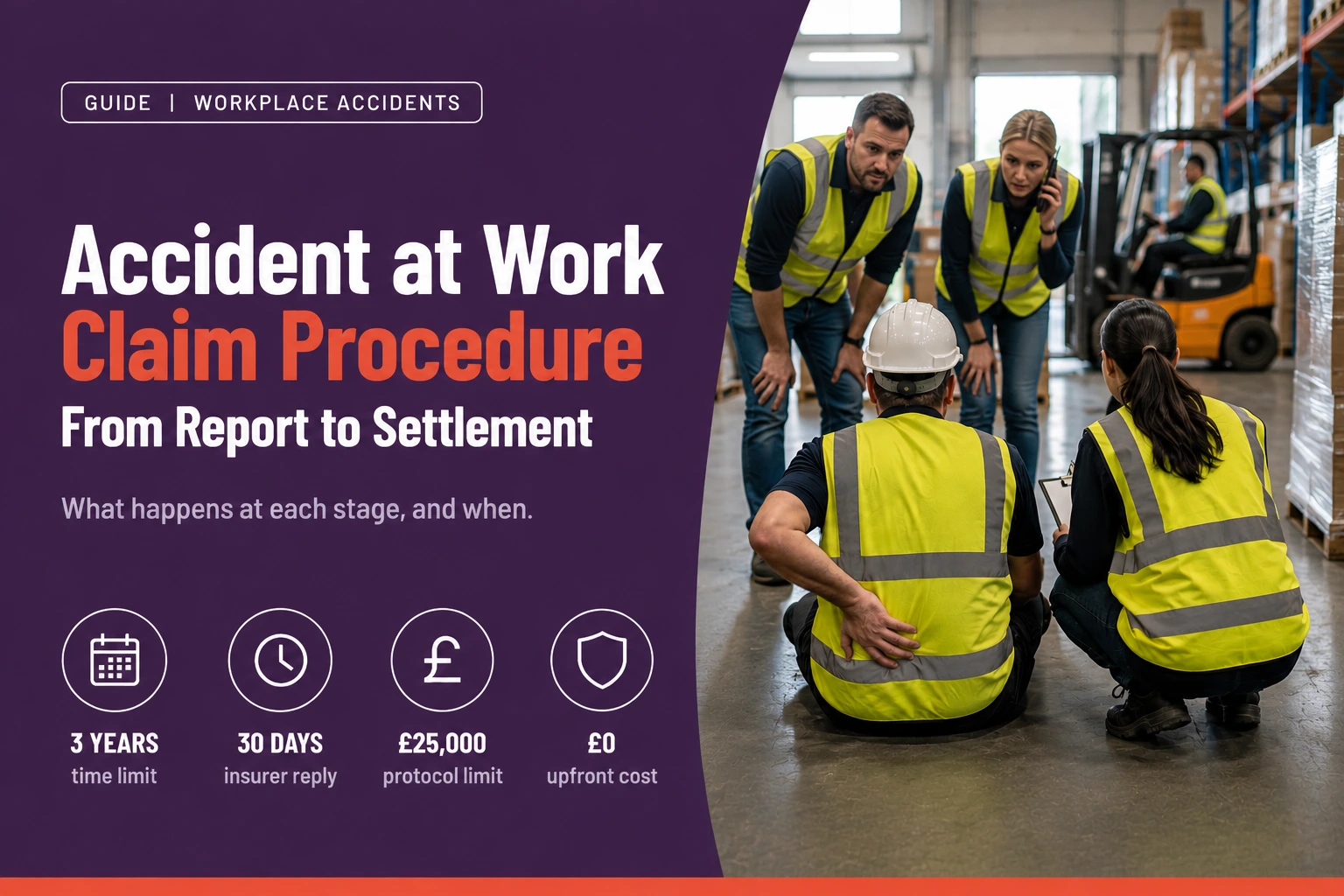

Time Limit
3 years
from date of death or knowledge
Insurer response
30 days
business days, EL claims
Protocol threshold
£25,000
fast-track claim value limit
Upfront cost
£0
on a No Win No Fee basis

Personal Injury Solicitor at Claim Time Solicitors, Birmingham. Handling personal injury and child injury claims across England and Wales on a No Win No Fee basis.
Every guide we publish is verified against UK statute and current case law before release.
The accident at work claim procedure is the sequence a workplace injury claim follows from the day of the accident to the day it settles. It runs in six stages: get medical treatment, report the accident to your employer, preserve evidence, instruct a solicitor, submit the claim to your employer’s insurer, and attend an independent medical examination. Your employer’s insurer has 30 business days to say whether it accepts liability for claims valued under £25,000. Most claims settle by negotiation without ever reaching a courtroom.
The Health and Safety Executive estimates that 680,000 workers were injured at work in Great Britain during 2024/25. Employers reported 59,219 of those injuries under RIDDOR. The HSE’s own assessment is that employers report only around half of the injuries they are legally required to report.
That gap matters, because a lot of people who could bring a claim never find out how the process actually works. They assume it means court, or that it will cost them money, or that it will put their job at risk.
This guide sets out the accident at work claim procedure step by step: what happens at each stage, who decides what, how long each part takes, and what your employer’s insurer is required to do. It also covers what compensation is made up of, the time limits that apply, and what changes if the accident was partly your fault.
What is the accident at work claim procedure?
The accident at work claim procedure is the legal process for recovering compensation from your employer’s insurer after a workplace injury caused by your employer’s negligence. Claims valued up to £25,000 follow the Pre-Action Protocol for Low Value Personal Injury (Employers’ Liability and Public Liability) Claims.
A claim is brought against your employer’s insurance, not against your employer personally. The Employers’ Liability (Compulsory Insurance) Act 1969 requires almost every employer in Great Britain to hold employers’ liability insurance, and regulation 3 of the Employers’ Liability (Compulsory Insurance) Regulations 1998 sets the minimum cover at £5 million. That policy exists precisely so that injured employees can be compensated without the business having to fund it directly.
This is worth understanding early, because the fear of damaging the employer financially stops a lot of people before they start.
The claim procedure is separate from the reporting duties your employer owes to the Health and Safety Executive. Those sit under RIDDOR and are covered in our guide to what RIDDOR is and how it affects your claim. Whether or not your employer filed a RIDDOR report, your right to claim is decided on negligence, not on paperwork.
The accident at work claim procedure step by step
Six stages: medical treatment, reporting the accident internally, preserving evidence, instructing a solicitor, submitting the claim to the insurer, and an independent medical examination. The first three should happen within days. The rest run over months.
- 1Get medical treatmentSame dayAttend A&E, a minor injuries unit or your GP as soon as you can. This is about your health first. It also creates a dated medical record linking the injury to the accident, which becomes the foundation of the claim later.
- 2Report the accident to your employerWithin daysTell your supervisor or manager, and make sure it goes in the accident book. Ask for a copy of the entry and keep it. If the entry is wrong, say so in writing rather than signing it. The accident book is an internal record and works differently from a RIDDOR report, and the difference is explained in our RIDDOR guide.
- 3Preserve evidenceWithin daysPhotograph the scene, the equipment and any hazard before anything is cleared or repaired. Take the names and contact details of anyone who saw what happened. CCTV is usually overwritten within around 28 days, so if footage exists, ask for it to be preserved in writing straight away. A solicitor can send a formal preservation letter on your behalf.
- 4Instruct a solicitorWeeksA solicitor assesses whether the facts support a claim, confirms the funding arrangement, and takes over communication with your employer and their insurer from that point. You do not have to deal with the insurer yourself.
- 5The claim is submitted to the insurerMonthsFor claims valued up to £25,000 your solicitor submits a Claim Notification Form through the official Portal. The insurer must acknowledge it the next business day and then investigate. Larger or more complex claims follow the standard Pre-Action Protocol instead, which starts with a Letter of Claim.
- 6Independent medical examinationMonthsAn independent medical expert examines you and produces a report on your injuries, your treatment and your likely recovery. That report is what the value of the claim is built on.
The first three stages are the ones you control, and they are the ones that decide how strong the claim is later. Everything from stage four onward is handled for you.
Do you have grounds for a claim?
Three things need to be established: that your employer owed you a duty of care, that they breached it, and that the breach caused your injury. Being injured at work is not by itself enough.
Every employer owes employees a duty of care under the Health and Safety at Work etc. Act 1974 and at common law. That part is rarely in dispute. The argument is almost always about breach and causation.
Breach means the employer failed to take reasonable steps to keep you safe. In practice, claims commonly arise from:
- No training, or training that did not cover the task
- Unsafe systems of work, including unrealistic pace or staffing
- Equipment that was faulty, unguarded or poorly maintained
- Personal protective equipment that was missing, unsuitable or not enforced
- Risk assessments that were never carried out, or were carried out and then ignored
Causation means the breach is what caused your injury, rather than something unrelated. This is where medical evidence does the work, particularly where a pre-existing condition is involved.
If you are unsure whether your circumstances meet these tests, our Claim Checker is a starting point, though it does not replace advice on your specific facts.
What happens after your claim is submitted
For employers’ liability claims valued under £25,000, the insurer has 30 business days from the date the Claim Notification Form was sent to investigate and respond on liability. Larger claims run to different timescales.
Once your claim reaches the insurer, one of three things happens.
| Insurer Response | What It Means | What Happens Next |
|---|---|---|
| Liability admitted Most common | The insurer accepts that the employer was at fault. | The claim moves on to valuing your injuries and losses. |
| Liability denied Disputed | The insurer gives its reasons and the claim leaves the fast-track process. | This does not end the claim. It is investigated further and, if necessary, court proceedings are issued. Most claims still settle after that point rather than going to trial. |
| Admitted, with contributory negligence alleged Partial | The insurer accepts fault but argues you contributed to your own injury. | The claim leaves the fast-track process and is negotiated on its facts. See the section on partial fault below. |
For claims above £25,000 the standard Pre-Action Protocol for Personal Injury Claims applies instead. The defendant must acknowledge the Letter of Claim within 21 days and then has up to three months to investigate and state its position on liability.
The fast-track process also has a lower limit. For accidents on or after 6 April 2022, claims worth less than £1,500 fall outside it and are handled through the small claims track. Your solicitor will tell you which route applies once your injuries have been assessed.
The medical assessment
An independent medical expert examines you, reviews your records and writes a report on your injuries and prognosis. Your solicitor arranges it and the insurer usually pays for it. It is not an examination by your employer’s doctor.
The expert is instructed to give an independent opinion, not to act for either side. The appointment normally lasts under an hour and covers how the accident happened, what your symptoms have been, what treatment you have had, and how the injury affects your daily life and your work.
The report sets out the expert’s view on how long recovery is likely to take and whether any effects are likely to be permanent. Where injuries are more serious, reports from more than one specialty may be needed, and the claim may be paused until your condition stabilises enough for a reliable prognosis.
“Be accurate rather than stoic. Understating symptoms at the medical examination is one of the more common ways a claim ends up undervalued, and by the time the report is written it is difficult to correct.”
What compensation covers
Compensation falls into two parts. General damages cover the injury itself, the pain and the effect on your life. Special damages cover money you have actually lost or spent.
General damages are assessed by reference to the Judicial College Guidelines, 18th edition, published in April 2026, alongside awards made in comparable reported cases. The medical report is what places your injury within those brackets. Figures vary substantially with severity and recovery time, which is why no reliable estimate can be given before the medical evidence exists.
Special damages are calculated from documentation rather than judgement, and typically include:
- Lost earnings to date, and future loss of earnings where you cannot return to the same work.
- Treatment costs, including physiotherapy and private care where reasonable.
- Travel to medical appointments.
- Care and assistance, including unpaid help from family.
- Equipment, adaptations and prescription costs.
Keep receipts, payslips and appointment records throughout. Special damages are recovered on evidence, and undocumented losses are difficult to include.
How long does an accident at work claim take?
It depends mainly on whether liability is admitted and how long your injuries take to stabilise. Claims where liability is accepted early and recovery is complete settle considerably faster than claims that are disputed or involve long-term injury.
Four things drive the timescale more than anything else.
- Whether liability is admitted. An early admission removes the longest single source of delay.
- Whether your condition has settled. A claim cannot be valued properly until a medical expert can give a reliable prognosis. For serious injuries this can mean waiting.
- Whether more than one medical opinion is needed. Multiple specialties take longer to coordinate.
- Whether the losses are complex. Future loss of earnings and long-term care needs take longer to quantify than a few weeks of sick pay.
Your solicitor should be able to give you a realistic indication once liability is resolved and the medical evidence is in. Any estimate given before that point is guesswork.
What if the accident was partly your fault?
You can still claim. Under the Law Reform (Contributory Negligence) Act 1945, compensation is reduced by the percentage you were responsible for rather than refused altogether.
If a court or the insurer assesses you as 25% responsible, you recover 75% of the assessed value of your claim. The claim does not fail.
This matters because a belief that they were partly to blame stops a lot of people from taking advice at all. Employers and insurers sometimes encourage that belief. In practice, courts look at whether the employer’s system of work made the mistake foreseeable. An employee who was rushing because of an unrealistic workload, or who used equipment in a way they were never trained not to, is not automatically the author of their own injury.
Where contributory negligence is alleged, the claim leaves the fast-track process and is negotiated on its facts.
Time limits that apply to your claim
Three years from the date of the accident, under section 11 of the Limitation Act 1980. Where an illness or condition developed over time, the three years runs from the date you first knew it was linked to your work.
Two situations change the starting point.
Date of knowledge. For conditions that develop gradually, such as industrial deafness, hand-arm vibration syndrome or a repetitive strain injury, the clock starts when you first knew, or could reasonably have known, that your condition was significant and connected to your work. Section 14 of the Limitation Act 1980 sets out what counts as knowledge for this purpose.
Claimants under 18 or lacking capacity. For someone injured as a child, the three years starts on their eighteenth birthday. Where a person lacks the mental capacity to conduct a claim, the limitation period does not run while that continues.
Courts have discretion under section 33 of the Limitation Act 1980 to allow a claim outside the three years, but it is exercised sparingly and should never be relied on.
Courts have discretion under section 33 of the Limitation Act 1980 to allow a claim outside the three years, but it is exercised sparingly and should never be relied on.
Employment claims, such as unfair dismissal, run to far shorter deadlines than personal injury claims. If you think you have been treated badly for reporting an accident, take advice quickly rather than waiting for the injury claim to conclude.
How the claim is paid for
Most workplace injury claims are funded by a Conditional Fee Agreement, commonly called No Win No Fee. There is nothing to pay upfront. If the claim does not succeed and you have complied with the agreement, you pay nothing for your solicitor’s work.
If the claim succeeds, a success fee is deducted from your compensation. That fee is capped at 25% and your solicitor must explain the terms in writing before you commit to anything. You should see the full agreement before the claim begins.
Some people already have legal expenses cover through a home insurance policy, a motor policy or a trade union without knowing it. It is worth checking, because it can change how the claim is funded.
Worry about the job is the reason a lot of people never take advice. In practice, employers rarely retaliate, because the compensation is paid by their insurer rather than out of the business.
The legal position has two parts. Dismissing an employee for raising a health and safety concern is automatically unfair under section 100 of the Employment Rights Act 1996, and no qualifying period of service is needed for that protection. Where someone is dismissed after bringing a compensation claim, the position depends on the facts and on how long they have worked there, so it is worth having a solicitor look at the circumstances rather than assuming either way. This is covered in more detail in our guide on being fired after an injury at work.
Frequently Asked Questions
What is the accident at work claim procedure?
The accident at work claim procedure is the process a workplace injury claim follows from accident to settlement. It runs in six stages: medical treatment, reporting the accident to your employer, preserving evidence, instructing a solicitor, submitting the claim to your employer’s insurer, and attending an independent medical examination. Claims valued up to £25,000 follow the Pre-Action Protocol for Low Value Personal Injury (Employers’ Liability and Public Liability) Claims.
How long does my employer's insurer have to respond to my claim?
Do I have to go to court to claim for an accident at work?
Can I claim if the accident at work was partly my fault?
Yes. Under the Law Reform (Contributory Negligence) Act 1945, compensation is reduced to reflect your share of responsibility rather than refused. If you are assessed as 25% responsible, you recover 75% of the value of your claim. Being partly at fault does not end a claim.
Will making a claim cost me anything if I lose?
On a Conditional Fee Agreement, there is nothing to pay upfront, and if the claim is unsuccessful and you have complied with the agreement, you pay nothing for your solicitor’s work. If the claim succeeds, a success fee capped at 25% is deducted from your compensation. Your solicitor must set out the terms in writing before the claim begins.
What is the time limit for an accident at work claim?
Three years from the date of the accident, under section 11 of the Limitation Act 1980. Where a condition developed over time, the three years runs from the date you first knew, or could reasonably have known, that it was connected to your work. For anyone injured under the age of 18, the three years begins on their eighteenth birthday.
Summary
The accident at work claim procedure runs in six stages, and the first three happen in the days after the accident: medical treatment, an accident book entry, and preserved evidence. Those three decide how strong the claim is later, and they are the only part you handle yourself.
Once a solicitor is instructed, the claim goes to your employer’s insurer. For claims valued under £25,000 the insurer has 30 business days to say whether it accepts liability. Above that threshold, the defendant acknowledges within 21 days and has up to three months to respond. An admission of liability is the most common outcome, and it removes the longest source of delay.
Compensation is made up of general damages for the injury itself, assessed against the Judicial College Guidelines, and special damages for financial losses you can document. The medical report is what the valuation rests on, which is why no reliable figure exists before that report is written.
Three years is the limit for most claims, but it can start later where a condition developed over time. Being partly at fault reduces compensation rather than ending the claim. On the job worry that stops many people taking advice, employers rarely retaliate, because the compensation comes from their insurer rather than the business
Key takeaways
- A claim is against your employer’s insurer, not your employer. Employers’ liability insurance is compulsory under the Employers’ Liability (Compulsory Insurance) Act 1969, with the £5 million minimum set by the 1998 Regulations made under it.
- Being injured at work is not enough on its own. Duty of care, breach and causation all have to be established.
- CCTV is usually overwritten within around 28 days. Ask for it to be preserved in writing straight away.
- Compensation has two parts. General damages for the injury, special damages for documented financial loss. Keep receipts and payslips.
- Partial fault reduces, it does not remove. Assessed at 25% responsible means recovering 75% of the claim’s value.
- Three years from the accident, or from the date of knowledge where a condition developed gradually, with knowledge defined by section 14 of the Limitation Act 1980. Employment claims run to much shorter deadlines.
- Dismissal for raising a health and safety concern is automatically unfair under section 100 of the Employment Rights Act 1996, with no qualifying period. Where a dismissal follows a compensation claim, the position turns on the facts and on length of service, so take advice.
- 1. Pre-Action Protocol for Low Value Personal Injury (Employers' Liability and Public Liability) Claims, sets the £25,000 threshold, the Claim Notification Form process and the insurer's response periods.
- 2. Limitation Act 1980, section 11, the three-year limitation period for personal injury actions.
- 3. Limitation Act 1980, section 14, the definition of date of knowledge for personal injury actions.
- 4. Limitation Act 1980, section 33, the court's discretion to allow a claim outside the limitation period.
- 5. Law Reform (Contributory Negligence) Act 1945, the basis on which damages are reduced for partial fault.
- 6. Health and Safety at Work etc. Act 1974, the employer's general duty to protect employee health and safety.
- 7. Employers' Liability (Compulsory Insurance) Act 1969, the compulsory insurance requirement.
- 8. Employers' Liability (Compulsory Insurance) Regulations 1998, regulation 3, the £5 million minimum level of cover.
- 9. Employment Rights Act 1996, section 100, automatically unfair dismissal in health and safety cases, listing the specific protected reasons.
- 10. HSE, Key figures for Great Britain 2024/25, 680,000 self-reported injuries and 59,219 RIDDOR-reported employee injuries.
- 11. HSE, Non-fatal injuries at work in Great Britain, the estimate that employer reporting stands at around half.
Glossary of Key Terms
Disclaimer: The information on this page is for general guidance only and does not constitute legal advice. Guidance is based on the Pre-Action Protocol for Low Value Personal Injury (Employers’ Liability and Public Liability) Claims, the Limitation Act 1980 and current HSE guidance as at August 2026. Claim Time Solicitors is authorised and regulated by the Solicitors Regulation Authority (SRA No. 612481) and is an accredited member of The Law Society (ID No. 444171). No Win No Fee refers to a Conditional Fee Agreement; the solicitor’s success fee is capped at 25% of compensation. Terms apply.


