
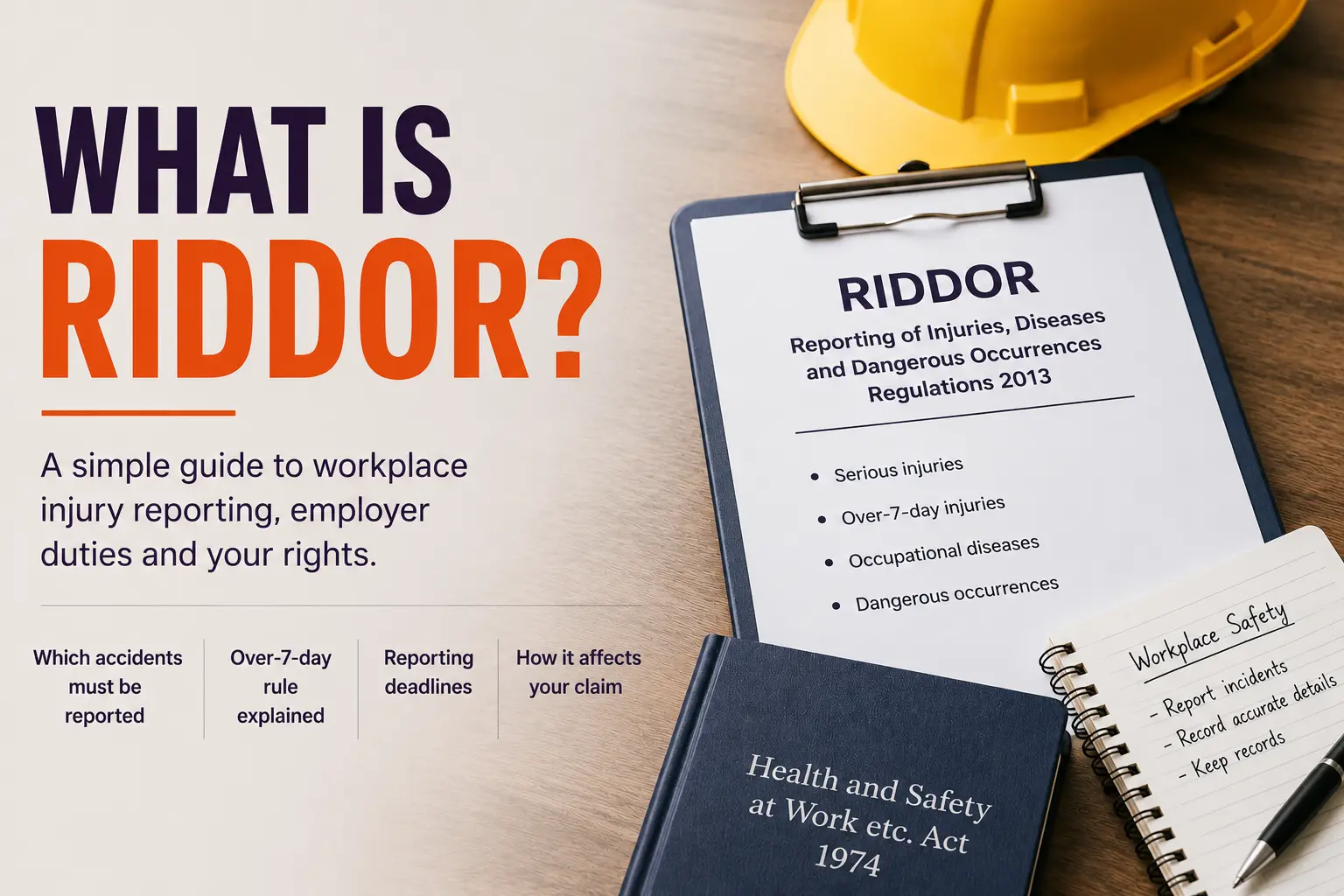

Law that requires reporting
RIDDOR 2013
SI 2013/1471
Over-7-day deadline
15 days
from date of accident
Injuries reported 2024–25
59,219
HSE employee statistics
Upfront cost
£0
No Win No Fee basis
Written by

Azhar Ali
Personal Injury Solicitor at Claim Time Solicitors, Birmingham. Handling personal injury and child injury claims across England and Wales on a No Win No Fee basis.
This guide is reviewed against the Reporting of Injuries, Diseases and Dangerous Occurrences Regulations 2013 (SI 2013/1471), current HSE guidance, and SRA standards. It is for general information only and does not constitute legal advice.
RIDDOR stands for the Reporting of Injuries, Diseases and Dangerous Occurrences Regulations 2013. It is the UK law that requires employers to report serious workplace accidents to the Health and Safety Executive (HSE). Whether your employer has to report your specific accident depends on the severity of your injury. Deaths, specified injuries (such as fractures other than fingers, thumbs and toes), any injury causing more than seven consecutive days off normal duties, certain diseases, and dangerous occurrences must all be reported. Not being RIDDOR-reported does not prevent you from making a personal injury claim.
If you have been injured at work, one of the first things you might hear is the word “RIDDOR.” So what is RIDDOR, and why does it matter to you? In short, it is the law that determines whether your employer was legally required to report your accident to the HSE.
Understanding RIDDOR helps you know whether your employer met their legal obligations after your injury, and what it means if they did not.
This guide explains RIDDOR in plain English. It covers which accidents must be reported, how the over-7-day rule actually works, what happens if your employer doesn’t comply, and what RIDDOR means or doesn’t mean for any personal injury claim you might make.
What is RIDDOR?
RIDDOR is the law that requires employers to report serious workplace accidents to the Health and Safety Executive. It stands for the Reporting of Injuries, Diseases and Dangerous Occurrences Regulations 2013.
Definition
Reporting of Injuries, Diseases and Dangerous Occurrences Regulations 2013 (SI 2013/1471)
RIDDOR came into force on 1 October 2013, replacing the previous RIDDOR 1995 regulations. It is made under the Health and Safety at Work Act 1974 and applies to all work activities in Great Britain. Northern Ireland has separate equivalent regulations. The regulations place reporting duties on employers, the self-employed, and those in control of work premises, collectively called “responsible persons.”
RIDDOR is the law that requires employers to report serious workplace accidents to the Health and Safety Executive. It stands for the Reporting of Injuries, Diseases and Dangerous Occurrences Regulations 2013.
RIDDOR puts the duty on the employer, not on the injured person. It is a reporting law, which is why it produces a document rather than a payment, and why the rest of this page is about what that document is worth to you.
Does a RIDDOR report help my personal injury claim?
A RIDDOR report can strengthen a personal injury claim because it creates an official regulatory record that is difficult for an insurer to dispute. But it is not required, many successful claims are brought without one.
A RIDDOR report is one piece of evidence in what will be a broader evidential picture. It tells an insurer, and a court, if it comes to that, your employer formally notified the HSE that a serious incident occurred. It is an official, contemporaneous document that your employer completed under legal obligation. That makes it harder to dispute than an internal accident book entry alone.
However, RIDDOR reports do not establish fault. A report simply records that an incident occurred and met the reporting threshold. It does not determine who was responsible or what compensation is appropriate. A personal injury claim still needs to establish that your employer breached their duty of care and that breach caused your injury, and this is done through medical evidence, witness statements, photographs, and accident records, with or without a RIDDOR report.
| Evidence | With RIDDOR report | Without RIDDOR report |
|---|---|---|
| Accident circumstances | Officially recorded. | Must rely on the accident book, witnesses and other evidence. |
| Employer knowledge | Shows the employer acknowledged the incident. | Can still be proved using emails, reports or witness evidence. |
| Medical records | Still required to prove the injury. | Still required to prove the injury. |
| Witness statements | Helpful supporting evidence. | Often becomes more important where no RIDDOR report exists. |
| Photographs and CCTV | Supports how the accident happened. | May become key evidence where the employer disputes the incident. |
| Compensation claim | RIDDOR does not automatically prove negligence. | A claim can still succeed without a RIDDOR report if negligence is proven. |
Which accidents must be reported under RIDDOR?
RIDDOR requires employers to report deaths, specified injuries, over-7-day incapacitation injuries, occupational diseases, and dangerous occurrences. Not all workplace accidents are reportable, the thresholds matter.
RIDDOR gives each category its own regulation, which is the clearest way to check whether yours is covered. These are the seven that must be reported to the Health and Safety Executive.
| What | Covers | Where it comes from |
|---|---|---|
| 1. Deaths | Any work-related death, including one occurring within a year of the accident. | Regulation 6 |
| 2. Specified injuries to workers | Fractures other than to fingers, thumbs and toes, amputations, loss of sight, crush injuries to the head or torso, serious burns, scalping, loss of consciousness, and certain confined space injuries. | Regulation 4(1) |
| 3. Over-7-day incapacitation | A worker unable to do their normal duties for more than seven consecutive days. | Regulation 4(2) |
| 4. Injuries to people who are not workers | A member of the public, customer or visitor injured at the workplace and taken directly to hospital for treatment. | Regulation 5 |
| 5. Occupational diseases | Certain diagnosed conditions where the work involves the associated activity. | Regulation 8 |
| 6. Dangerous occurrences | Serious near-misses, even where nobody was hurt. Schedule 2 lists the categories. | Regulation 7 |
| 7. Gas incidents | Flammable gas incidents causing death, unconsciousness or hospital treatment. | Regulation 11 |
| Over-3-day incapacitation | Record it, do not report it. More than three consecutive days off normal duties, excluding the day of the accident, goes in the accident book but is not sent to HSE. | Regulation 12 |
Source: HSE, types of reportable incidents, and the Reporting of Injuries, Diseases and Dangerous Occurrences Regulations 2013. Specified injuries are set out in regulation 4(1) itself, not in Schedule 1, which is headed “Reporting and Recording Procedures”.
The last row is the one that catches people out. More than three days off is recordable, more than seven is reportable, and they are different duties with different consequences. If you were off for five days and nothing went to HSE, that is not a failure to report. It should still be in the accident book.
The over-7-day rule how to count the days correctly
If a work accident leaves you unable to perform your normal duties for more than seven consecutive days, your employer must report it to the HSE within 15 days of the accident. Weekends and rest days count. The accident day itself does not.
This is the RIDDOR trigger that causes the most confusion, and the most under-reporting. Many employers miscount, exclude weekends, or misclassify employees on light duties as “back at work.” Here is exactly how the count works.
Light duties count as incapacitation. If you return to work on modified or restricted duties, because you cannot perform your normal job that still counts as incapacitation under RIDDOR. The threshold is not about attendance; it is about whether you can perform your normal duties. An employee on light duties who crosses seven days still triggers reporting.
The report must be made within 15 days of the accident, not 15 days from when the threshold is crossed. If a Monday accident results in the employee still being incapacitated on the following Tuesday (day 8), the employer must report to the HSE by the Monday 15 days after the original accident.
How long does an employer have to report an accident under RIDDOR?
Fatal and specified injuries must be reported without delay as soon as practicable. Over-7-day injuries must be reported within 15 days of the accident. All reports go to the HSE online at hse.gov.uk/riddor , or by phone for fatalities and major injuries only.
| Incident type | Deadline | How to report |
|---|---|---|
| Death or specified major injury | Without delay, HSE interprets this as within 10 days | Online at hse.gov.uk/riddor or by phone: 0345 300 9923 (working hours only) |
| Over-7-day incapacitation | Within 15 days of the accident | Online only, the phone line is not for over-7-day reports |
| Occupational disease | Without delay after diagnosis is confirmed | Online at hse.gov.uk/riddor |
| Dangerous occurrence | Without delay | Online or by phone for the most serious incidents |
Records of all RIDDOR reports and of all workplace accidents where the employee was off normal duties for more than three consecutive days, even if not reportable must be kept for at least three years under Regulation 12 of RIDDOR 2013.
RIDDOR vs the accident book what's the difference?
These are two separate things that are often confused.
| Accident Book Entry | RIDDOR Report |
|---|---|
| Internal company record | Legal notification submitted to the Health and Safety Executive (HSE). |
| Required for most workplace accidents | Only required for incidents that meet the reporting criteria under RIDDOR. |
| Helps employers investigate incidents | Allows the HSE to monitor workplace safety and investigate serious events. |
| Kept by the employer | Submitted online (or by telephone for fatalities and specified injuries) to the HSE. |
| Does not replace a compensation claim | Does not automatically create a personal injury claim or prove employer negligence. |
Both records matter. The accident book entry is often the first piece of evidence you can obtain, and you are entitled to a copy. Always request one in writing. If your employer refuses, note that refusal and let your solicitor know.
How to find out whether your accident was reported
Ask your employer in writing, then request the records formally if that gets you nowhere. You cannot file the report yourself, but there is a separate HSE route that is open to any worker.
Most people never find out, and they assume that settles it. It does not.
Start by asking your employer in writing. A short email asking whether the accident was reported under RIDDOR, and requesting a copy, creates a dated record of the question whether or not you get an answer. That email is useful either way.
Worth knowing first
You cannot file the report yourself
HSE is explicit that reports should only be submitted by the “responsible person”, meaning employers in relation to workers, some self-employed people, and those in control of work premises. It says plainly that you should not report if you are an injured person, unless you are self-employed. What you can do instead is raise a concern with HSE, which is a separate mechanism open to any worker, anyone acting on a worker’s behalf, and members of the public.
If a claim is already underway, your solicitor can request the report alongside the accident book entry and the safety paperwork behind it. In practice that is how most people find out, and it is faster than asking for each document separately.
What if there is no accident book entry, or your employer will not show you one?
Not every employer has to keep an accident book, and a missing entry changes the evidence rather than the claim. Where an entry does exist, it is your personal data and you can request a copy.
If there is no accident book at all
Not every employer has to keep one. The duty applies to mines, quarries and premises covered by the Factories Act 1961, and to every employer with ten or more people normally employed at the same time on or about the same premises, under regulation 25(3) of the Social Security (Claims and Payments) Regulations 1979. A small employer with six staff is not breaking that rule by having no book.
It changes the evidence, not the claim. Where there is no book, a text to your supervisor on the day, a message to a colleague, the hospital record, or your own dated note all do the same job. A claim does not depend on a particular form existing.
If the entry exists but you cannot get a copy
Your accident record is your personal data, so you can make a subject access request. Ask in writing for the accident book entry, any RIDDOR report, the risk assessment and any investigation notes, all in the same request rather than one at a time.
The organisation normally has one month to reply. If your request is complex, or you have made several, it can take up to an extra two months, but it must tell you within that first month that it is doing so and explain why. If you have read that a subject access request takes forty days, that was the old rule under the Data Protection Act 1998 and it no longer applies.
One date worth knowing
Regulation 25(3) requires the accident record to be preserved for at least three years from the date of its entry. Section 11 of the Limitation Act 1980 gives you the same three years to bring a claim. Leave it late and the record can lawfully be destroyed in the same month the claim becomes time-barred.
The two clocks run together and they run out together. If your accident was more than two years ago and nobody has shown you the paperwork, that is the thing to deal with first, before anything else on this page.
What happens if my employer doesn't report my accident under RIDDOR?
Failing to report a RIDDOR-reportable incident is a criminal offence. But your employer’s failure to report does not prevent you from making a personal injury claim, you can still proceed without a RIDDOR report.
Under RIDDOR 2013, failure to report is a criminal offence. Employers who do not comply can be investigated by the HSE, prosecuted, fined, and in serious cases face imprisonment. The HSE takes non-reporting seriously, particularly where an unreported incident later results in a fatality or major injury.
If you believe your employer should have reported your accident and has not done so, you can contact the HSE directly. The HSE Incident Contact Centre accepts reports from employees and members of the public who believe a reportable incident has not been properly reported. You can also raise a formal concern through the HSE website at hse.gov.uk/contact.
“An employer failing to file a RIDDOR report when they should have done so tells you something about how seriously they take their safety obligations. It also leaves a gap in the official record, which is exactly why you should act quickly to preserve your own evidence independently.”
Can I lose my job for reporting a workplace accident?
Not lawfully, where the safety concern is what prompted it. Two separate provisions cover this, and which one applies depends on whether you were dismissed or treated badly short of it.
Section 100 of the Employment Rights Act 1996 makes a dismissal automatically unfair where the principal reason is one of the health and safety reasons it lists. Those include bringing circumstances you reasonably believed were harmful to your employer’s attention, and leaving a workplace you reasonably believed put you in serious and imminent danger. Unlike an ordinary unfair dismissal claim there is no qualifying period, so the protection applies from your first day.
Section 44 covers being treated badly short of dismissal for the same reasons: losing shifts, being moved to worse work, being passed over. Section 44 expressly does not apply where the treatment amounts to dismissal, which is why the two sit side by side rather than overlapping.
Neither section covers simply bringing a compensation claim, and we are not going to tell you otherwise. What they cover is what usually happened first, which is that somebody reported a danger. If you raised the hazard before you were hurt, you are in considerably stronger territory than the claim alone would put you in, and it is worth mentioning at the first call rather than the fifth.
Summary
Whether your employer has to report your accident depends entirely on the severity of your injury. RIDDOR 2013 requires employers to report deaths, specified injuries, over-7-day incapacitation injuries, occupational diseases, and dangerous occurrences. Minor accidents that don’t cross these thresholds must be recorded in the accident book but don’t need to go to the HSE.
The over-7-day rule is the most frequently misapplied part of RIDDOR. The accident day is not counted. Weekends and rest days are. Light duties count as incapacitation. The report must reach the HSE within 15 days of the accident, not 15 days from when the threshold is crossed.
Fear of losing your job is the most common reason people don’t act after a workplace injury. The Employment Rights Act 1996 makes dismissal for pursuing a legitimate personal injury claim automatically unfair, with no qualifying period. The protection applies from day one of employment.
If your employer didn’t report your accident when they should have, that is a criminal offence, but it does not prevent you from making a personal injury claim. A RIDDOR report is useful evidence, not a requirement. Your medical records, accident book entry, photographs, and witness statements are the core of any claim, regardless of whether a RIDDOR report was filed.
Key takeaways
- Not all workplace accidents trigger RIDDOR reporting — only deaths, specified injuries, over-7-day incapacitation, occupational diseases, and dangerous occurrences. Minor injuries go in the accident book only.
- Specified injuries include fractures (except fingers, thumbs, and toes), amputations, loss of sight, serious burns over 10% of the body, and loss of consciousness from head injury or asphyxia.
- The over-7-day rule is about normal duties, not attendance — employees on light duties still count as incapacitated. Weekends and rest days are included. The accident day is not.
- Deadlines matter — fatal and specified injuries must be reported without delay; over-7-day injuries within 15 days of the accident. All reports go to hse.gov.uk/riddor.
- Failure to report is a criminal offence — but it does not end your right to claim. You can pursue compensation whether or not a RIDDOR report was filed.
- A RIDDOR report strengthens a claim but is not required — medical records, the accident book, CCTV, photographs, and witness statements are the primary evidence base.
- CCTV is typically overwritten within 28 days — request preservation in writing immediately. A solicitor can send a formal preservation letter on your behalf.
- Dismissal for pursuing a claim is automatically unfair under the Employment Rights Act 1996, s.100. No qualifying employment period required.
Sources & References
- Reporting of Injuries, Diseases and Dangerous Occurrences Regulations 2013 (RIDDOR 2013) — Defines which workplace accidents, occupational diseases and dangerous occurrences must be reported to the Health and Safety Executive.
- Health and Safety Executive (HSE) — RIDDOR Guidance — Official guidance on who must report, what must be reported, reporting deadlines and how to submit a RIDDOR report.
- HSE — Submit a RIDDOR Report — Official online reporting service for employers, self-employed people and those in control of work premises.
- Health and Safety Executive — Contact HSE — Contact information for reporting concerns where a reportable workplace incident has not been notified correctly.
- Health and Safety at Work etc. Act 1974 — The primary legislation placing duties on employers to protect the health, safety and welfare of employees and others affected by their work.
- Limitation Act 1980, Section 11 — Establishes the standard three-year limitation period for most personal injury claims in England and Wales.
Frequently Asked Questions
What is RIDDOR?
Does my employer have to report my accident at work?
How long does an employer have to report an accident under RIDDOR?
What happens if my employer doesn't report my accident under RIDDOR?
A late report still breaches the regulations and the HSE can take enforcement action over it. From a claimant’s point of view a late report is better than none, because it creates an official record of the incident. It also documents that the employer did not comply on time.
Employers occasionally file late once they realise a claim may follow. That is not something to discourage, but it is worth telling your solicitor about, because the timing itself becomes part of the picture
Does a RIDDOR report help my personal injury claim?
No. RIDDOR is a regulatory reporting duty and has no bearing on the value of a claim. Compensation is assessed on the severity of your injury, using the Judicial College Guidelines, plus your evidenced financial losses. A report is supporting evidence, not a factor in the calculation.
People sometimes assume a formal HSE report unlocks a higher award, or that its absence caps what they can recover. Neither is true. The report may help establish that the accident happened and when, but the figure itself comes from the medical evidence and the losses you can document.
What is the over-7-day rule under RIDDOR?
Any work-related accident leaving an employee unable to perform their normal duties for more than seven consecutive days must be reported to the HSE. The day of the accident is excluded. Weekends and rest days are included. In practice this means at least eight days must have passed since the accident. Light duties count as incapacitation — you don’t need to be fully absent. The employer must report within 15 days of the date of the accident.
Glossary of Key Terms
Disclaimer: The information on this page is for general guidance only and does not constitute legal advice. RIDDOR guidance is based on the Reporting of Injuries, Diseases and Dangerous Occurrences Regulations 2013 (SI 2013/1471) and current HSE guidance as of June 2026. Employers should refer to hse.gov.uk/riddor for the most current reporting requirements. Claim Time Solicitors is authorised and regulated by the Solicitors Regulation Authority (ID No. 444171) and is an accredited member of The Law Society. No Win No Fee refers to a Conditional Fee Agreement; the solicitor’s success fee is capped at 25% of compensation. Terms apply.


