

Deadline Under 18
None
no limitation while a minor
Deadline From 18
3 years
until their 21st birthday
Who Claims
Parent
as litigation friend
Upfront cost
£0
No Win No Fee

Personal Injury Solicitor at Claim Time Solicitors, Birmingham. Handling personal injury and child injury claims across England and Wales on a No Win No Fee basis.
Every guide we publish is verified against UK statute and current case law before release.
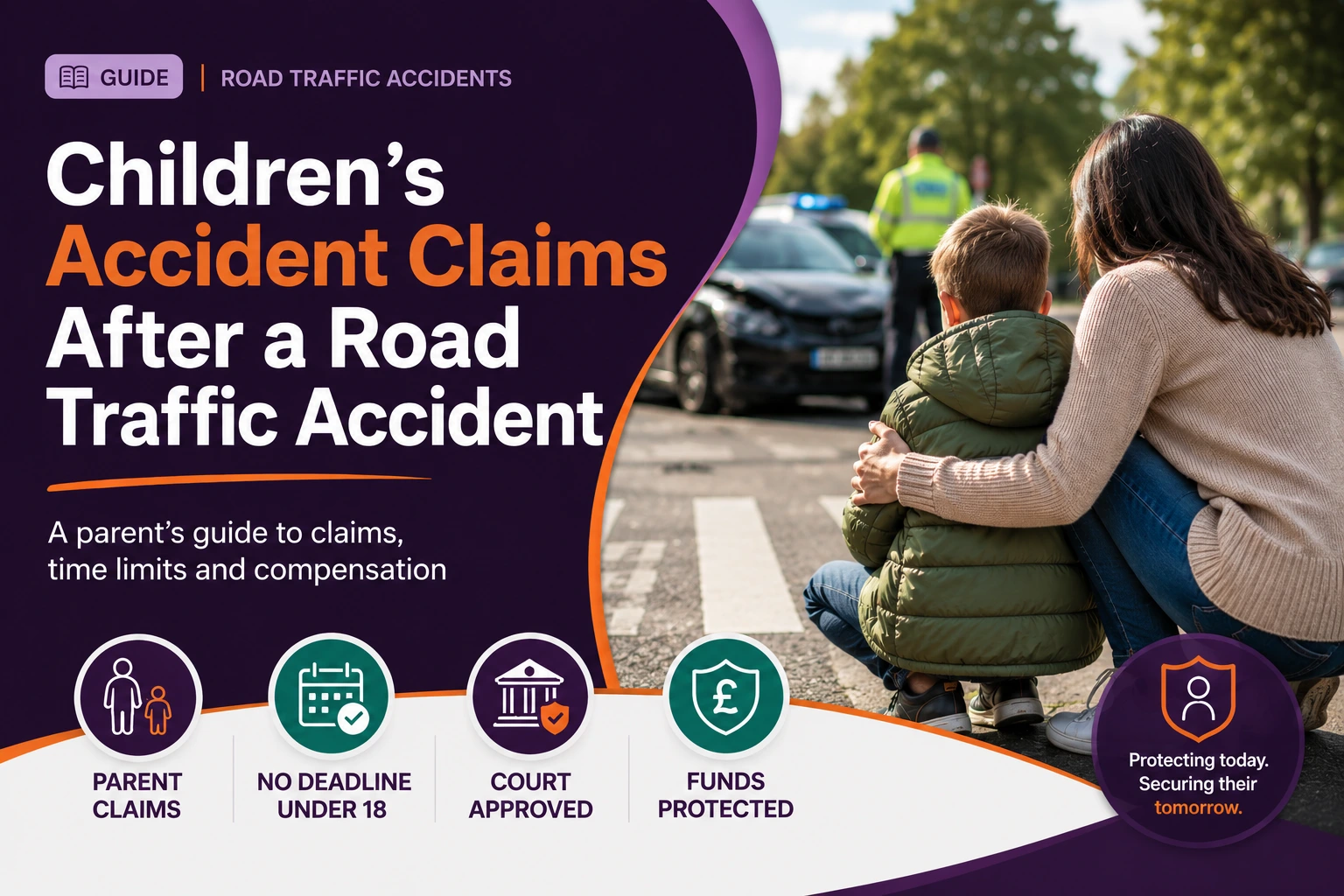
If your child has been injured in a road traffic accident caused by someone else, you can bring a claim on their behalf as their litigation friend. Children’s accident claims work differently from adult claims in three ways: a parent or guardian brings the claim, there is no limitation deadline while the child is under 18, and any settlement has to be approved by a court and held for the child until they turn 18.
When your child is hurt in a road accident, the legal side is usually the last thing on your mind. It becomes a question later, once the immediate worry has settled and the practical costs start adding up.
Children’s accident claims follow different rules from adult claims, and some of those differences work in your favour. The most important one is that you are not up against a three year deadline while your child is still a minor.
This guide covers who brings the claim, how the time limits actually work, what happens if the driver’s insurer tries to blame your child, and where the money goes once a claim settles.
What are children's accident claims?
A claim brought on behalf of someone under 18 who was injured through another person’s negligence. In road accidents that usually means an at-fault driver.
Children are injured on the roads as pedestrians, cyclists, car passengers and on school transport. Their smaller size and more limited road awareness often mean injuries are more serious than they would be for an adult in the same collision.
The legal basis is the same as any road traffic claim. Someone owed your child a duty of care, they breached it, and your child was injured as a result. What changes is the procedure, because a child cannot conduct legal proceedings themselves.
Who brings the claim?
A parent, guardian or other suitable adult acts as the child’s litigation friend and conducts the claim on their behalf.
Definition
Litigation friend
An adult appointed to conduct legal proceedings on behalf of a child or someone who lacks mental capacity. They make decisions in the child’s best interests and are usually a parent, though it can be another relative or, if needed, a court-appointed representative.
Being a litigation friend sounds more formal than it is in practice. You give instructions to the solicitor, you are kept informed, and you make decisions about the claim. What you cannot do is accept a settlement on your own authority, because any settlement for a child needs court approval.
Time limits: why there is no rush, and why you should not wait
No limitation period runs while your child is under 18. If no claim has been brought by then, they have three years from their 18th birthday, so until they turn 21.
This is the point most often misunderstood, so it is worth being precise about it.
| Stage | Who Can Claim | Deadline |
|---|---|---|
| Child is under 18 | A parent or guardian, as litigation friend | No limitation period runs |
| Child turns 18 | The young person, in their own right | Three years, until their 21st birthday |
| After 21 | Generally out of time | Court discretion only, rarely granted |
Under section 28 of the Limitation Act 1980, time does not run against a person while they are under a disability, which includes being under 18.
So there is no deadline pressure in the way there is for an adult claim. That said, waiting is rarely the right call. Witnesses move on and forget details, CCTV and dashcam footage is overwritten within weeks, vehicles are repaired or scrapped, and the medical picture is easier to evidence closer to the event.
You do not have to wait until your child turns 18 to claim, and you should not. The absence of a deadline is about protecting the child’s rights, not a reason to delay.
If the driver blames your child
Courts do not judge children by adult standards. A child’s age and understanding are taken into account when assessing whether they contributed to an accident.
Insurers sometimes argue that a child ran into the road, was not looking, or was not wearing a seatbelt correctly. It is worth knowing that this argument carries much less weight against a child than it would against an adult.
The courts have long accepted that children cannot be expected to show the same judgement, caution or road awareness as adults. A very young child is generally incapable of contributory negligence at all, and for older children the standard applied is what could reasonably be expected of a child of that age, not of a careful adult.
Even where some responsibility is found, it reduces the compensation by a percentage rather than ending the claim.
“Insurers will sometimes open with an allegation that the child was at fault. It is usually a negotiating position rather than a legal assessment, and it should not be accepted at face value.”
What compensation covers
The injury itself, plus treatment costs, care, and where relevant the longer-term effect on education, development and future earning capacity.
Compensation in a child’s claim falls into the same two categories as an adult claim, but the second one often looks different.
The injury itself
Valued against the Judicial College Guidelines, 18th Edition, based on the nature of the injury, the recovery period and any lasting effects. Whiplash injuries lasting up to two years follow the fixed statutory tariff instead.
Financial and developmental losses
- Medical treatment, physiotherapy and rehabilitation
- Travel to appointments
- Care and assistance provided by parents
- Specialist equipment or home adaptations
- Educational support where schooling has been disrupted
- Loss of future earning capacity, where a serious injury will affect their working life
Serious childhood injuries can take longer to value than adult ones, because the full effect on development and education may not be clear for some time. That is normal, and it is one reason a claim for a badly injured child should not be rushed to settlement.
Does your child have a valid accident claim?
Answer four quick questions for clear guidance.
What happens to the money
A court has to approve the settlement, and the compensation is then held in a court-controlled account until the child turns 18.
Parents are sometimes surprised that the money does not come to them. The arrangement exists to protect the child, and the early release process is there for genuine needs in the meantime.
Summary
Children’s accident claims give parents more time than adult claims do, but that time is best used early rather than saved. You act as litigation friend, the court oversees any settlement, and the compensation is protected until your child is old enough to receive it.
If an insurer has suggested your child was partly to blame, that is worth challenging rather than accepting. The standard applied to children is not the standard applied to adults.
Key takeaways
- No limitation period runs while your child is under 18
- If no claim is brought by then, they have until their 21st birthday
- A parent or guardian acts as litigation friend to conduct the claim
- Children are not judged by adult standards on contributory negligence
- Settlements require court approval and are held for the child until 18
- Funds can be released early for treatment, equipment or educational support
Frequently Asked Questions
Do I have to wait until my child turns 18 to claim?
No. You can bring a claim on your child’s behalf at any time as their litigation friend. No limitation deadline runs while they are under 18. If no claim has been brought by their 18th birthday, they then have three years to claim in their own right.
What happens to my child's compensation after the claim settles?
What if the driver says the accident was partly my child's fault?
Will making a claim affect the driver personally?
In almost all cases the driver’s insurer pays, not the driver. A claim seeks compensation for your child’s injuries, not punishment. If the driver was uninsured or cannot be traced, a claim can be made through the Motor Insurers’ Bureau instead.
Do we have to pay anything upfront?
No. Children’s accident claims are handled on a No Win No Fee basis. If the claim is unsuccessful and you have complied with the agreement, you pay nothing for our work.
Glossary of Key Terms
Disclaimer: The information on this page is for general guidance only and does not constitute legal advice. Compensation figures are indicative, and individual outcomes vary. Claim Time Solicitors is authorised and regulated by the Solicitors Regulation Authority (SRA No. 612481). No Win No Fee refers to a Conditional Fee Agreement; terms apply.


