

Dashcam Ownership
27%
of UK drivers (Aviva)
Used in a Claim
62%
of dashcam-owning drivers
Proved Not at Fault
32%
of those who used footage
Upfront cost
£0
No Win No Fee

Personal Injury Solicitor at Claim Time Solicitors, Birmingham. Handling personal injury and child injury claims across England and Wales on a No Win No Fee basis.
Every guide we publish is verified against UK statute and current case law before release.
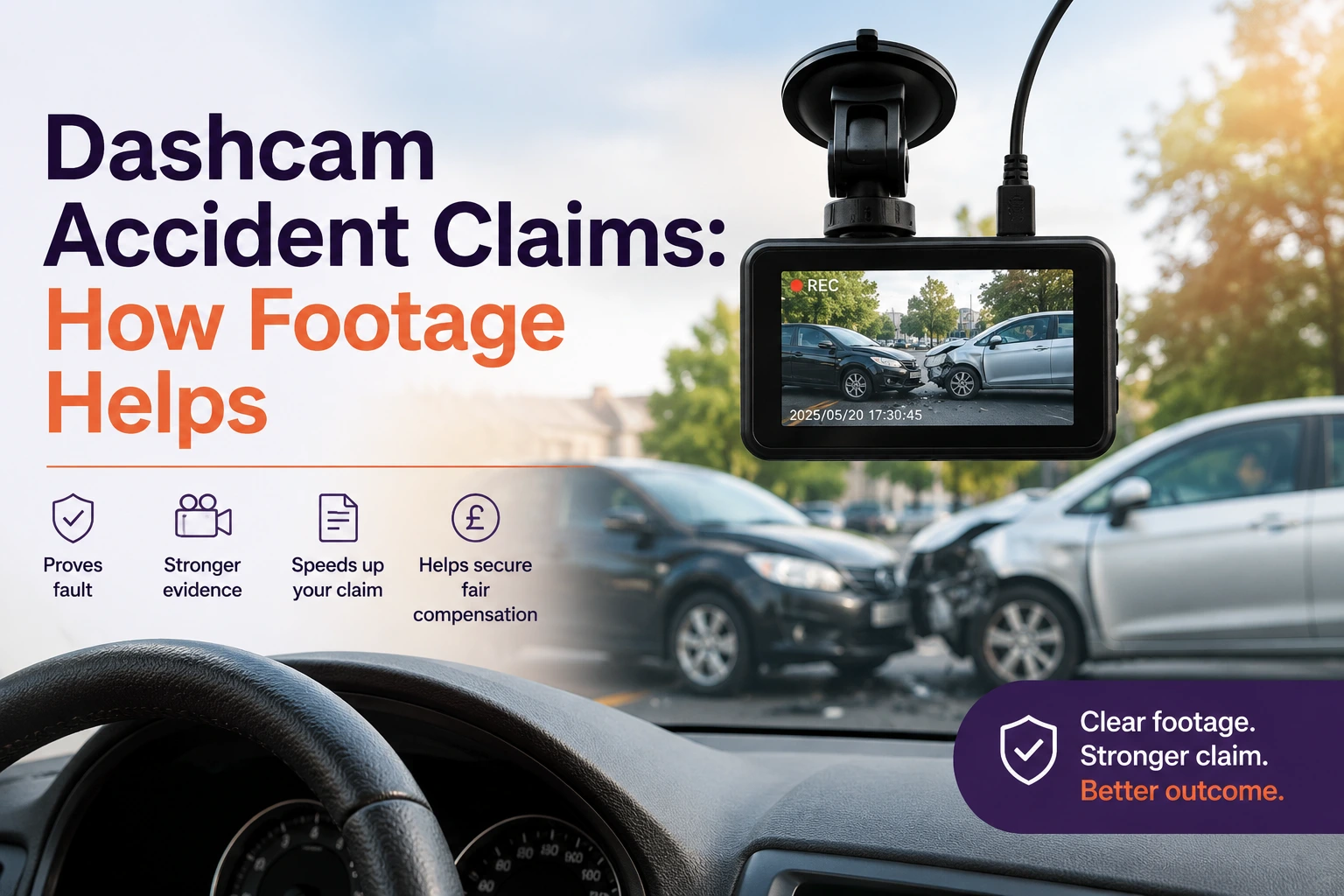
Dashcam footage can be some of the strongest evidence in dashcam accident claims, showing objectively what happened rather than relying on memory. It’s admissible in UK claims and court proceedings, provided it’s unedited and clearly time-stamped. You can send it to the police, your insurer, or your solicitor, but it’s worth getting advice before you do, since how and when footage is submitted can affect how much weight it carries.
In many road traffic accident claims, what actually happened is disputed. Two drivers give two different accounts, and without independent evidence, insurers are often left weighing one word against another. Dashcam footage changes that.
Around 27% of UK drivers now use a dashcam, and of those who’ve been in an accident, 62% used their footage as part of the claim, with 32% saying it directly proved they weren’t at fault. If you have footage of your accident, it could be the difference between a straightforward claim and a drawn-out dispute over liability.
This guide explains what counts as usable dashcam evidence, how to submit it, and what can weaken its value in dashcam accident claims.
What counts as dashcam evidence?
Any footage from a front- or rear-facing camera in your vehicle that captures the lead-up to, and moment of, a collision.
Definition
Dashcam footage
Video recorded automatically on a loop by a camera mounted in a vehicle, typically retaining a set window of footage before and after an event such as sudden braking or impact.
Because it records continuously and is time-stamped, dashcam footage can capture detail that’s easy to miss or misremember in the moment, including:
- The moments immediately before a collision
- The collision itself
- Road signs, signals and number plates
- The other driver’s behaviour, such as speed or lane position
- Weather and road conditions at the time
How dashcam footage helps prove fault
Footage gives insurers and courts an objective account of the accident, which is harder to dispute than conflicting witness statements.
Clear dashcam footage can:
- Show speeding, tailgating, or a red-light violation by the other driver
- Confirm you were driving safely at the time
- Counter a false or exaggerated account from the other party
- Capture reckless manoeuvres that would otherwise be your word against theirs
Unlike a witness’s memory, footage doesn’t change over time, which is why insurers increasingly give it significant weight in disputed claims. It’s also become an important tool in identifying staged, or “crash for cash,” collisions, where a driver deliberately causes an accident to bring a fraudulent claim. Footage that shows the manoeuvre as it happened can protect an innocent driver from being wrongly blamed.
Footage doesn’t need to be dramatic to be useful. Even a clear, unedited clip showing normal driving before impact can be enough to settle a disputed liability question.
Submitting footage with your claim
Yes, you can submit dashcam footage to the police, your insurer, or your solicitor. Getting advice before you do can help ensure it’s used to your advantage.
UK authorities and insurers accept dashcam footage as part of an accident report. You can typically submit it:
- To the police, including via a dashcam evidence portal where available
- Directly to your insurer through secure digital upload
- To your solicitor, to support a personal injury or damage claim
Submitting footage early, before memories fade and while the file’s metadata is intact, tends to strengthen a claim, particularly where fault is otherwise unclear.
“Footage is only as useful as the context around it. We look at what it shows, but also when it was submitted and whether it’s been altered in any way, because both affect how much weight an insurer will give it.”
If the footage isn't yours, or the other side wants it
Independent footage from a witness’s dashcam or nearby CCTV can carry real weight, and the other side can request your footage through formal disclosure, but not outside it.
Sometimes the clearest evidence isn’t your own. A witness’s dashcam, or CCTV from a nearby building, can be decisive, especially where both drivers dispute what happened, since third-party footage is inherently impartial.
During a claim, the other side may request relevant footage through formal disclosure procedures, and where it directly relates to the accident, you’d generally need to provide it. You don’t need to share footage informally or outside those procedures. Your solicitor manages disclosure to protect your position while meeting your legal obligations.
What makes dashcam evidence weak or unusable
Footage carries less weight if the timestamp is wrong, the quality is poor, it appears edited, or the camera was obstructing the driver’s view.
Before relying on dashcam footage, it’s worth checking for the issues that most commonly undermine it:
- An inaccurate or missing timestamp
- Poor video quality that makes key details hard to make out
- Footage that appears to have been cut or edited
- A camera position that obstructed the driver’s own view of the road
A professional review before submission can help identify whether footage strengthens your case or needs to be supplemented with other evidence.
How we use your footage
We review the footage for liability evidence, combine it with your medical and financial records, and present a structured case to insurers.
When you get in touch about a dashcam accident claim, we:
- Review your footage for clear evidence of liability
- Gather supporting documents, including medical records where relevant
- Present a structured case to insurers early in the process
- Advise you on next steps whether or not you have footage
We handle dashcam accident claims on a No Win No Fee basis, so there’s nothing to pay upfront.
Can dashcam footage strengthen your accident claim?
Answer four quick questions to receive clear guidance based on your circumstances.
Summary
Dashcam footage has become one of the most reliable forms of evidence in UK road traffic accident claims, precisely because it doesn’t rely on memory. Whether it’s your own footage or a witness’s, clear and unedited video can resolve disputes over fault far more quickly than competing accounts.
If you have dashcam footage of your accident, the most useful step is getting it reviewed early, before deciding how and where to submit it.
Key takeaways
- 62% of UK drivers with a dashcam who’ve had an accident used the footage in their claim
- Dashcam footage is admissible in UK claims and court proceedings if unedited and clearly time-stamped
- You can submit footage to the police, your insurer, or your solicitor
- The other side can request your footage through formal disclosure, not informally
- Poor quality, edited, or obstructed footage carries less evidential weight
Sources & References
1. Aviva plc, “Dash for dash cam” survey, June 2018 (Censuswide, 2,438 UK motorists)
Frequently Asked Questions
Can dashcam footage help my road traffic accident claim?
Yes. Dashcam footage is often one of the strongest forms of evidence in a road traffic accident claim, providing objective proof of how the collision happened and helping to establish fault.
Is dashcam footage admissible in court in the UK?
Can I send dashcam footage with my accident report?
What if the other driver disputes what happened?
Dashcam footage can counter false allegations and clarify events. In disputed claims, including cases involving suspicious or staged behaviour, recorded evidence often resolves liability quickly.
Do I have to pay anything upfront?
Yes. Common grounds for refusal include insufficient medical evidence, failure to report the accident, exaggerated or inconsistent symptoms, and missing the three-year limitation period. Acting early, seeing a doctor promptly, and using a solicitor significantly reduces the risk of refusal and strengthens the claim against insurer challenges.
Glossary of Key Terms
Disclaimer: The information on this page is for general guidance only and does not constitute legal advice. Compensation outcomes vary by individual case and depend on the specific facts and evidence. Claim Time Solicitors is authorised and regulated by the Solicitors Regulation Authority (ID No. 444171) and accredited by The Law Society . No Win No Fee refers to a Conditional Fee Agreement; the solicitor’s success fee is capped at 25% of compensation recovered. Terms apply.


