
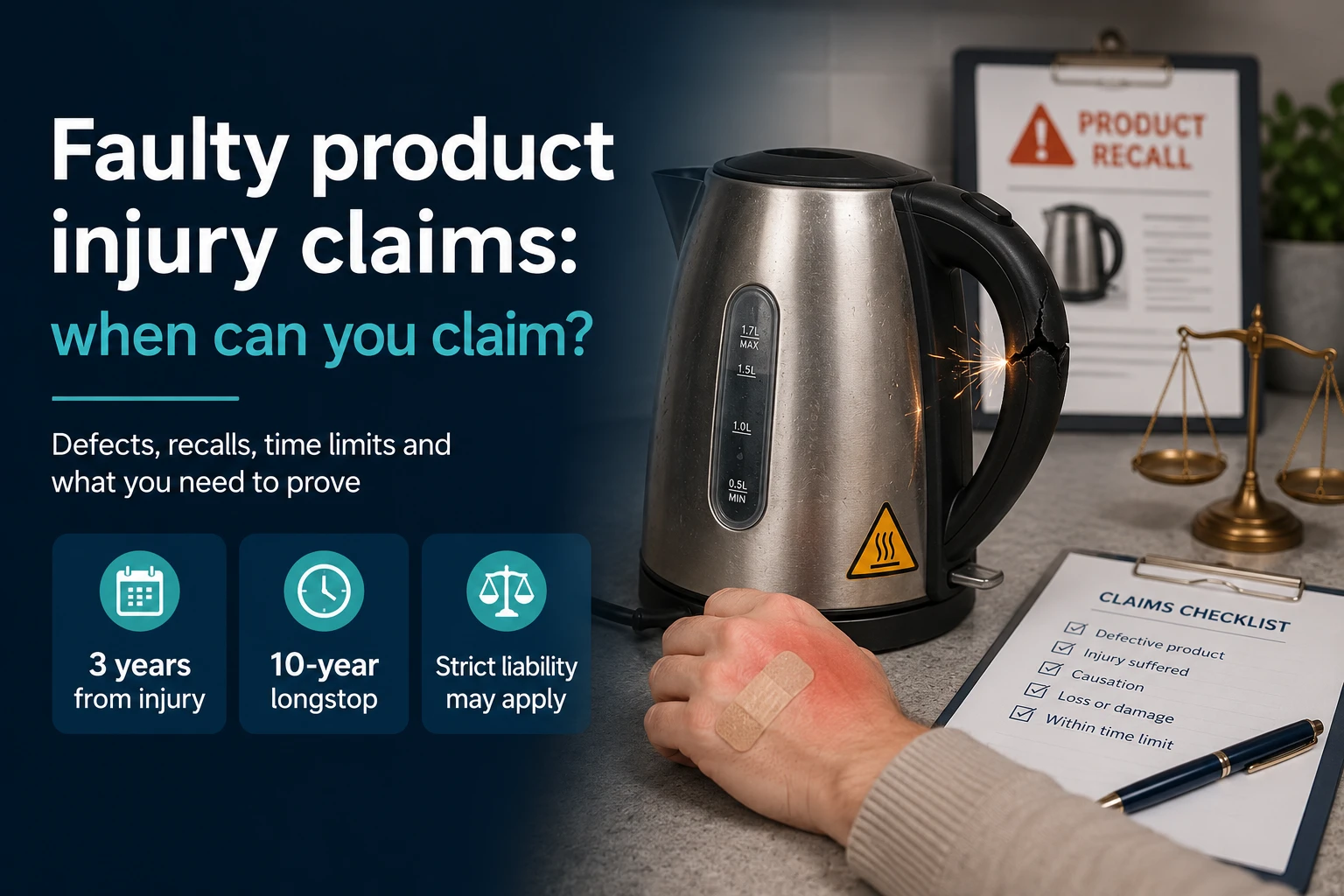

Time limit
3 years
from the date of injury
Longstop
10 years
from when the product was supplied
Negligence
Not needed
strict liability may apply
Upfront cost
£0
No Win No Fee, terms apply
Written by

Rizwan Shabir
Personal Injury Solicitor at Claim Time Solicitors, Birmingham. Handling personal injury and child injury claims across England and Wales on a No Win No Fee basis.
Every guide we publish is checked against current UK legislation and official guidance before release.
You may be able to bring a faulty product injury claim if a product was defective, you used it in a reasonable way, and it caused you an injury or a financial loss. Under the Consumer Protection Act 1987 you do not usually need to prove that anyone was careless, only that the product was defective and that the defect caused your harm. A recall can help support the defect part of your case, but it does not settle the rest of it.
Most people who contact us about faulty product injury claims are not asking a legal question. They are asking a practical one. Something they bought caused them harm, and they want to know whether that counts for anything.
This guide answers that question. It covers what makes a product legally defective, how a recall affects your position, where allergic reactions and labelling failures fit in, and what you would need to show. If you have already complained to the company and got nowhere, there is a section on that too.
When do you have a faulty product compensation claim?
When a product was defective, you used it as a reasonable person would, and the defect caused you an injury or a financial loss that you can evidence.
Not every disappointing product is a legal defect. A kettle that stops working is a consumer rights issue, and you would take that up with the retailer for a refund or replacement. A kettle that scalds you because the handle failed is something different. That is where product liability law comes in.
The line between the two is injury. Once a product has harmed you rather than simply let you down, you move out of refund territory and into a personal injury claim. The two can run alongside each other, but they are separate things and they are handled differently. Compensation for faulty goods that have only disappointed you is a retailer matter. An injury caused by faulty goods is a claim against whoever produced them.
If you have been hurt by a faulty product, the practical questions are the same whatever the item was: was it defective, who is responsible for it, what can you prove, and how long have you got. The rest of this guide takes them in that order.
Was the product defective, or was it used the wrong way?
A product is defective if its safety is not what people generally are entitled to expect. Using it in a way the maker could reasonably foresee still counts, even if you did not follow every instruction.
This is the point most people get stuck on. They worry that because they did something slightly outside the instructions, the whole thing falls apart. In practice the test is less strict than that.
Definition
Defective
Under section 3 of the Consumer Protection Act 1987, a product is defective when its safety is not what people generally are entitled to expect, taking into account how it was marketed, what instructions or warnings came with it, and what it would reasonably be expected to be used for. That definition is the whole of faulty product law in a single sentence, and it is the reason a product can be defective in law even though it was built exactly as the manufacturer intended.
The question is not whether you followed the manual exactly. It is whether the way you used the product was something the manufacturer should have anticipated. Standing on a chair to reach a shelf is foreseeable. So is a child getting hold of something that was not childproofed properly.
Where your own actions did contribute, that does not usually end the claim. It reduces it. The legal term is contributory negligence, and it adjusts the award by a percentage rather than removing your right to bring the case.
Defects that most often lead to a faulty product compensation claim
Three broad categories: manufacturing faults in an individual item, design faults affecting a whole product line, and failures in labelling, instructions or warnings.
A manufacturing defect
The design was sound but this particular item was not made properly. A faulty handle that was not fixed securely and gives way when the kettle is full, which is the most common faulty goods injury we are asked about. A weld that fails on a garden chair. A seam that splits on a pressure hose. These are the claims where the batch number matters most, because other items from the same batch may have failed the same way, and a recall often follows.
A design defect
Every item was made exactly as intended and the intention was unsafe. A heater with no tip-over cut-out. A child’s toy with a part small enough to be swallowed. A ladder that is stable only on perfectly level ground. These claims are harder and more valuable, because if the design is at fault then every unit shares the problem, which is why they often end in a recall.A failure to warn or instruct
A failure to warn or instruct
The product was made as designed and the design was sound, but you were not told what you needed to know to use it safely. A missing warning, a warning too small to read, instructions that omit a step, or a product sold without the guard or safety device it needs. Under section 3 of the Consumer Protection Act 1987 the warnings and instructions a product carried are part of what determines whether it was defective, so this is a defect in law and not merely poor service. Missing allergen information sits here.
The failures we see most often across all three categories are handles and grips that give way, electrical components that overheat or catch fire, glass and ceramics that shatter in normal use, furniture that collapses, cords and straps that break under load, and guards or cut-outs that do not work. The injuries that follow are usually burns and scalds, cuts and lacerations, crush and trapping injuries, fractures from a collapse or a fall, and chemical burns or respiratory irritation.
Whichever kind of defect it is, keep the product. In a faulty product injury claim the item itself is usually the single most important piece of evidence, and an engineer examining it is often what establishes the defect.
The Office for Product Safety and Standards recorded 2,396 product safety notifications on the UK Product Safety Database between April 2025 and March 2026, covering 3,368 individual products. Of those notifications, 563 (23%) were classed as serious. Of the products, cosmetics, personal care and grooming accounted for 833 (25%), toys 732 (22%) and electrical appliances and equipment 545 (16%).
Allergic reactions to a product
An allergic reaction can be a faulty product compensation claim where something about the product was wrong: an ingredient that was not listed, contamination during manufacture, a missing or inadequate warning, or a product marketed as free from a substance it actually contained. A reaction to an ingredient that was properly declared usually is not a claim, because nobody is at fault for it.
Reactions to cosmetics, skincare and hair dye have their own rules about ingredient limits and labelling, and we cover them in full on our allergic reaction claims page.
Cosmetics being the most notified category of all surprises people. It is a useful reminder that product safety problems are not limited to electrical goods and machinery, and that everyday items you apply to your skin sit in the same regulatory framework. The Office for Product Safety and Standards does not publish year-on-year comparisons from this database, because enforcement bodies do not all use it in the same way, so these figures describe one year rather than a trend.
Allergic reactions, ingredients and labelling failures
An allergic reaction can support a claim where the product was contaminated, where an ingredient was not properly disclosed, or where the labelling did not carry the warning it should have.
A reaction on its own is not usually enough. Some people react to ingredients that are perfectly safe and properly declared, and no one is at fault for that. The claim arises when something about the product was wrong.
The situations we see most often are these:
- An ingredient was present but not listed, or was listed under a name that obscured it
- The product was contaminated during manufacture with something that should not have been there
- A required warning was missing, too small, or worded in a way that did not convey the risk
- The product was marketed as suitable for sensitive skin or as free from a particular substance when it was not
Skincare, haircare, cosmetics and fragrance products come up regularly, and so do topical treatments bought online from sellers based outside the UK. Where the seller is abroad, the importer into the UK can be liable instead. That is worth knowing, because people often assume an overseas manufacturer puts the matter beyond reach.
Cosmetics, personal care and grooming products were the most notified category on the Product Safety Database in 2025 to 2026, accounting for a quarter of all notified products. A reaction to something you put on your skin is not an unusual event at the margins of product safety. It is the single largest category the regulator records.
If the product was recalled, what does that actually prove?
A recall is strong evidence that a defect existed. It does not prove that the defect caused your injury, and it does not entitle you to compensation on its own.
This is the single most misunderstood point in product liability, and it cuts both ways.
A recall helps you. It is a documented acknowledgement, often involving a regulator, that something was wrong with the product. That takes the argument about whether a defect existed and largely settles it. Without a recall, establishing the defect can be the hardest part of a claim.
But a recall is a safety measure, not a compensation scheme. Its purpose is to get dangerous items out of circulation. A refund or a free replacement under a recall is not compensation for an injury, and accepting one does not stop you claiming.
| Question | Does a recall settle it? | What you still need |
|---|---|---|
| Was the product defective? | ✓ Largely yes | Proof your item falls within the recalled batch or model |
| Did the defect injure you? | No | Medical evidence linking the injury to the product |
| What are your losses? | No | Records of treatment costs, lost income and other expenses |
| Who is responsible? | Partly | Identifying the producer, own-brander or UK importer |
If the recall came after your injury
The timing does not count against you. A recall issued after you were hurt is still evidence that the defect was real, and in some cases it is the thing that brings the problem to light.
If you kept using the product after a recall notice
This is more difficult but not fatal. Much depends on whether the notice actually reached you. Recalls are often publicised in ways that never come to the attention of the people holding the product, and a manufacturer arguing that you should have known has to show that the warning was reasonably communicated.
“A recall tells you the defect existed. It does not tell you the defect harmed you. Those are two separate things, and a claim needs both.”
What you need to show to claim
Under the Consumer Protection Act 1987 you do not need to prove that the producer was careless. You need to prove the product was defective and that the defect caused your damage. This is a lower bar than an ordinary negligence claim.
Definition
Strict liability
Under the Consumer Protection Act 1987 you do not need to prove that the producer was careless. You need to prove the product was defective and that the defect caused your damage. This is a lower bar than an ordinary negligence claim.
- The product was defective. A manufacturing fault, a design fault, or inadequate labelling, instructions or warnings.
- You used it in a foreseeable way. Not necessarily perfectly, but in a way the producer should have anticipated.
- The defect caused your injury. This is where medical evidence does the work. A doctor’s record made close to the time carries far more weight than a later recollection.
- You suffered loss you can evidence. The injury itself, plus treatment costs, lost earnings, travel to appointments and anything else you can document.
Point three is where most claims are won or lost. If you take one thing from this guide, make it that: see a medical professional, and make sure the product is mentioned in what they write down.
Who you actually claim against
Section 2 of the Consumer Protection Act 1987 makes the producer liable, which usually means the manufacturer, along with any business that put its own name on the product. Where the product was made outside the UK, the business that imported it into the UK can be liable instead. That is worth knowing, because people often assume an overseas manufacturer puts the matter beyond reach, and it does not. If you cannot identify any of them, section 2(3) lets you ask the supplier in writing to name them, and the supplier becomes liable itself if it does not.
If the product made an existing condition worse
You can still claim. Where a defective product aggravates a condition you already had, the claim covers the difference the product made rather than the underlying condition. In practice that means your medical records from before the incident become important evidence rather than a problem, because they show what your baseline was. Tell your solicitor about the pre-existing condition at the outset. It does not weaken the claim and concealing it would.
"I already complained to the company." Does that affect your claim?
Complaining does not weaken your claim, and it often helps by creating a dated record. Accepting a refund or replacement is not the same as settling an injury claim.
A lot of people come to us convinced they have already ruined things by contacting the manufacturer. They usually have not. A complaint made at the time is a dated account of what happened, written before anyone was thinking about litigation, and that can be useful.
Two things are worth watching. First, a refund or replacement offered under a returns policy or a recall is not compensation for injury, and it does not end your right to claim. Second, if a company asks you to sign anything described as a full and final settlement, or a waiver, take advice before you sign it. Those documents can be much broader than they look.
If you still have the correspondence, keep it. Emails, letters, chat transcripts and reference numbers all help.
How much is a faulty product compensation claim worth?
It depends on the injury and on what it has cost you. Compensation has two parts: an amount for the injury itself, and an amount for your financial losses.
Definition
General and special damages
General damages compensate for the injury itself, including pain, suffering and the effect on your daily life. Special damages cover financial losses you can evidence, such as treatment costs, lost earnings and travel expenses.
General damages are assessed against the Judicial College Guidelines, now in their 18th edition, published on 9 April 2026. Courts and solicitors use them as the reference point for what a particular injury is worth, adjusted for how severe it was, how long recovery took, and whether any effects are permanent.
Compensation for defective products is therefore worked out from your own evidence rather than from a table. We cannot give you a figure from a web page, and any firm that offers one before seeing your medical evidence is guessing. What we can do is look at your situation and give you a realistic view of the range, once we understand the injury and what it has cost you.
How long do you have to claim?
Three years from the date of injury, or from when you first realised the product caused it. There is also a ten year longstop running from when the producer supplied that product.
The three year period is the one most people know about. The ten year longstop catches them out, and it is the part of product liability claims limitation that costs people their claim.
The right to bring a Consumer Protection Act claim against a producer ends ten years after that producer supplied the particular product to someone else, regardless of when you were injured. If you are hurt by something you have owned for a long time, the longstop can close the door before the three year period has even started to run.
For children, the three year period does not usually begin until their eighteenth birthday, and for people who lack the capacity to bring a claim themselves it can be paused. The ten year longstop is not extended in either case. That is an important distinction, so if a long-owned product has injured a child, take advice quickly rather than assuming there is time in hand.
Where the product was also faulty in the consumer rights sense, a separate claim against the retailer for a refund, repair or replacement runs on its own timetable. That is a different route with different deadlines, and it does not replace an injury claim.
What to do now
Stop using the product, keep it, get medical attention, gather your paperwork, check the recall databases, and take advice before signing anything.
Stop using it and keep it
Straight awayDo not return it, throw it away or repair it. Keep the packaging, the batch or serial number, and the receipt or order confirmation if you have one. The product itself is usually the single most important piece of evidence.
Get medical attention
Within 48 hoursSee a GP, pharmacist or A&E depending on severity, and make sure the product is mentioned in the notes. This is what links the injury to the product later on.
Photograph everything
First weekThe product, the packaging, the labelling, and the injury as it develops. Reactions and bruising change quickly and you cannot recreate them later.
Check for a recall
First weekSearch the GOV.UK product safety alerts, reports and recalls service for the product and model. If a notice already exists, it may support the defect part of your claim.
Take advice before signing
Before you respondIf the company has offered a settlement or asked you to sign a waiver, speak to a solicitor first. A first conversation with us costs nothing.
How Claim Time Solicitors can help
We act for injured people, not for insurers or manufacturers. If you contact us about a faulty product injury claim, we will look at what happened, tell you honestly whether we think there is a case, and explain what pursuing it would involve.
Practically, that means identifying who is legally responsible, which is often less obvious than it looks once importers and own-branders are in the picture. It means gathering the medical evidence that links the product to your injury. And it means dealing with the manufacturer’s insurers so that you do not have to.
Most product liability claims we take on run under a No Win No Fee agreement. If the claim does not succeed and you have kept to the agreement, you do not pay us for our work. If it does succeed, our success fee is capped at 25% of your damages for pain, suffering and loss of amenity, plus your past financial losses. Damages for future financial losses are not included in that calculation. We will set all of this out in writing before you commit to anything.
Summary
A faulty product injury claim turns on four things: a defect, foreseeable use, a causal link to your injury, and losses you can evidence. Strict liability under the Consumer Protection Act 1987 means you do not have to prove anyone was careless, which makes these claims more accessible than people expect.
A recall is useful but partial. It goes a long way towards establishing the defect and does nothing for causation or loss. The practical steps matter more than the legal theory: keep the product, get seen medically, and take advice before you sign anything a company puts in front of you.
Key takeaways
- You do not need to prove negligence, only defect and causation
- A recall supports the defect, not the whole claim
- Allergic reactions can qualify where labelling or contamination was at fault
- Accepting a refund or replacement does not end an injury claim
- Three years to claim, with a ten year longstop from supply
- Keep the product itself, it is usually the most important evidence
Frequently Asked Questions
Can I claim if the product was recalled after I was injured?
What if I carried on using the product after a recall notice?
Does a recall automatically strengthen my claim?
Can an allergic reaction to a product be a claim?
It can, where something about the product was wrong. That usually means an undisclosed or mislabelled ingredient, contamination during manufacture, or a missing warning. A reaction to an ingredient that was properly declared is generally not a claim, because the product was not defective. Keep the item, the packaging and the batch number, and get the reaction recorded medically.
Who pays the compensation?
Usually the producer, which means the manufacturer or the business that put its own brand on the product. Where the item was made outside the UK, the business that imported it into the UK can be liable instead. Retailers can also be responsible in certain circumstances, particularly where they cannot identify who supplied them. Working out who to pursue is part of what a solicitor does.
How long do I have to make a faulty product injury claim?
Three years from the date of the injury, or from when you first realised the product had caused it. There is also a ten year longstop running from when the producer supplied that particular product, and it applies regardless of when you were hurt. For children the three year period usually starts at eighteen, and it can be paused for people who lack capacity, but the ten year longstop is not extended in either case.
Sources & References
- Office for Product Safety and Standards, Product Safety Database Annual Report , 1 April 2024 to 31 March 2025. 1,418 notifications covering 1,792 products, of which 335 (24%) were classed as serious. Category shares: electrical appliances and equipment 26%, toys 19%, cosmetics 12%.
- Consumer Protection Act 1987 , Part I, section 2 (who is liable), section 3 (the meaning of "defect") and section 4 (the relevant time).
- Judicial College, Guidelines for the Assessment of General Damages in Personal Injury Cases, 18th edition, published 9 April 2026 by Oxford University Press. A print and subscription publication, used in England and Wales.
- Limitation Act 1980, section 11A . The three year period runs from the later of the accrual of the cause of action and the date of knowledge. The ten year longstop runs from the relevant time as defined in section 4 of the Consumer Protection Act 1987.
- Limitation Act 1980, section 28(7) . The extension for disability does not apply to the ten year longstop in section 11A(3).
- Consumer Protection Act 1987, section 6(4) . Contributory negligence applies to Part I claims through the Law Reform (Contributory Negligence) Act 1945, section 1 .
- Conditional Fee Agreements Order 2013, article 5 . The 25% cap on success fees in personal injury proceedings at first instance, applied to general damages for pain, suffering and loss of amenity and to pecuniary loss other than future pecuniary loss, net of Compensation Recovery Unit recoveries.
- GOV.UK, Product safety alerts, reports and recalls .
- Solicitors Regulation Authority, SRA Standards and Regulations .
Disclaimer:This page is general information about faulty product injury claims and is not legal advice. Whether you are able to claim, and what any claim may be worth, depends on the facts of your case. No Win No Fee refers to a Conditional Fee Agreement and terms apply, including a success fee capped at 25% of damages for pain, suffering and past losses. Claim Time Solicitors is authorised and regulated by the Solicitors Regulation Authority.


