

Do you need to prove negligence?
No
strict liability applies
Who is liable?
Manufacturer
or importer / retailer
Time limit
3 years
10-year longstop
Upfront cost
£0
No Win No Fee basis
Written by

Azhar Ali
Personal Injury Solicitor at Claim Time Solicitors, Birmingham. Handling personal injury and child injury claims across England and Wales on a No Win No Fee basis.
This guide is reviewed against current UK statute including the Occupiers’ Liability Acts 1957 and 1984, Judicial College Guidelines (18th edition, April 2026), and SRA standards. It is for general information only and does not constitute legal advice.
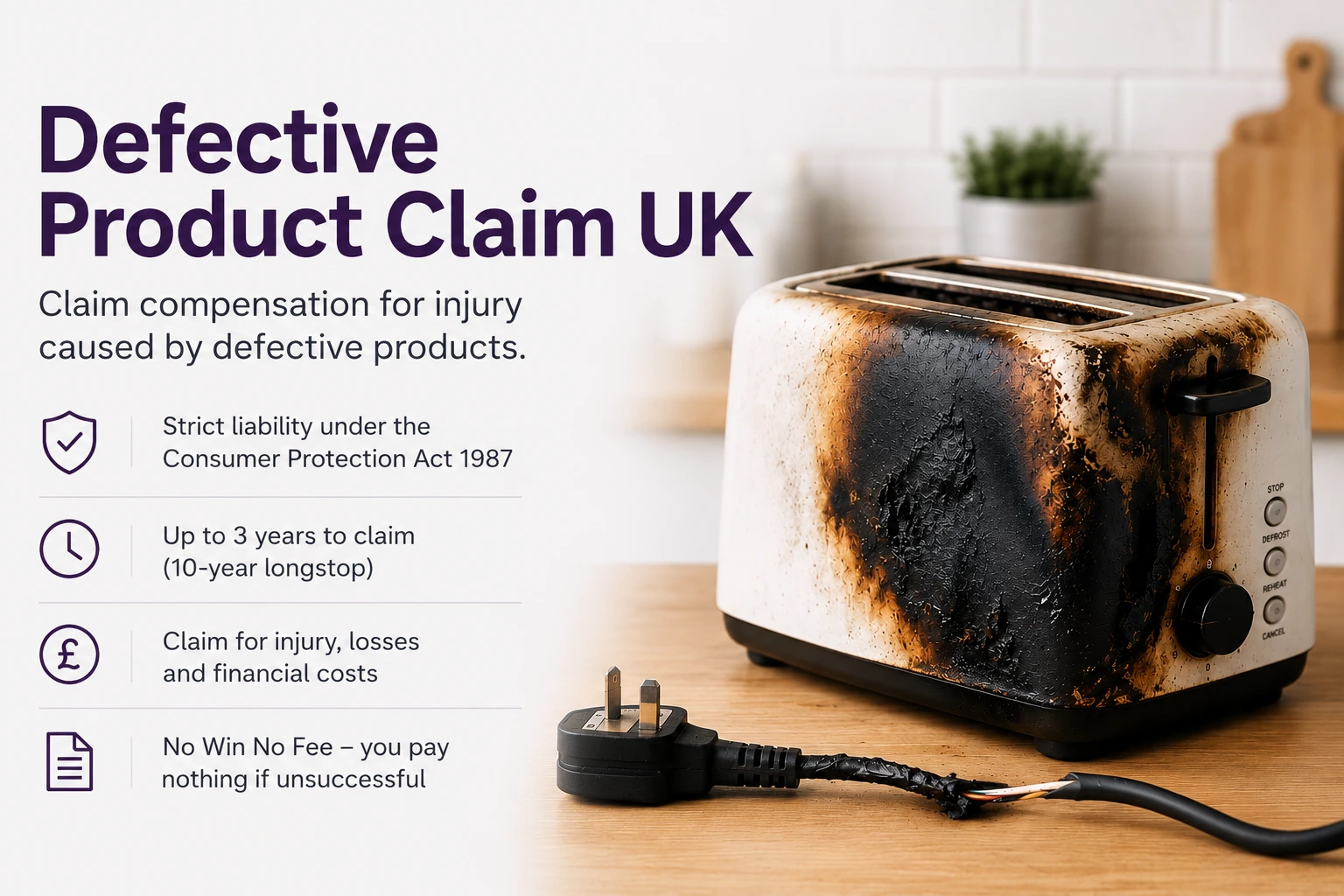
If a product you bought or used was defective and that defect caused you injury, you can make a defective product claim in the UK under the Consumer Protection Act 1987. You do not need to prove the manufacturer was negligent only that the product was defective and the defect caused your injury. This is called strict liability. The claim goes against the manufacturer, importer, or retailer. Most defective product claims are handled on a No Win No Fee basis.
A product you trusted caused you harm. Whether it was a faulty electrical appliance, a contaminated food product, a children’s toy that broke in a dangerous way, or a cosmetic that caused a chemical burn, the law gives you the right to claim compensation when a defective product causes injury. The Consumer Protection Act 1987 places the responsibility on the producer, not on you and you do not need to prove they were careless. You only need to prove the product was defective and the defect caused your injury.
This guide explains how a defective product claim works in the UK, who is liable, what the law actually says, what compensation covers, and what to do if you have been injured by a product that was not safe.
Can I claim for a defective product?
To make a defective product claim in the UK, you need to establish three things: the product was defective, you suffered injury or damage, and the defect caused the injury. You do not need to prove how the defect happened or that the manufacturer was careless.
The Consumer Protection Act 1987 (CPA 1987) created a strict liability regime for defective product claims in the UK. This means the question is not whether the manufacturer took reasonable care it is whether the product was defective. If it was, and that defect caused your injury, the manufacturer is liable regardless of how or why the defect occurred.
This is a significant legal advantage for anyone making a defective product claim. In most personal injury claims, you must prove the other party was negligent that they failed to take reasonable care. Under the CPA 1987, that burden does not apply. The focus is on the product itself, not on the manufacturer’s behaviour.
What counts as a defective product in UK law?
A product is defective under the CPA 1987 if its safety is not what a person is generally entitled to expect. This is an objective test — it looks at what a reasonable consumer would expect, not what the manufacturer intended.
The courts consider several factors when assessing whether a product meets the safety standard consumers are entitled to expect: how the product was marketed and presented, what instructions and warnings were provided, what a reasonable consumer would do with the product, the price point and any implied quality expectations, and the state of scientific and technical knowledge when the product was supplied.
A product does not need to be recalled to be legally defective. A product recall is a decision by the manufacturer or a regulatory body it is not the same as a legal finding of defect. Many defective product claims succeed against products that were never recalled. Equally, a product being recalled does not automatically mean a claim will succeed — the claimant must still show the defect caused their specific injury.
Key concept
Three types of product defect
Manufacturing defect: the product departed from its intended design during production. One unit is faulty while others are fine.
Design defect: the product was manufactured exactly as designed, but the design itself is unsafe. Every unit carries the same risk.
Warning/instruction defect: the product lacks adequate warnings, safety instructions, or information about risks that a consumer needs to use it safely.
Who is liable for a defective product in the UK?
| Party | When they are liable | Example |
|---|---|---|
| Producer (manufacturer) | Primary liability, if the product is defective | A UK manufacturer whose kitchen appliance causes a fire |
| Importer into the UK | Liable when they brought the product into the UK from outside | A UK distributor who imports electronics from China |
| Own-brander | Liable when they put their name or brand on the product | A supermarket own-brand product manufactured by a third party |
| Retailer / supplier | Liable only if they cannot identify the manufacturer or importer when asked | A retailer who sells unbranded goods and cannot trace the source |
This chain of liability is designed to help identify a responsible party in a defective product claim. Even if the manufacturer is based overseas and difficult to reach, the UK importer who brought the product into the country is liable in their place. If neither can be identified, the retailer who sold you the product may be held responsible — unless they can identify the producer or importer within a reasonable time of being asked.
Strict liability — why you do not need to prove negligence
Strict liability under the CPA 1987 is the single most important concept in any defective product claim in the UK. It means the manufacturer is liable for damage caused by a defective product regardless of whether they were negligent, regardless of whether they took reasonable care, and regardless of whether the defect was foreseeable.
The manufacturer has one principal defence: the development risks defence (also known as the state of the art defence). This applies only if the manufacturer can show that the state of scientific and technical knowledge at the time the product was supplied was such that a producer of products of the same description could not have been expected to discover the defect. This is a narrow defence and rarely succeeds in practice for consumer products
Common types of defective product claims in the UK
- Electrical appliances — overheating, electrical shock, fire caused by faulty wiring, battery failure. Includes kitchen appliances, chargers, heaters, and personal care devices.
- Children’s toys and products — small parts that detach and pose choking hazards, toxic materials, sharp edges, collapsible structures. Subject to additional safety regulations under the Toy Safety Regulations 2011.
- Food and drink — contamination (foreign objects, bacteria, allergens not declared on labelling). Covers packaged food, restaurant meals, and takeaway items.
- Cosmetics and personal care products — chemical burns, allergic reactions, skin damage from undeclared ingredients or unsafe formulations.
- Vehicles and vehicle components — brake failure, airbag defects, seatbelt failure, tyre blowouts, steering column faults. Can overlap with road traffic accident claims.
- Medical devices — implant failure, prosthetic defects, faulty monitoring equipment. Subject to additional regulation under the Medical Devices Regulations 2002.
- Furniture and household items — collapse, structural failure, fire risk from non-compliant materials. Includes mattresses, chairs, shelving, and garden furniture.
- Pharmaceutical products — undisclosed side effects, contamination, incorrect dosage information. Pharmaceutical defective product claims are complex and often involve group litigation.
What to do after a product injures you
- Get medical attention — see a GP or attend A&E the same day. Ask the doctor to record the product as the cause of injury in your medical notes. The medical record is the primary evidence in any defective product claim.
- Preserve the product — do not throw away, repair, or return the product. Keep it exactly as it was when the injury occurred. Store it safely. The product itself is evidence of the defect.
- Photograph everything — the product, any visible defect, the packaging, batch numbers, serial numbers, and your injuries. Photograph before any cleanup or repair.
- Keep the receipt and packaging — proof of purchase, packaging, instruction manuals, and warranty documents all help identify the manufacturer and establish when the product was supplied.
- Report the product — report to the retailer in writing. You can also report to Trading Standards or the Office for Product Safety and Standards (OPSS). A formal report creates an official record.
- Do not contact the manufacturer’s legal team directly — they may ask you to return the product or sign a release. Speak to a solicitor before engaging with the manufacturer.
- Contact a solicitor — a solicitor experienced in defective product claims can advise on preserving evidence, identifying the liable party, and starting the claim process.
Manufacturers and retailers sometimes ask you to return the defective product for investigation or replacement. Do not do this without legal advice. Once the product is back in the manufacturer’s possession, you lose control of the primary evidence in your defective product claim. A solicitor can arrange independent examination of the product while keeping it in safe custody.
Do you have a valid defective product claim?
Answer four quick questions to receive clear guidance based on your circumstances.
How much compensation for a defective product claim UK?
Compensation covers general damages for the injury itself (assessed under the JCG 18th edition, April 2026) plus special damages for all financial losses caused by the defective product. Property damage claims under the CPA 1987 have a £275 minimum threshold.
| Injury type | Indicative range |
|---|---|
| Minor burns — full recovery | £2,430 to £8,290 |
| Serious burns — scarring, permanent | £32,450 to £97,730 |
| Minor soft tissue — full recovery | £800 to £4,270 |
| Eye injury — minor, full recovery | £4,270 to £9,760 |
| Eye injury — total loss of one eye | £61,690 to £72,430 |
| Food poisoning — serious, lasting effects | £4,270 to £10,730 |
| Moderate psychiatric — PTSD | £6,470 to £22,510 |
All figures are indicative from the Judicial College Guidelines (JCG), 18th edition (April 2026). Every defective product claim is assessed individually. Special damages are calculated separately and added where appropriate.
Time limits — the 3-year deadline and the 10-year longstop
You have three years from the date of injury or from the date you became aware the injury was caused by the defective product (the date of knowledge). But there is also a 10-year longstop from the date the product was first supplied after which the right to claim under the CPA 1987 expires completely.
The three-year limitation works the same way as other personal injury claims — it runs from the date of the accident or from when you first knew (or should reasonably have known) that the injury was caused by the product. The 10-year longstop is unique to defective product claims under the CPA 1987. It creates an absolute cut-off regardless of when the injury occurred or when the claimant became aware of it.
For children, the three-year clock does not start until their 18th birthday, but the 10-year longstop still applies from the date the product was supplied. This means a child injured by a product supplied more than 10 years ago may have no claim under the CPA 1987, even if the three-year limitation has not yet expired. A solicitor can advise on alternative routes, including common law negligence claims, where the longstop does not apply.
Summary
A defective product claim in the UK is brought under the Consumer Protection Act 1987, which imposes strict liability on manufacturers. You do not need to prove the manufacturer was negligent — only that the product was defective and the defect caused your injury. The liable party is the producer, or if the product was imported, the importer. If neither can be identified, the retailer may be held responsible.
Compensation covers general damages for the injury under the JCG 18th edition plus special damages for all financial losses. The time limit is three years from injury or date of knowledge, with a 10-year longstop from when the product was first supplied. The most important step after a product injury is preserving the product itself — it is the primary evidence of the defect.
Key takeaways
- Strict liability applies — you do not need to prove the manufacturer was negligent. Prove the product was defective and the defect caused your injury.
- The manufacturer is primarily liable — or the importer, own-brander, or retailer if the manufacturer cannot be identified.
- Do not throw away or return the product — it is the primary evidence of the defect. Store it safely and do not repair or modify it.
- See a doctor the same day — the medical record linking your injury to the product is the most important clinical evidence.
- Report the product to the retailer in writing and to Trading Standards or OPSS.
- The time limit is three years from injury or date of knowledge — but a 10-year longstop applies from when the product was first supplied.
- A product does not need to be recalled to be legally defective — many successful defective product claims involve products that were never recalled.
- Property damage has a £275 minimum threshold under the CPA 1987 personal injury claims have no minimum.
Sources & References
- Consumer Protection Act 1987 — Part I — Introduces strict liability for damage caused by defective products, including the definition of a defect (section 3), liable persons (section 2), and the development risks defence (section 4).
- Limitation Act 1980, Section 11A — Sets the three-year limitation period for defective product claims together with the 10-year longstop period.
- Judicial College Guidelines for the Assessment of General Damages in Personal Injury Cases (18th Edition) — The guideline used by courts and practitioners when valuing general damages for personal injury claims.
- General Product Safety Regulations 2005 — Establishes the general safety requirement for consumer products placed on the UK market.
- Office for Product Safety and Standards (OPSS) — The UK’s product safety regulator responsible for market surveillance, recalls and reporting unsafe consumer products.
Frequently Asked Questions
Can I claim for a defective product in the UK?
Who is liable for a defective product?
What counts as a defective product?
How long do I have to make a defective product claim?
Three years from injury or date of knowledge. There is also a 10-year longstop from when the product was first supplied — after which the CPA 1987 right expires completely. For children, the three-year clock starts at 18, but the 10-year longstop still applies.
Do I need to prove the manufacturer was negligent?
No. The CPA 1987 operates on strict liability. You prove the product was defective, you suffered injury, and the defect caused it. You do not need to prove how the defect occurred or that the manufacturer failed to take reasonable care.
Should I return the product to the manufacturer?
Not without legal advice. The product is the primary evidence of the defect. Once it is back with the manufacturer, you lose control. A solicitor can arrange independent examination while keeping the product in safe custody.
Glossary of Key Terms
Disclaimer: The information on this page is for general guidance only and does not constitute legal advice. Compensation outcomes vary by individual case and depend on the specific facts and evidence. Claim Time Solicitors is authorised and regulated by the Solicitors Regulation Authority (ID No. 444171) and accredited by The Law Society . No Win No Fee refers to a Conditional Fee Agreement; the solicitor’s success fee is capped at 25% of compensation recovered. Terms apply.


