

Success Fee Cap
25%
of set damages
Time Limit
3 years
for most injury claims
Upfront Cost
£0
No Win No Fee
Free
£0
no obligation
Written by

Rizwan Shabir
Personal Injury Solicitor at Claim Time Solicitors, Birmingham. Handling personal injury and child injury claims across England and Wales on a No Win No Fee basis.
This guide is reviewed against current UK statute including the Health and Safety at Work etc. Act 1974, the Employment Rights Act 1996, and SRA standards.
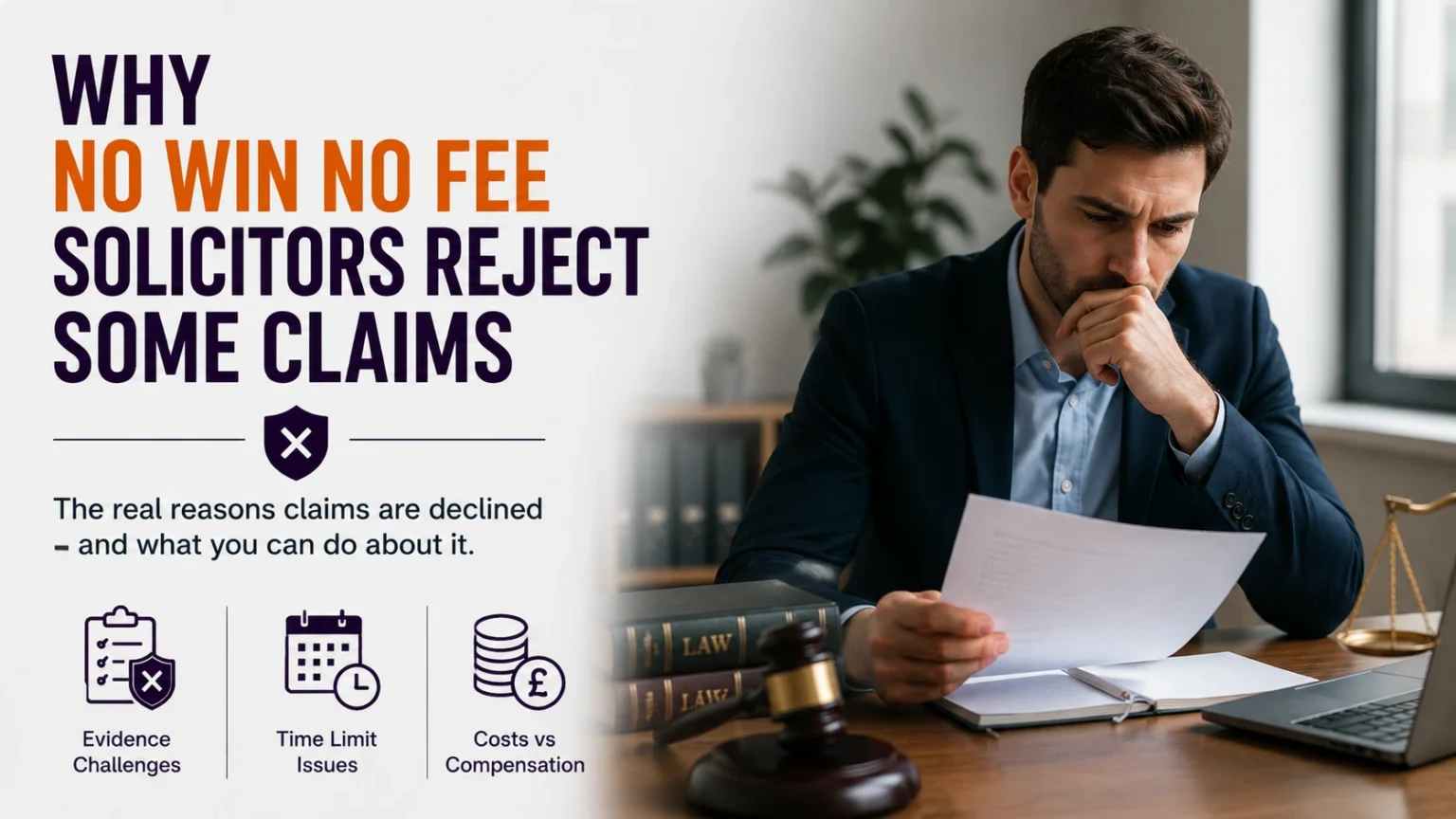
No Win No Fee pitfalls are real. Some solicitors turn some claims down because they carry the financial risk if the case does not succeed. A claim is more likely to be declined when liability is hard to prove, and the three-year time limit has passed, the likely compensation is small next to the legal costs, or a pre-existing condition makes the injury difficult to link to the accident. A rejection is not always the final word. Another firm may take a different view, and there are steps you can take to give your case a stronger footing.
No Win No Fee is meant to make legal help feel low risk, and for most people it does. So it can be confusing, and a little disheartening, to be told that a solicitor will not take your case on. If that has happened to you, or you are weighing up a claim and want to understand the catch before you start, this guide is for you.
We will explain what No Win No Fee actually means, the honest disadvantages that come with it, and the specific reasons a solicitor might say no. We will also look at what percentage a solicitor can take from your compensation, and how to read the early signs of whether your claim is likely to be accepted.
What does no win no fee mean?
No Win No Fee is an arrangement where you pay nothing towards your solicitor’s charges if your claim does not succeed. If it does succeed, a capped success fee is taken from your compensation.
Definition
Conditional Fee Agreement (CFA)
The formal name for a No Win No Fee arrangement. Your solicitor only charges a fee if your claim is successful, which is why the risk of the case matters so much to whether they take it on.
In plain terms, No Win No Fee means the solicitor shares the risk of your claim. If the case does not win, you are not left with a bill for their time, provided you have kept to the terms of the agreement. If the case does win, the solicitor is paid a success fee, which is taken as a percentage of your compensation rather than charged to you upfront.
Because the firm only gets paid when a claim succeeds, it has to make a judgment at the outset about how likely that is. That single fact explains most rejections. A solicitor is not deciding whether your injury matters. They are deciding whether the case can realistically be won on the available evidence. You can read more in our full guide to how No Win No Fee works.
Why solicitors reject some claims?
The most common reasons are weak evidence of liability, a missed time limit, costs that outweigh the likely award, a pre-existing condition that clouds causation, and an account that does not hold together.
Most rejections come down to a handful of practical issues. None of them mean your experience was not real or that you did nothing wrong. They reflect how hard the case would be to prove, and what it would cost to run.
Here are the reasons we see most often when a claim is turned down:
1. Liability is hard to prove
To succeed, a claim usually needs to show that someone else was legally at fault and that their fault caused your injury. Where there are no witnesses, no photographs, no CCTV and no clear record of what happened, it can be one person’s word against another. That does not make you wrong. It makes the case harder to win, and a No Win No Fee solicitor has to weigh that risk carefully.
2. The claim is outside the time limit
Most personal injury claims must be started within three years of the accident, or of the date you first knew your injury was linked to it. There are exceptions, for example for children and for people who lack mental capacity, but once the limit has passed a court can refuse to hear the case at all. If you are close to the deadline, it is worth getting advice quickly.
3. The costs would outweigh the compensation
Some claims are genuinely valid but likely to recover only a modest sum, while the work needed to prove them is significant. When the expected legal costs come close to, or exceed, the likely compensation, a firm may decide the case is not viable to run on a No Win No Fee basis. This is one of the harder rejections to hear, because the claim is not weak, it is simply uneconomic.
4. A pre-existing condition clouds the picture
If you had a prior injury or a health condition affecting the same part of the body, the other side may argue that the accident is not what caused your symptoms. You can still claim for the way an accident made an existing condition worse, but it takes clearer medical evidence to separate the two, and that raises the risk on the case.
5. The account is inconsistent
Insurers look closely at whether your version of events stays consistent across the accident report, your medical records and what you say later. Honest differences happen, especially after a shock. But where the details shift in ways that are hard to explain, it weakens credibility, and a solicitor may be reluctant to take the case on.
| Reason | Can it be fixed? | What often helps |
|---|---|---|
| Unclear liability | Sometimes | Witness details, photos, CCTV, dashcam |
| Time limit passed | Rarely | Act fast; limited exceptions apply |
| Costs exceed award | Sometimes | A firm used to lower-value claims |
| Pre-existing condition | Often | Clear medical records and expert opinion |
| Inconsistent account | Usually | A single, careful written statement |
A rejection is usually about the strength of the evidence and the economics of the case, not about whether you deserve support. Understanding which reason applied to you is the first step to knowing what to do next.
The real pitfalls and disadvantages of no win no fee
The main disadvantages are a success fee deducted from your compensation, possible insurance costs, the risk of losing certain protections if you break the agreement, and the fact that not every claim will be accepted.
No Win No Fee is a genuinely useful way to fund a claim, but it is fair to be clear about the trade-offs. Being upfront about the pitfalls is part of how we think a solicitor should treat you.
Here are the disadvantages worth knowing before you begin.
- A success fee comes out of your compensation. If you win, a percentage is deducted for the solicitor’s success fee, so you do not keep the entire award.
- There may be an insurance premium. Many claims are backed by After the Event insurance, which covers certain costs if the case loses. The premium can be deducted from your compensation when you win.
- Breaking the agreement can create a bill. If you stop co-operating, mislead the firm or drop the case without good reason, you may lose the No Win No Fee protection and become liable for costs.
- Not every claim is accepted. As covered above, firms decline cases they judge too risky, so No Win No Fee is not a guarantee that someone will take your claim.
- Lower-value claims can be harder to place. If your claim is small, some firms may not take it on, simply because the costs of running it are high relative to the likely award.
“Being honest about the downsides is not a weakness. A claim you understand from the start is a claim you can make good decisions about.”
What percentage do no win no fee solicitors take?
In personal injury cases the success fee is capped at 25% of your general damages and past financial losses. Future losses are not included in that calculation.
This is one of the most common questions people ask, and it is a reasonable one. In personal injury claims, the success fee a solicitor can take is capped by law at 25% of certain parts of your compensation. Specifically, it applies to your general damages, which cover pain, suffering and loss of amenity, and to your past financial losses. Compensation awarded for future losses is left out of that calculation.
The exact percentage within that cap can vary between firms and cases, so it should always be set out clearly in your agreement before you sign. If anything about the deductions is unclear, ask for it in plain figures. A good firm will welcome the question rather than talk around it.
Ask two questions before you sign any No Win No Fee agreement: what percentage will be deducted if I win, and will there be any insurance premium or other cost taken from my compensation. The answers should be clear and in writing.
Are medical negligence cases rejected more often?
Medical negligence claims are often harder to accept because they need expert medical evidence to show both that care fell below an accepted standard and that this caused harm.
Medical negligence claims tend to be more complex than a typical accident claim, so it is common for a firm to look at them more cautiously. To succeed, a claim usually has to show two things: that the care you received fell below a reasonable standard, and that this failing is what caused your injury. Both points often need independent expert opinion before a firm can judge the case.
Because of that, many firms handling medical negligence will seek a preliminary expert view before deciding whether to take a case on. A rejection at this stage frequently reflects the strength of that early evidence, rather than a view that nothing went wrong. Our team can talk you through the options in a medical negligence claim and explain what evidence would help.
How to tell if your claim is likely to succeed?
Claims tend to be stronger when fault is clear, the injury is well documented, you are within the time limit, and your account is consistent across every record.
No solicitor can promise an outcome, and you should be cautious of anyone who does. What an experienced solicitor can do is assess the likely strength of your claim early on. These are the factors that usually point towards a claim being accepted.
- Fault is reasonably clear. There is evidence pointing to someone else being responsible, such as a witness, a photograph, a police reference or CCTV.
- The injury is documented. You saw a GP, attended A&E or have a medical record that connects the injury to the accident.
- You are within the time limit. The accident happened within the last three years, or you have only recently learned it caused your injury.
- Your account is consistent. What you reported at the time matches your medical notes and what you say now.
- Your losses can be evidenced. You have kept payslips, receipts and records of costs linked to the injury.
If most of these apply to you, it is well worth having your claim assessed. The quickest way to find out is our free claim checker, which gives you a no-obligation view of where you stand.
What to do if your claim is turned down?
Ask why it was declined, gather any missing evidence, and seek a second opinion. A different firm may assess the same facts differently.
A rejection from one firm is not always the end of the road. Different solicitors have different areas of focus and different appetites for risk, so a claim that one firm declines may still be viable elsewhere.
If you have been turned down, these steps can help.
- Ask for the reason. A clear explanation tells you whether the issue is evidence, timing, value or something that can be addressed.
- Fill the gaps. If the concern was missing evidence, track down witness details, photographs, medical records or receipts.
- Check the time limit. Confirm how long you have left, because this shapes how quickly you need to act.
- Get a second opinion. Speak to another specialist firm and share the reason you were given, so they can assess the case with full context.
Do you have a valid injury claim?
Our free interactive claim readiness tool helps you understand whether your treatment may support a compensation claim before speaking to a solicitor
Answer four quick questions to receive clear guidance based on your circumstances.
Summary
No Win No Fee removes the upfront cost of making a claim, but it does not remove the need for a case that can realistically be won. That is why some claims are declined. The reasons are practical, and they centre on evidence, timing and value rather than on whether your injury mattered.
If you understand why a claim might be turned down, you are in a much better position to strengthen your own case or to seek a second opinion. Being clear about the disadvantages, including the success fee and any insurance costs, is part of making a decision you feel comfortable with.
Key takeaways
- No Win No Fee means no solicitor’s fee if the claim loses, and a capped success fee if it wins
- Claims are declined mainly for weak liability evidence, a missed time limit, low value against high cost, or a clouded medical picture
- The success fee in injury claims is capped at 25% of general damages and past losses
- A rejection from one firm does not mean your claim has no future elsewhere
- Clear evidence, a documented injury and a consistent account are what make a claim stronger
Sources & References
- Conditional Fee Agreements Order 2013 — made under the Legal Aid, Sentencing and Punishment of Offenders Act 2012. This sets the 25% cap on success fees in personal injury cases, applied to general damages and past pecuniary loss.
- Limitation Act 1980, Section 11 — sets the standard three-year time limit for personal injury claims, subject to certain exceptions.
- House of Commons Library — briefing and guidance on No Win No Fee funding arrangements.
- Solicitors Regulation Authority — Standards and Regulations governing solicitors and regulated law firms.
Frequently Asked Questions
What are the main dangers or pitfalls of No Win No Fee?
Why would a solicitor reject my injury claim?
What percentage do No Win No Fee solicitors take?
Can I get a second opinion if my claim is rejected?
Yes. A rejection by one firm does not mean every firm will decline. Solicitors weigh risk differently and specialise in different areas, so it is worth asking why you were turned down and then speaking to another specialist. Sharing the reason you were given helps the next firm assess your case with full context.
How do I know if my No Win No Fee claim will be successful?
No one can promise an outcome, but a claim is generally stronger when fault is clear, your injury is documented, you are within the three-year time limit, and your account is consistent. If most of those apply, it is worth having your claim assessed. A free claim check is a simple way to get an early, honest view before you commit to anything.
Glossary of Key Terms
Disclaimer: The information on this page is for general guidance only and does not constitute legal advice. Compensation outcomes vary by individual case and depend on the specific facts and evidence. Claim Time Solicitors is authorised and regulated by the Solicitors Regulation Authority (ID No. 444171) and accredited by The Law Society . No Win No Fee refers to a Conditional Fee Agreement; the solicitor’s success fee is capped at 25% of compensation recovered. Terms apply.


