

Time Limit
3 years
from date of accident
Road Casualties
128,375
Great Britain, 2024 (DfT)
Motor Claims Paid
£11.7bn
UK, 2024 (ABI)
Upfront cost
£0
No Win No Fee

Personal Injury Solicitor at Claim Time Solicitors, Birmingham. Handling personal injury and child injury claims across England and Wales on a No Win No Fee basis.
Every guide we publish is verified against UK statute and current case law before release.
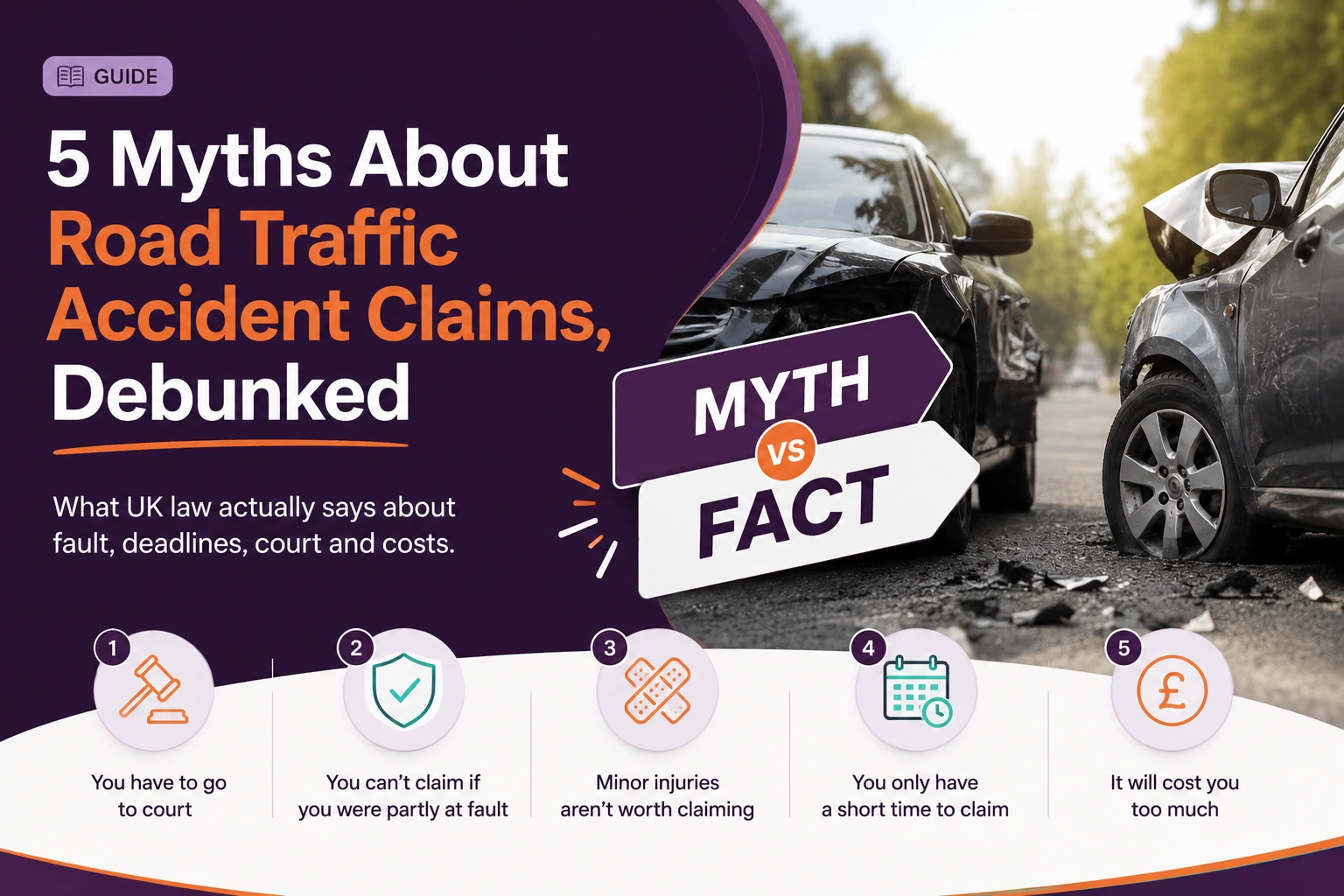
Most myths about road traffic accident claims get the law wrong in the same direction, by making claiming sound harder or riskier than it is. In reality, most claims settle without a court hearing, being partly at fault usually reduces a claim rather than ending it, and the standard time limit is three years from the date of the accident. Knowing what the law actually says is the difference between claiming and wrongly assuming you cannot.
Plenty of people who could bring a claim never do. Not because they were told no, but because they were told something inaccurate by a colleague, a relative, or a half-remembered story about someone at work.
The scale is not small. There were 128,375 road casualties in Great Britain in 2024, including 1,633 people killed. Motor insurers paid out a record £11.7 billion in claims across the UK in the same year. Claims are routine. The myths around them are not.
Here are the five that come up most often, and what the law actually says.
Myth 1: Claiming always means going to court
The large majority of road traffic claims are settled through negotiation with the insurer. Court proceedings are the exception, not the default.
This is probably the single biggest deterrent, and it comes from picturing a claim as a trial. In practice, a claim is usually a structured exchange of evidence and offers between your solicitor and the other side’s insurer. Most are resolved before proceedings are ever issued.
Court becomes a realistic prospect in a narrower set of situations: where liability is genuinely disputed, where the insurer refuses to make a reasonable offer, or where the injuries are severe enough that valuation is contested. Even then, cases frequently settle after proceedings are issued but before any hearing takes place.
Starting a claim is not the same as starting a court case. If your claim did head towards a hearing, you would be advised well in advance and would decide whether to proceed.
Myth 2: You cannot claim if you were partly at fault
Being partly responsible usually reduces the compensation rather than removing the right to claim. This is called contributory negligence.
Definition
Contributory negligence
Where the injured person contributed to the accident or to the extent of their injuries. Under the Law Reform (Contributory Negligence) Act 1945, damages are reduced by a percentage reflecting that share of responsibility, rather than refused outright.
In practice this means fault is apportioned. If a claim is valued at a certain figure and you are found 25% responsible, you would recover 75% of that figure. The claim does not disappear.
Common examples where a deduction may apply include not wearing a seatbelt, exceeding the speed limit at the time, or a pedestrian stepping into the road without looking. In each case the other driver’s negligence still counts, and still has to be paid for.
It is also worth saying that people are often wrong about their own share of the blame. Insurers do not always agree with a driver’s initial self-assessment, in either direction.
Myth 3: Minor injuries are not worth claiming for
Injuries that seem minor at first can develop, and a claim covers financial losses as well as the injury itself.
Soft tissue injuries in particular can take days to declare themselves, and some go on considerably longer than expected. Judging a claim by how you feel in the first 48 hours is not a reliable test. A claim also covers more than pain and suffering.
Recoverable losses commonly include:
- Lost earnings while you were unable to work
- Medical treatment and physiotherapy costs
- Travel costs to appointments
- Care and assistance provided by family
- Vehicle damage and replacement transport
For whiplash injuries lasting up to two years, compensation follows a fixed statutory tariff rather than individual assessment. More serious injuries, and injuries lasting beyond two years, are valued individually against the Judicial College Guidelines.
Myth 4: It is too late to claim
The general limit is three years from the date of the accident, or from the date you became aware of the injury. Different rules apply for children and for people who lack mental capacity.
- Under the Limitation Act 1980, most personal injury claims must be brought within three years. Two important exceptions are worth knowing:
- Children: the three years does not start until their 18th birthday, so a claim can be brought up to their 21st. Before that, a parent or guardian can claim on their behalf.
- Lack of mental capacity: where someone cannot manage their own affairs, the time limit may not run at all while that continues
- Three years sounds generous, and it is the reason people delay. The practical problem is evidence. Witness recollection fades, CCTV and dashcam footage is overwritten, and vehicles get repaired or scrapped. A claim brought at two years and eleven months is legally valid and evidentially much weaker.
Myth 5: Claiming is expensive and risky
Most road traffic claims are handled under a Conditional Fee Agreement, so there are no upfront legal fees.
Definition
Conditional Fee Agreement (CFA)
A “No Win No Fee” arrangement. Your solicitor is paid only if the claim succeeds, usually through a success fee deducted from the compensation, subject to a cap. If the claim does not succeed and you have complied with the agreement, you do not pay for your solicitor’s work.
What people are usually worried about is being left with a bill after losing. A CFA is designed to address exactly that, and is normally paired with insurance covering the other side’s costs and disbursements. Your solicitor should explain the deductions clearly before you sign anything, and you are entitled to ask.
The other quiet worry is insurance premiums. Claiming as the non-fault party in an accident someone else caused is not the same as making an at-fault claim on your own policy, and the two affect renewal differently.
Avoid The Mistakes That Could Harm Your Claim
Download our free guide to learn the common mistakes people make after an accident and the simple steps that can help protect your claim.
- Free instant download
- Clear, practical guidance
- No obligation
Why myths about road traffic accident claims persist
Three things keep them alive. Rules genuinely have changed, particularly the whiplash reforms in 2021 and the tariff uprating in 2025, so advice that was accurate a few years ago may no longer be. Second-hand accounts get compressed and distorted in the retelling. And some of it is simply that claims are unfamiliar territory, and unfamiliar things sound riskier than they are.
“Most people who decide not to claim have not been told no by anyone qualified to say so. They have talked themselves out of it based on something they heard.”
Summary
The myths above share a common shape. Each one makes claiming sound more difficult, more expensive or more confrontational than it usually is, and each one costs people something they were entitled to.
Court is the exception rather than the rule. Partial fault reduces a claim rather than ending it. Minor injuries can still involve real financial loss. Three years is the general deadline, with exceptions for children. And No Win No Fee exists precisely so that cost is not the barrier.
Key takeaways
- Most road traffic claims settle through negotiation, without a court hearing
- Contributory negligence reduces damages by a percentage, it does not bar a claim
- Claims cover financial losses, not just the injury itself
- The general time limit is three years, extended for children and those lacking capacity
- Conditional Fee Agreements mean no upfront legal fees
- 1. Department for Transport, Reported road casualties in Great Britain, provisional results 2024, published May 2025
- 2. Association of British Insurers, motor insurance claims data for 2024, published February 2025
- 3. The Whiplash Injury (Amendment) Regulations 2025, SI 2025/615
- 4. Limitation Act 1980, sections 11, 14 and 28
- 5. Judicial College Guidelines for the Assessment of General Damages in Personal Injury Cases, 18th Edition (April 2026)
Frequently Asked Questions
Will I have to go to court if I make a claim?
In most cases, no. The large majority of road traffic claims settle through negotiation with the insurer. Court becomes relevant mainly where liability is disputed or the insurer will not make a reasonable offer, and even then many cases settle before a hearing.
Can I still claim if the accident was partly my fault?
How long do I have to make a claim?
Is a minor injury worth claiming for?
It can be. Soft tissue injuries often take days to develop and can last longer than expected. A claim also covers lost earnings, treatment costs, travel and care, which can be significant even where the injury itself is modest.
What does No Win No Fee actually mean?
It means there are no upfront legal fees. Under a Conditional Fee Agreement, your solicitor is paid only if the claim succeeds, through a capped success fee deducted from the compensation. If the claim does not succeed and you have complied with the agreement, you pay nothing for our
Glossary of Key Terms
Disclaimer: The information on this page is for general guidance only and does not constitute legal advice. Compensation figures are indicative, and individual outcomes vary. Claim Time Solicitors is authorised and regulated by the Solicitors Regulation Authority (SRA No. 612481). No Win No Fee refers to a Conditional Fee Agreement; terms apply.


