

Is the rear driver at fault?
Usually
Depending on evidence
Most common injury
Whiplash
24-72 hrs to appear
Time limit
3 years
Limitation Act 1980
Upfront cost
£0
No Win No Fee basis
Written by

Azhar Ali
Personal Injury Solicitor at Claim Time Solicitors, Birmingham. Handling personal injury and child injury claims across England and Wales on a No Win No Fee basis.
This guide is reviewed against current UK statute including the Occupiers’ Liability Acts 1957 and 1984, Judicial College Guidelines (18th edition, April 2026), and SRA standards. It is for general information only and does not constitute legal advice.
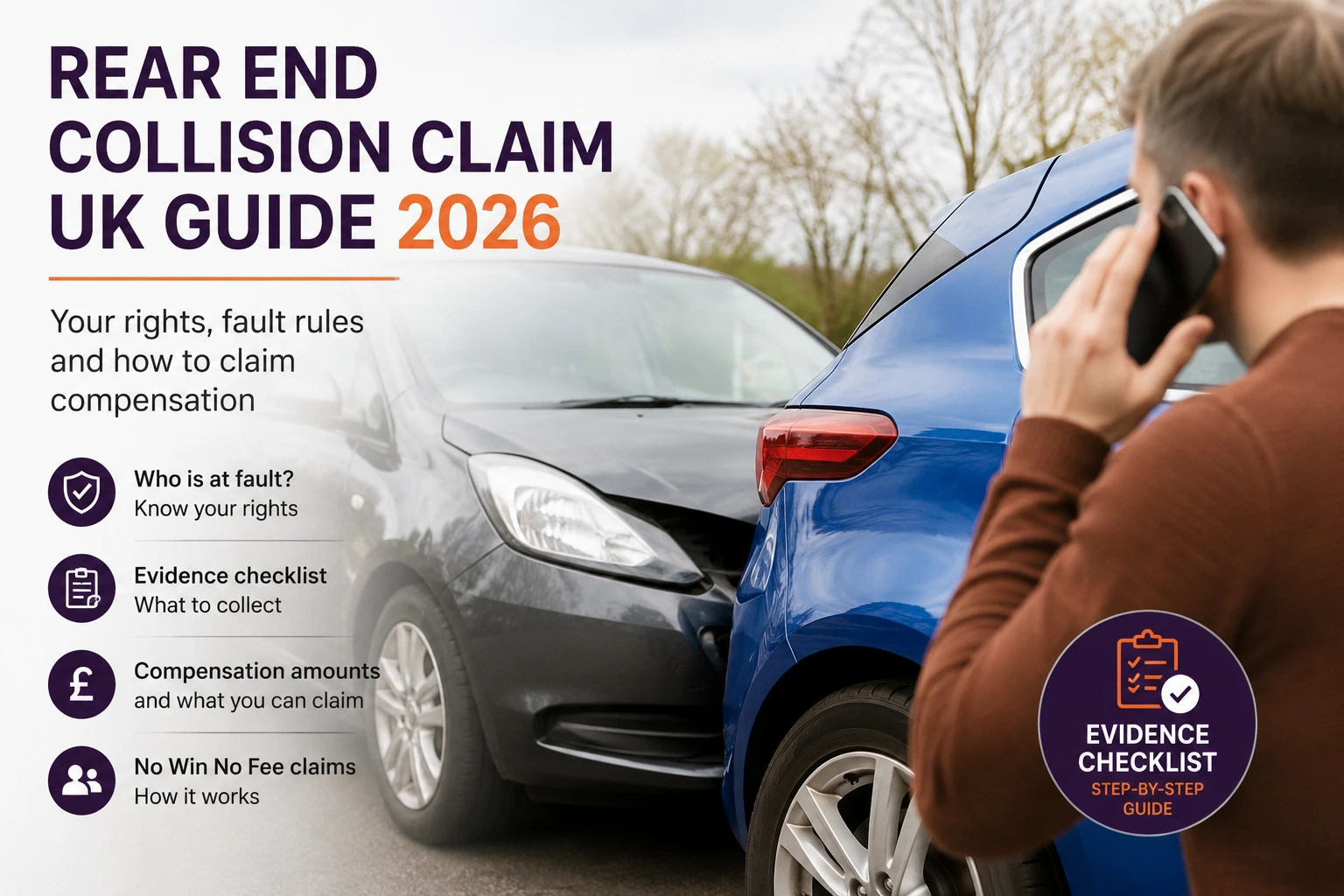
In many rear-end collisions in the UK, the rear driver is usually treated as the likely at-fault driver because drivers must leave enough space to stop safely. However, liability is not automatic. The rear driver may dispute fault if evidence shows the front driver caused or contributed to the crash. If you were hit from behind and injured, you may be able to claim against the other driver’s insurer.
A rear end collision is one of the most common types of road accident in the UK. You were stationary or moving normally when another vehicle drove into the back of yours. The impact may have seemed minor at the time, but the effects can be significant: whiplash, back pain, headaches, and anxiety that builds in the days after the collision rather than at the moment of impact.
This guide explains who is liable in a rear end collision, when the rear driver is not at fault, what compensation a rear end collision claim covers, and what to do if you have been rear-ended. It is written for the person sitting at home with a stiff neck and a growing list of questions about what comes next.
Is the rear driver always at fault in a rear end collision?
UK law creates a strong presumption that the rear driver is at fault in a rear end collision. This presumption exists because the Highway Code requires all drivers to maintain a safe following distance and drive at a speed that allows them to stop safely. If a rear end collision occurs, the starting position is that the rear driver failed to do this.
This presumption is not a strict legal rule. It is an evidential starting point. In practice, it means the rear driver’s insurer must produce evidence to shift the blame. Without that evidence, the rear driver is treated as fully liable. For the person who was rear-ended, this is a significant advantage in any rear end collision claim, because the burden of proof effectively sits with the other side from the outset.
The presumption holds in the vast majority of cases. At traffic lights, in queuing traffic, at roundabouts, on motorways, and in all situations where the front vehicle was driving normally or was stationary. If you were rear-ended while driving lawfully, the other driver’s insurer will find it difficult to argue anything other than full liability.
When the rear driver is NOT at fault
There are limited circumstances where the rear driver can successfully argue they were not at fault, or that liability should be shared. These are the exceptions, not the norm, and the rear driver must produce evidence to support them.
| Scenario | Why it shifts liability | Evidence needed |
|---|---|---|
| Front driver reversed into the rear vehicle | Front driver caused the contact, not the rear driver. | Dashcam, CCTV, witness statements, damage position. |
| Brake-checking (deliberate hard braking) | Front driver intentionally created the hazard. | Dashcam footage showing deliberate braking without cause. |
| Front driver pulled out suddenly | Rear driver had insufficient time or space to react. | Witnesses, CCTV, junction layout evidence. |
| Front vehicle had broken brake lights | Rear driver received no visual warning of braking. | Vehicle inspection report, dashcam, police report. |
| Multi-vehicle pile-up | Rear driver was pushed into the front vehicle by a third vehicle. | Police report, witness accounts, damage pattern analysis. |
Even in these scenarios, the rear driver’s insurer often argues for split liability rather than full reversal. A 50/50 split, or a 70/30 in the rear driver’s favour, is more common than a complete reversal of the presumption. Your solicitor’s role is to challenge any attempt to attribute fault to you and to present evidence that supports full liability on the other driver.
What to do after a rear end collision
- Stop and check for injuries. Call 999 if anyone is hurt. Even if the impact felt minor, check yourself and your passengers carefully.
- Exchange details with the other driver: name, address, registration, insurer, and policy number.
- Photograph the damage to both vehicles from multiple angles. Include the road, any skid marks, traffic signals, and the position of both vehicles before they are moved.
- Note witnesses. Get names and contact numbers before they leave.
- Report to the police within 24 hours if details were not exchanged, if anyone was injured, or if you suspect drink-driving or other offences.
- See a GP or attend A&E the same day. Seek medical help promptly if you have symptoms after a rear-end collision. Call 999 or go to A&E for serious symptoms; for non-emergency advice, contact your GP or use NHS 111.
- Do not admit fault or apologise. The legal presumption is in your favour. Do not undermine it with comments at the scene.
- Contact a solicitor before speaking to any insurer. The rear driver’s insurer may contact you quickly to offer a settlement before you understand the full value of your rear end collision claim.
Avoid The Mistakes That Could Harm Your Claim
Download our free guide to learn the common mistakes people make after an accident and the simple steps that can help protect your claim.
- Free instant download
- Clear, practical guidance
- No obligation
Whiplash after a rear end collision
Whiplash is the most common injury in rear end collision claims. The sudden deceleration forces the head forward and back in a rapid motion that strains the soft tissue in the neck. You may feel fine at the scene. Symptoms typically develop 24 to 72 hours later: neck stiffness, reduced range of movement, headaches radiating from the base of the skull, shoulder pain, and sometimes dizziness or concentration difficulties.
Whiplash injuries lasting up to 24 months are valued under the 2025 whiplash tariff (SI 2025/615, in force 31 May 2025). Injuries lasting beyond 24 months, or where whiplash is combined with other injuries such as fractures or disc damage, are assessed under the Judicial College Guidelines (18th edition, April 2026) and can attract significantly higher compensation.
| Injury duration | Tariff amount |
|---|---|
| Not more than 3 months | £300 |
| More than 3, not more than 6 months | £595 |
| More than 6, not more than 9 months | £1,025 |
| More than 9, not more than 12 months | £1,595 |
| More than 12, not more than 15 months | £2,435 |
| More than 15, not more than 18 months | £3,550 |
| More than 18, not more than 24 months | £4,975 |
Tariff figures from the Whiplash Injury (Amendment) Regulations 2025 (SI 2025/615), which introduced a 15% uplift for accidents occurring on or after 31 May 2025. Claims involving injuries lasting longer than 24 months or additional non-whiplash injuries are assessed under the Judicial College Guidelines. Special damages are additional.
How much compensation for a rear end collision in the UK?
Short answer
Rear end collision compensation covers two components: general damages for the injury (assessed under the whiplash tariff or JCG 18th edition depending on type and duration) and special damages for all financial losses caused by the accident.
Special damages in a rear end collision claim can include lost earnings for time off work, medical treatment and physiotherapy costs, travel to appointments, vehicle repair or hire costs, prescription costs, and care provided by family members.
These require documentary evidence: payslips, receipts, invoices, appointment records. Special damages are calculated separately from the injury compensation and are often the larger part of the total award in rear end collision claims where the claimant has significant time off work.
For injuries beyond whiplash, such as disc herniation, vertebral fractures, or chronic pain conditions that develop after a rear end collision, compensation is assessed under the JCG 18th edition and can be substantially higher than the tariff figures. A medical expert determines whether the injury falls within the tariff system or outside it.
Evidence that strengthens a rear end collision claim
Evidence Checklist — Rear End Collision Claim
- Dashcam footage
Save the original footage immediately. It often provides the clearest evidence of how the collision occurred.
- Photographs
Take photographs of vehicle damage, road layout, skid marks and weather conditions.
- Witness details
Collect names and contact details for anyone who witnessed the collision.
- Police report
Keep the incident reference number or collision report if police attended.
- Medical records
Attend all medical appointments and retain copies of reports and treatment records.
- Vehicle repair estimate
Keep repair invoices, engineer's reports and photographs before repairs begin.
- Financial losses
Retain receipts for travel, treatment, medication and evidence of lost earnings.
How long do you have to claim after a rear end collision?
Three years from the date of the accident under the Limitation Act 1980. For children, the clock starts on their 18th birthday. Three years is the ceiling, not the target. Evidence degrades long before any legal deadline.
CCTV footage is overwritten within 28 days. Dashcam recordings can be lost. Witness memories fade within weeks. Whiplash symptoms that develop days after the rear end collision need same-day medical records to establish the link. A rear end collision claim started in the first days will always be stronger than one started months or years later.
Summary
In most rear end collisions in the UK, the rear driver is presumed to be at fault. This presumption exists because all drivers must maintain a safe following distance and be able to stop in time. It can be challenged in limited circumstances, such as the front driver reversing, brake-checking, pulling out suddenly, or having broken brake lights, but the rear driver must produce evidence to support their version.
Whiplash is the most common injury in rear end collision claims. Symptoms typically develop 24 to 72 hours after the collision. Whiplash claims lasting up to 24 months are valued under the 2025 tariff (SI 2025/615), with awards ranging from £300 to £4,975.
More serious injuries are assessed under the JCG 18th edition and can attract substantially higher compensation. Special damages for lost earnings, medical costs, and vehicle damage are calculated separately.
Evidence is critical: dashcam footage, photographs, police reports, witnesses, and same-day medical records. The time limit is three years, but evidence degrades long before that. A rear end collision claim started early is always stronger than one started late.
Key takeaways
- The rear driver is presumed at fault in most UK rear end collisions. The burden of proof sits with them, not with you.
- Exceptions exist but are limited: front driver reversed, brake-checked, pulled out suddenly, or had broken brake lights. The rear driver must prove it.
- Whiplash symptoms take 24 to 72 hours to appear. See a GP or attend A&E the same day, even if you feel fine at the scene.
- 2025 whiplash tariff: £300 (up to 3 months) to £4,975 (18-24 months) under SI 2025/615.
- Injuries beyond whiplash (disc damage, fractures, chronic pain) are assessed under the JCG 18th edition at higher values.
- Dashcam footage is the strongest evidence. It defeats brake-checking arguments and reversal claims.
- Do not admit fault or apologise at the scene. The presumption is already in your favour.
- Do not accept the insurer’s first offer without legal advice. It will be lower than the claim’s true value.
- The time limit is three years, but CCTV is overwritten in 28 days. Act early.
Sources & References
- Highway Code – Rule 126 — Drivers must maintain a safe following distance, allowing sufficient space to stop safely.
- Whiplash Injury (Amendment) Regulations 2025 (SI 2025/615) — Introduced a 15% uplift to the statutory whiplash tariff for road traffic accidents occurring on or after 31 May 2025.
- Whiplash Injury Regulations 2021 (SI 2021/642) — Original statutory whiplash tariff and compensation framework introduced under the Civil Liability Act 2018.
- Judicial College Guidelines (18th Edition, April 2026) — The guideline used by courts and legal professionals when assessing general damages for personal injury claims beyond the statutory whiplash tariff.
- Road Traffic Act 1988 – Section 170 — Sets out the legal duty to stop after a road traffic accident, exchange details and, where required, report the collision to the police.
- Limitation Act 1980 – Section 11 — Establishes the standard three-year limitation period for personal injury claims in England and Wales.
Frequently Asked Questions
Is the rear driver always at fault in a rear end collision?
How much compensation for a rear end collision UK?
Can I claim for whiplash after a rear end collision?
How long do I have to claim?
Three years from the accident date. CCTV is overwritten in 28 days, witnesses forget within weeks, and whiplash needs same-day medical records. Act early for the strongest position.
What if the other driver says I reversed into them?
This is a common defence. Your solicitor gathers dashcam footage, CCTV, witness statements, and damage position analysis to rebut it. The burden of proof sits with the rear driver to disprove the presumption of their fault.
What should I do after a rear end collision?
Stop, check injuries, exchange details, photograph damage, note witnesses, report to police within 24 hours, see a GP the same day. Do not admit fault. Contact a solicitor before speaking to the other driver’s insurer.
Glossary of Key Terms
Disclaimer: The information on this page is for general guidance only and does not constitute legal advice. Compensation outcomes vary by individual case and depend on the specific facts and evidence. Claim Time Solicitors is authorised and regulated by the Solicitors Regulation Authority (ID No. 444171) and accredited by The Law Society . No Win No Fee refers to a Conditional Fee Agreement; the solicitor’s success fee is capped at 25% of compensation recovered. Terms apply.


