
Who can claim
Parent
or litigation friend
Time limit
Age 21
3 years from 18th birthday
Settlement approval
Court
Required for all child claims
Upfront cost
£0
No Win No Fee basis

Personal Injury Solicitor at Claim Time Solicitors, Birmingham. Handling personal injury and child injury claims across England and Wales on a No Win No Fee basis.
This guide is reviewed against current UK statute, Limitation Act 1980, Civil Procedure Rules, and SRA guidance. It is for general information only and does not constitute legal advice.
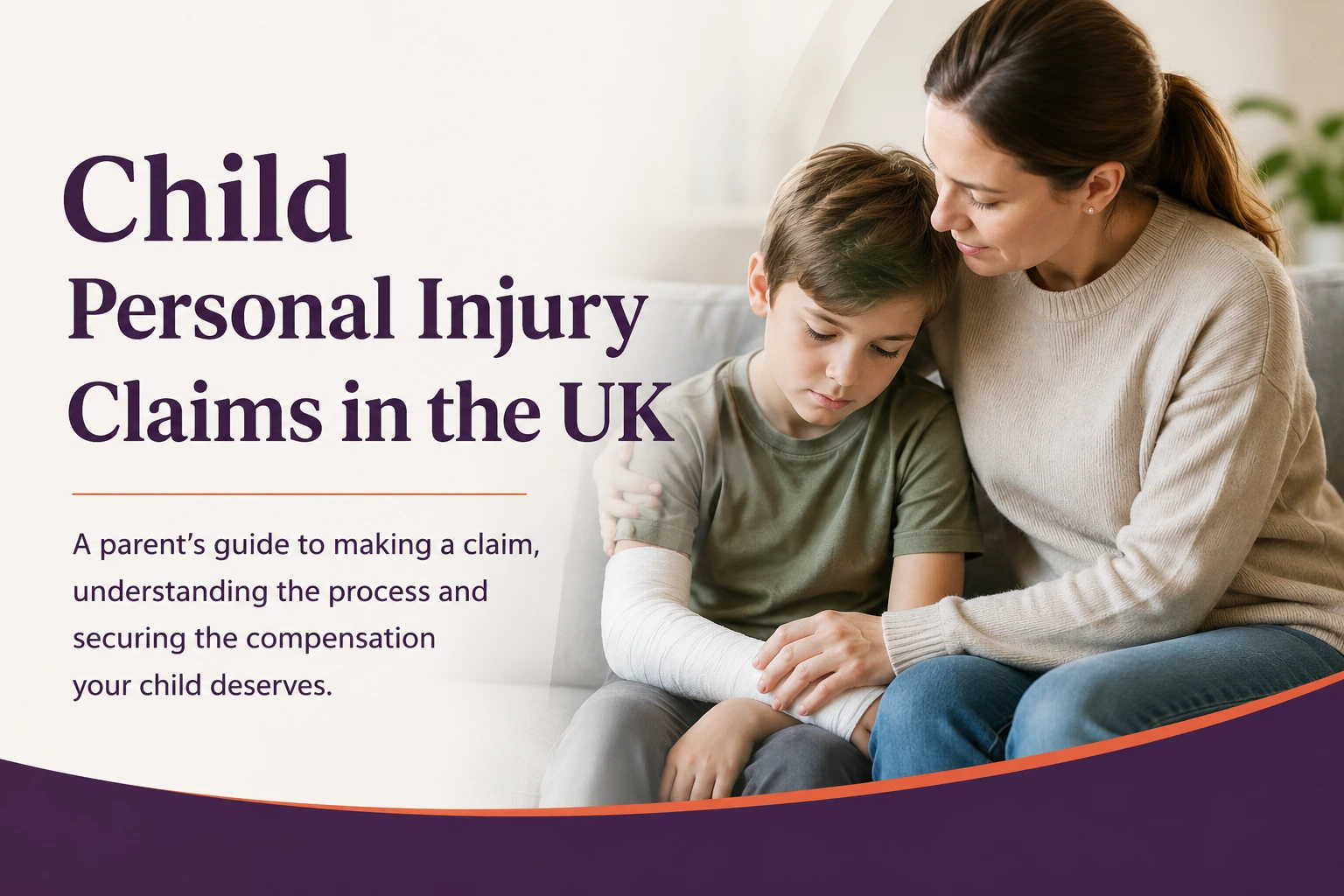
A child personal injury claim allows a parent or guardian to seek compensation when a child has been injured through someone else’s negligence. Because children under 18 cannot bring legal proceedings themselves, a parent acts as a litigation friend to manage the claim. Any settlement must be approved by a court. Compensation is held securely until the child turns 18. There is no strict deadline while the child is under 18, but acting early strengthens the evidence.
If your child has been injured through someone else’s negligence, it is natural to feel overwhelmed dealing with their recovery while trying to work out whether you have any legal options. Child personal injury claims exist precisely for this situation.
This guide explains how child personal injury claims work in the UK. It covers who can make a claim, how the litigation friend process works, what happens to any compensation, and what the time limits are. If you have already decided you want to proceed, it also explains what to expect from a solicitor.
What are child personal injury claims?
Child personal injury claims are legal claims brought on behalf of a child when they have been injured through another person’s or organisation’s negligence. Because children cannot bring claims themselves, a parent or guardian acts on their behalf.
A personal injury claim for a child follows the same basic legal principles as an adult claim. Someone owed the child a duty of care, breached that duty, and that breach caused the injury. The difference is procedural: a child lacks legal capacity to conduct proceedings, so an adult must manage the claim on their behalf.
These claims are not about placing blame for its own sake. They exist to ensure a child who has been harmed through no fault of their own has access to compensation that reflects the impact of that injury now and in the future. A serious childhood injury can affect education, development, and long-term independence. Child personal injury claims are designed to address the full picture, not just the immediate medical costs.
When can you make a child personal injury claim?
You may be able to make a child personal injury claim if your child was injured through someone else’s negligence meaning they had a duty of care, failed to meet it, and that failure caused the injury.
Three things generally need to apply for a claim to succeed. A duty of care must have existed. That duty must have been breached. The breach must have directly caused the injury. All three need to be established on the evidence.
| How It Happened | Who May Be Responsible | Legal Basis |
|---|---|---|
| Road traffic accident | At-fault driver or their insurer | Duty of care on public roads |
| Accident at school | School or local authority | Duty of care to pupils in their care |
| Defective toy or product | Manufacturer, distributor, or retailer | Consumer Protection Act 1987 |
| Playground accident | Local authority or premises owner | Occupiers' Liability Act 1957 & 1984 |
| Sports injury at school or club | Coach, club, or school | Duty of care — adequate supervision and safe equipment |
| Dog attack | Dog owner | Animals Act 1971 |
| Medical negligence | NHS trust or private provider | Duty of care owed by medical professionals |
Even if the child was partly responsible for the incident, a claim may still be possible. Under the principle of contributory negligence, courts reduce compensation proportionally they do not automatically reject the claim.
You can use our Claim Checker for a quick initial indication of whether your situation may qualify.
Common types of child personal injury claim
Road traffic accidents
Road accidents are among the most common causes of serious injury in children. In 2023, 3,355 children aged 7 and under were killed or injured on roads in Britain — equivalent to nine young children being harmed every day. Where another driver’s negligence caused or contributed to the accident, a child personal injury claim may be possible for the child’s injuries, pain and suffering, and any long-term effects.
School accidents
Schools and local authorities owe a duty of care to every pupil. Where a child is injured because that duty was not met through inadequate supervision, unsafe equipment, poorly maintained premises, or a failure to manage known risks a claim against the school or local authority may be possible. This includes incidents in lessons, on school trips, at breaks, and during sports.
Defective products
Manufacturers, distributors, and retailers can be held liable when a product that is unsafe causes injury. For children, this commonly includes unsafe toys, faulty baby equipment, household appliances, and food products with mislabelled allergens. Under the Consumer Protection Act 1987, you do not need to prove fault you need to show the product was defective and that the defect caused the injury. See our guide on when a defective product causes harm for more detail.
Playground injuries
RoSPA reports approximately 40,000 children’s playground injuries in the UK each year that result in a hospital visit. Where poor maintenance, faulty equipment, or inadequate surfacing contributed to the injury, the organisation responsible for the playground may be liable.
Sports injuries
Many sports injuries are accidents with no grounds for a claim. But where a coach, school, or club failed in their duty of care through inadequate supervision, unsafe equipment, or pushing a child to play through an injury a claim may be possible. Our guide on sports injuries at school explains how liability is assessed in these cases.
| Cause | Examples | Likely Claim Outcome |
|---|---|---|
| Failure to look properly | Driver distracted, missed crossing signal | Strong claim |
| Speeding | Unable to stop in time, exceeded limit near crossing | Strong claim |
| Failure to yield at crossing | Jumped red light, ignored zebra crossing | Strong claim |
| Distracted driving | Using phone, adjusting sat-nav | Strong claim |
| Driving under influence | Alcohol or drugs impairing reactions | Strong claim |
| Poor road or pavement condition | Broken paving, unmarked hazard | Depends on council liability |
| Poor visibility or missing signage | No warning signs, unlit crossing area | Depends on responsible authority |
What is a litigation friend?
A litigation friend is an adult who manages a child personal injury claim on the child’s behalf. They instruct the solicitor, make decisions in the child’s best interests, and represent the child throughout the legal process.
Children under 18 cannot bring legal proceedings themselves. The law requires an adult to act for them this person is the litigation friend. In most child personal injury claims, the litigation friend is a parent or close relative, though it can also be a guardian or professional advocate.
Definition
Litigation friend
A person who conducts legal proceedings on behalf of a child or someone without mental capacity. A litigation friend must be able to act fairly and competently and must not have interests conflicting with those of the child. They instruct the solicitor and take responsibility for managing the claim but the compensation belongs to the child, not to them. The role ends when the child turns 18 or when the claim concludes.
One important rule: you cannot act as a litigation friend if you are potentially responsible for the child’s injury. For example, if a parent was driving the car involved in the accident, a different person would need to act as the litigation friend for that claim.
Being a litigation friend does not mean you need legal expertise. Your solicitor handles the legal work. Your role is to make decisions in your child’s best interests, provide instructions, and attend the court approval hearing. Most parents find the process more straightforward than they expected.
How a child personal injury claim works
The process follows the same structure as an adult claim — instruct a solicitor, gather evidence, obtain medical reports, negotiate — with two important differences: all settlements require court approval, and compensation goes to the Court Funds Office rather than directly to the parent.
- 1Seek Medical Attention ImmediatelyYour child's health is the priority. Medical records created close to the incident are also the primary evidence in the claim.
- 2Preserve Evidence As Soon as PossiblePhotograph the scene and any hazard. Keep any defective products and their packaging. Get witness names and contact details. Report to the school, premises, or police as appropriate.
- 3Instruct a Solicitor Early DaysA solicitor advises on the strength of the claim, identifies the right defendant, and manages all correspondence. In child personal injury claims they also guide the litigation friend through their responsibilities.
- 4Investigation and Evidence Weeks 1–12Medical records, expert reports, witness statements, accident reports, CCTV, and school records are gathered to build the claim and establish liability.
- 5Letter of Claim Sent Months 1–3The formal opening of the claim. The defendant's insurer has a set period to respond under the relevant Pre-Action Protocol.
- 6Negotiation and Settlement Offer Once Evidence CompleteMost child injury claims settle through negotiation. Once an offer is agreed between the parties, it must go to a court for approval before it is final.
- 7Court Approval Hearing Final StageA judge reviews the settlement and medical evidence to confirm it is fair for the child. This is a private, relatively informal hearing — not a contested trial.
Court approval and the Court Funds Office
Every child personal injury settlement must be approved by a court before it is legally binding. Once approved, compensation is typically paid into the Court Funds Office and held there until the child turns 18.
This is one of the most important differences between a child injury claim and an adult claim. Even where both sides have agreed on a figure, a judge must review the evidence and confirm that the settlement is appropriate for the child. This exists to protect the child’s interests it means no-one can settle a claim for less than its true value without judicial scrutiny.
The court approval hearing is usually short, private, and relatively informal. Both solicitors attend. The litigation friend does not necessarily need to attend, though some judges invite them. The judge reviews the medical evidence and the proposed settlement, and if satisfied, approves it.
Once approved, the compensation does not go to the parent. It is paid into the Court Funds Office — a government-managed service that holds and invests money on behalf of those who cannot manage it themselves, including children. The money sits in an investment account and earns interest until the child’s 18th birthday, at which point they can apply to receive the full amount.
For smaller awards, a judge may instead order the money to be placed directly into a savings account chosen by the litigation friend, rather than going through the Court Funds Office.
“The court approval process exists to protect children, not to create obstacles. In practice it is one of the most straightforward parts of the claim — the judge’s role is to confirm the settlement is fair, which in a well-prepared case is usually a short and positive hearing.”
What compensation in a child personal injury claim may cover
Compensation in child personal injury claims covers general damages for pain, suffering, and impact on the child’s life, and special damages for financial losses including medical treatment, care, and travel costs.
The same two categories of damages apply to child personal injury claims as to adult claims.
Definition
General damages vs. special damages
General damages compensate for the injury itself — pain, suffering, and loss of amenity. Courts assess these against the Judicial College Guidelines (18th edition, April 2026). Special damages are actual financial losses that can be documented: medical treatment, physiotherapy, travel to appointments, and care provided by family members (both paid and unpaid).
In child personal injury claims, there are additional heads of loss that may apply beyond those typically claimed in adult cases:
- Impact on education and development: Time missed from school, tutoring costs, impact on grades and future opportunities
- Long-term care needs: If the injury has lasting consequences, future care costs can be included
- Psychological impact: Trauma, PTSD, anxiety, and the impact on the child’s social life and enjoyment of activities
- Parents’ lost earnings: Where a parent had to reduce hours or leave work to care for an injured child, those losses may be recoverable
- Travel costs: To and from all medical appointments, therapy sessions, and related appointments
- Specialist equipment: Aids, adaptations, or equipment needed as a result of the injury
The value of any claim depends entirely on the specific facts — the nature of the injury, its prognosis, and the evidence of its impact. Our Claim Value Estimator gives a free indicative figure based on your situation before you speak to a solicitor.
Time limits for child personal injury claims
There is no fixed deadline for a litigation friend to bring a child personal injury claim before the child turns 18. Once the child turns 18, they have three years to bring their own claim — meaning the absolute deadline is their 21st birthday.
The standard three-year limitation period for personal injury claims under the Limitation Act 1980 is suspended while the injured person is under 18. It only begins to run on their 18th birthday.
| Situation | Time Limit | Practical Meaning |
|---|---|---|
| Child under 18 | No fixed limitation period | A parent or litigation friend can bring the claim at any point before the child turns 18. |
| Child turns 18 | Three years | The limitation clock starts on the child's 18th birthday. |
| Adult claimant | Until age 21 | The child has until their 21st birthday to start proceedings themselves. |
| Best practice | As soon as possible | Evidence is fresher, witnesses are easier to trace, and medical records are easier to obtain. |
This means that technically, no claim needs to be filed until the child is 21. But acting early is strongly recommended for practical reasons that matter far more than the legal deadline.
Evidence fades. Witnesses forget details. CCTV footage is routinely overwritten within 28 days. Medical records created close to the incident are far stronger than those obtained years later. A claim started within weeks or months of the injury will almost always be better supported than one started years later regardless of where the legal deadline falls.
Keep every relevant piece of paper. Back up digital records. Ask your solicitor what level of documentation they need early on, so nothing gets missed
Summary
Child personal injury claims allow a parent or guardian to seek compensation when a child has been hurt through someone else’s negligence. Because children under 18 cannot bring legal proceedings themselves, an adult — known as a litigation friend manages the claim on their behalf. Any settlement must be reviewed and approved by a court, and compensation is held safely in the Court Funds Office until the child turns 18.
Claims can arise from any type of negligence-caused accident: road traffic incidents, school accidents, defective products, playground injuries, sports, dog attacks, and medical negligence. Compensation covers both the injury itself and any financial losses including medical costs, lost parental earnings, and long-term care needs where the injury has lasting effects.
There is no fixed deadline to bring a claim while the child is under 18. Once they turn 18, they have three years to act themselves making the absolute latest deadline their 21st birthday. Acting early is always better: evidence fades, witnesses forget, and CCTV is routinely overwritten within days.
Most child personal injury claims are handled on a No Win No Fee basis, meaning there is no upfront cost to the family. If the claim is unsuccessful, you pay nothing for the legal work.
Key takeaways
- A parent or guardian can claim on the child’s behalf by acting as a litigation friend, children under 18 cannot bring legal proceedings themselves
- Any negligence-caused accident qualifies: Road accidents, school incidents, defective products, playground injuries, sports, dog attacks, and medical negligence can all give rise to a claim
- No fixed deadline while the child is under 18: But acting early preserves evidence. Once the child turns 18, the deadline is their 21st birthday
- All settlements require court approval: A short, private hearing that protects the child’s interests, not a contested trial
- Compensation goes to the Court Funds Office, not the parent, and is held until the child turns 18
- Both general and special damages apply: Covering pain and suffering, medical costs, rehabilitation, lost parental earnings, and long-term care where relevant
- Partial fault does not end the claim: Courts reduce compensation proportionally under contributory negligence, they do not automatically reject it
- No Win No Fee: No upfront cost to the family if the claim is unsuccessful
- Over 72,000 children aged 0–14 are admitted to hospital from accidental injuries annually in the UK. Child personal injury claims exist to protect those affected by negligence
Sources & References
- NHS England / NHS Digital — A&E Waiting Times and Activity Statistics — Children aged 0–14 account for a significant proportion of A&E attendances and admissions resulting from accidental injuries.
- Brake Road Safety Charity — Child Casualties Statistics — Brake reported that 3,355 children aged seven and under were killed or injured on British roads in 2023, based on Department for Transport STATS19 data.
- Department for Transport — Road Accidents and Safety Statistics (STATS19) — Official casualty reporting data for road traffic incidents in Great Britain.
- Royal Society for the Prevention of Accidents (RoSPA) — Playground Safety — Approximately 40,000 children’s playground injuries each year result in a hospital visit in the UK.
- Court Funds Office — Holds and manages compensation awarded to children until they reach adulthood, under HM Courts and Tribunals Service supervision.
- Limitation Act 1980, Section 28 — Suspends limitation periods for those under a legal disability, including children.
- Consumer Protection Act 1987 — Establishes strict liability for injuries caused by defective products.
Frequently Asked Questions
Can a parent make a child personal injury claim on their child's behalf?
What is the time limit for a child personal injury claim?
What happens to compensation awarded in a child personal injury claim?
What types of accident can lead to a child personal injury claim?
Child personal injury claims can arise from any accident caused by someone else’s negligence. Common types include road traffic accidents, accidents at school caused by inadequate supervision, injuries from defective products, slips and trips on unsafe premises, playground accidents due to poor maintenance, dog attacks, and sports injuries where a coach or organisation failed in their duty of care.
What does compensation in a child injury claim cover?
Compensation typically covers general damages for pain, suffering and loss of amenity, and special damages for financial losses. Special damages may include medical treatment, physiotherapy, travel to appointments, and care costs. In child personal injury claims there may also be recoverable losses relating to impact on education, parents’ lost earnings while caring for the child, and long-term care needs if the injury has lasting consequences.
Will a child personal injury claim go to court?
Most child personal injury claims settle through negotiation without a full trial. However, all child injury settlements require court approval at an approval hearing, even where the parties have already agreed on an amount. This is a relatively short, private, and informal hearing where a judge reviews the evidence and confirms the settlement is fair. It is not the same as a contested trial.
Glossary of Key Terms
Disclaimer: The information on this page is for general guidance only and does not constitute legal advice. Compensation outcomes vary by individual case and depend on the specific facts and evidence. Claim Time Solicitors is authorised and regulated by the Solicitors Regulation Authority (ID No. 444171) and accredited by The Law Society . No Win No Fee refers to a Conditional Fee Agreement; the solicitor’s success fee is capped at 25% of compensation recovered. Terms apply.