
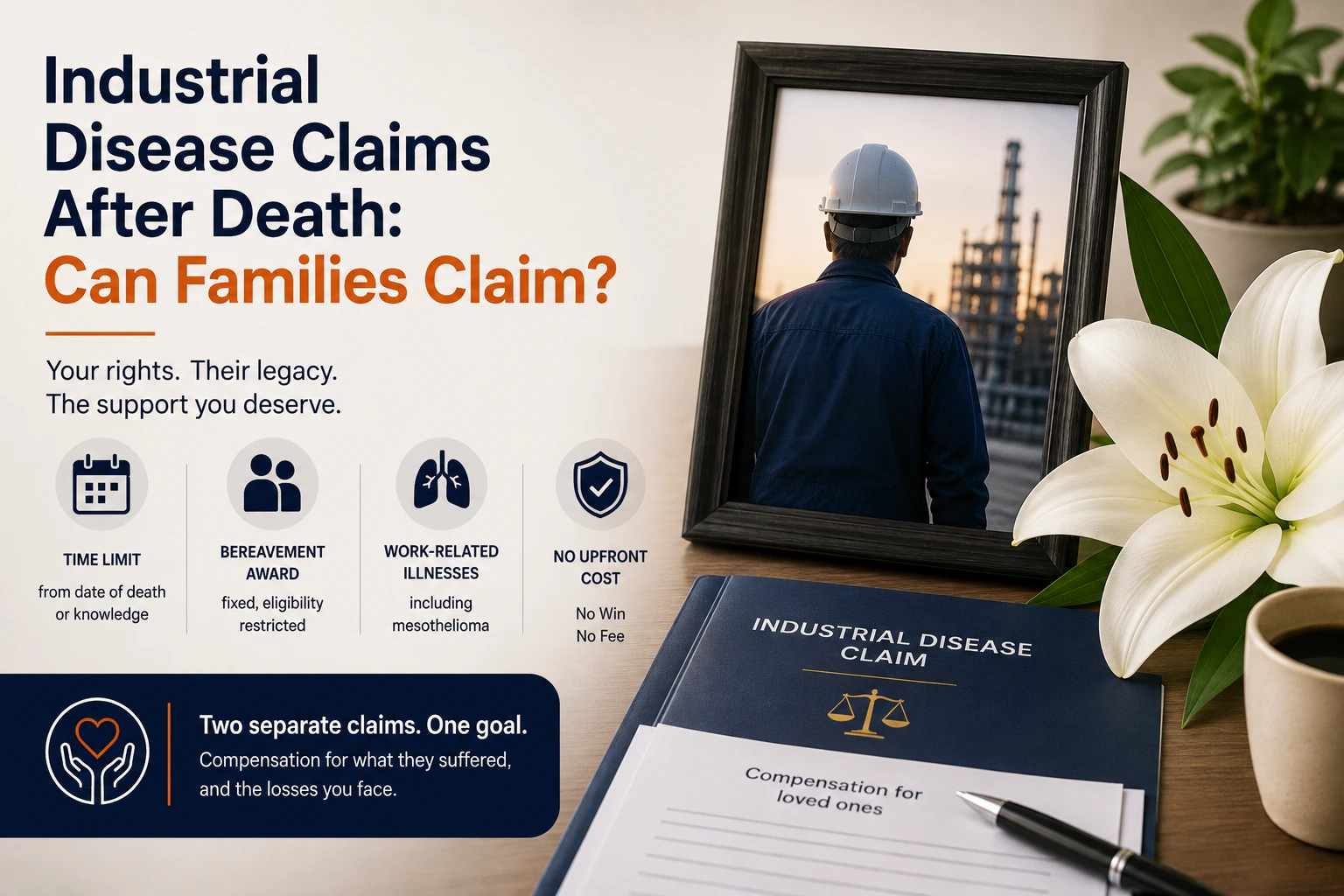

Time Limit
3 years
from date of death or knowledge
Bereavement Award
£15,120
fixed, eligibility restricted
Mesothelioma Deaths
2,218
Great Britain, 2023 (HSE)
Upfront cost
£0
No Win No Fee

Personal Injury Solicitor at Claim Time Solicitors, Birmingham. Handling personal injury and child injury claims across England and Wales on a No Win No Fee basis.
Every guide we publish is verified against UK statute and current case law before release.
Yes. Where someone has died from a disease caused by their work, industrial disease claims after death can usually be brought by the personal representative of their estate, by financially dependent family members, or both. Two separate routes exist in law, one for losses the person suffered before they died and one for the losses their dependants face afterwards. In most cases you have three years from the date of death, or from when the link to work became known.
Losing someone to an illness they picked up at work carries a particular kind of anger alongside the grief. Mesothelioma, asbestosis, an occupational cancer or a lung disease that took decades to show itself, all of it traces back to a workplace that was supposed to be safe.
Families often assume that once the person has died, the chance to hold anyone responsible has gone with them. That is not how the law works. Industrial disease claims after death can still be brought, and there are two distinct legal routes available depending on who is claiming and what for.
The scale of the problem is still significant. The Health and Safety Executive estimates around 11,000 lung disease deaths each year in Great Britain are linked to past workplace exposures, and 2,218 people died from mesothelioma alone in 2023.
This guide explains who can claim, what compensation covers, the deadlines that apply, and what the process actually involves.
What counts as an industrial disease?
An illness caused, or made significantly worse, by conditions at work. Most involve long-term exposure to something harmful, and many take decades to appear.
Definition
Latency period
The gap between exposure to a harmful substance and the appearance of symptoms. For asbestos-related diseases this is commonly 20 to 50 years, which is why so many claims involve employers the person left long ago.
Conditions that commonly give rise to a claim include:
- Asbestos-related diseases, including mesothelioma, asbestosis and pleural thickening
- Occupational lung conditions such as COPD, occupational asthma and silicosis
- Cancers linked to exposure to chemicals, dusts or fumes
- Other illnesses caused by hazardous materials the employer failed to control
The long latency period is the reason many of these claims only begin after someone has died. It is also why tracing old employers and their insurers is a normal part of the work rather than an obstacle.
Who can bring a claim after a death?
Two groups: the personal representative of the estate, claiming for what the person suffered before death, and financial dependants, claiming for their own losses afterwards. These are separate claims under separate Acts and often run together.
This is the part families most often misunderstand, so it is worth being precise. There are two distinct legal routes:
| Route | Who Brings It | What It Covers |
|---|---|---|
| Law Reform (Miscellaneous Provisions) Act 1934 | The personal representative, executor or administrator, on behalf of the estate | Losses the person suffered while alive: pain and suffering, lost earnings, care and treatment costs |
| Fatal Accidents Act 1976 | Financial dependants, such as a spouse, civil partner, cohabitee or dependent children | Losses the dependants face after the death: loss of financial support, loss of services, funeral expenses, and the statutory bereavement award where eligible |
You do not have to choose between the two routes. Where both apply, they are usually pursued together as part of a single claim.
What compensation can cover
Pain and suffering before death, lost earnings and care costs, the financial support dependants have lost, funeral expenses, and in some cases a fixed bereavement award.
Because two claims run in parallel, the recoverable losses fall into two groups.
Claimed by the estate:
- Pain, suffering and loss of quality of life the person experienced before death
- Earnings lost between diagnosis and death
- Medical treatment, nursing and care costs
- Travel and other expenses connected to the illness
Claimed by dependants:
- Loss of the financial support the person provided
- Loss of services such as childcare, home maintenance or care
- Funeral expenses, where the dependants paid them
- The statutory bereavement award, where the relationship qualifies
The total varies considerably depending on the person’s earnings, the stage of life they were at, the number of dependants and the nature of the illness. Nobody can give a reliable figure without knowing those details.
The Statutory Bereavement Award
A fixed payment of £15,120, set by statute. Eligibility is narrower than most people expect, and many close relatives do not qualify.
Under section 1A of the Fatal Accidents Act 1976, a fixed sum of £15,120 is payable in qualifying cases. The amount is set in law and cannot be increased by a court to reflect the circumstances of a particular death.
The list of people entitled to it is restricted to:
- The husband, wife or civil partner of the person who died
- A cohabiting partner who lived with them as a spouse or civil partner for at least two years immediately before the death
- The parents of an unmarried child who died under the age of 18
It is worth being direct about what that list leaves out, because families are often caught off guard by it. An adult child who loses a parent does not qualify. Nor does a parent whose child was over 18, or a sibling, or a grandchild. Where more than one eligible person claims, the £15,120 is divided between them rather than paid to each.
Not qualifying for the bereavement award does not mean you have no claim. Dependency losses and the estate’s claim are separate, and are often worth considerably more.
The rules described here apply in England and Wales. Scotland handles bereavement damages differently, assessing them case by case rather than by fixed sum.
Can your family bring a claim after a work-related death?
Answer four quick questions for clear guidance based on your situation.
Time limits after a death
Generally three years from the date of death, or from the date the family knew the death was linked to work, whichever is later.
The three-year limitation period under the Limitation Act 1980 runs from the date of death, or from the date of knowledge, meaning the point at which it became reasonably clear that the illness was caused by work. In disease cases the date of knowledge often matters more than the date of death, because the link to a former employer may only emerge from a post-mortem or an inquest.
Courts do have a discretion to allow claims outside the three years in some circumstances, but it is not something to rely on. Practically, the earlier a claim starts the better, because these cases depend on employment records, witness recollection and insurance archives that get harder to trace with time.
“In disease cases the evidence is often decades old. Colleagues who could describe the working conditions may themselves have died. Starting early is not about pressure, it is about whether the evidence still exists.”
What the claims process involves
Establishing the work history and exposure, obtaining medical and post-mortem evidence, tracing the employer’s insurer, and proving the exposure caused or contributed to the illness.
- 1Initial ReviewFree, no obligationWe look at the work history, the diagnosis and the death certificate to see whether a claim is realistic before anything else happens.
- 2Gathering EvidenceWeeks to monthsMedical records, post-mortem and inquest findings, employment history, HMRC records, and statements from former colleagues about working conditions.
- 3Tracing the InsurerOften the longest stepIf the employer no longer exists, the claim is usually made against the insurer who covered them at the time of exposure. Specialist tracing services exist for exactly this.
- 4Establishing LiabilityShowing the employer breached their duty of care and that the breach caused or materially contributed to the illness.
- 5Valuation and SettlementBoth the estate's claim and the dependency claim are valued and put to the insurer. Most cases settle without a court hearing.
If the employer has dissolved, that does not end the claim. Employers’ liability insurance was compulsory for most employers from 1972 onwards, and claims are brought against the insurer rather than the company itself.
Summary
A death does not end the right to hold a negligent employer to account. Industrial disease claims after death run through two routes, one on behalf of the estate for what the person went through, and one for the dependants left behind.
The three-year deadline, and the practical reality that evidence in these cases is often decades old, both point the same way: getting advice early matters, even if you are not sure yet whether you want to pursue anything.
Key takeaways
- Claims can be brought by the estate, by financial dependants, or both
- The statutory bereavement award is fixed at £15,120 and eligibility is restricted
- Adult children and siblings do not qualify for the bereavement award, but may still be dependants
- Time limits generally run three years from death or from the date of knowledge
- A dissolved employer does not prevent a claim, since it proceeds against their insurer
- 1. Health and Safety Executive, work-related respiratory disease and mesothelioma statistics for Great Britain, published July 2025
- 2. Fatal Accidents Act 1976, section 1A, as amended
- 3. Law Reform (Miscellaneous Provisions) Act 1934, section 1
- 4. Limitation Act 1980, sections 11, 12 and 14
- 5. Employers' Liability (Compulsory Insurance) Act 1969
Frequently Asked Questions
Can I claim if my relative has already died?
Yes. A claim can be brought by the personal representative of the estate for what your relative suffered before death, and separately by financial dependants for their own losses. Both routes remain available after a death.
What if the employer no longer exists?
How long do we have to start a claim?
Who can receive the bereavement award?
A spouse or civil partner, a cohabiting partner of at least two years, or the parents of an unmarried child who died under 18. Adult children and siblings do not qualify, though they may still have a dependency claim, which is often worth more.
Do we have to pay anything upfront?
No. These claims are handled on a No Win No Fee basis. If the claim is unsuccessful and you have complied with the agreement, you pay nothing for our work.
Glossary of Key Terms
Disclaimer: The information on this page is for general guidance only and does not constitute legal advice. Compensation figures are indicative, and individual outcomes vary. Claim Time Solicitors is authorised and regulated by the Solicitors Regulation Authority (SRA No. 612481). No Win No Fee refers to a Conditional Fee Agreement; terms apply.


