
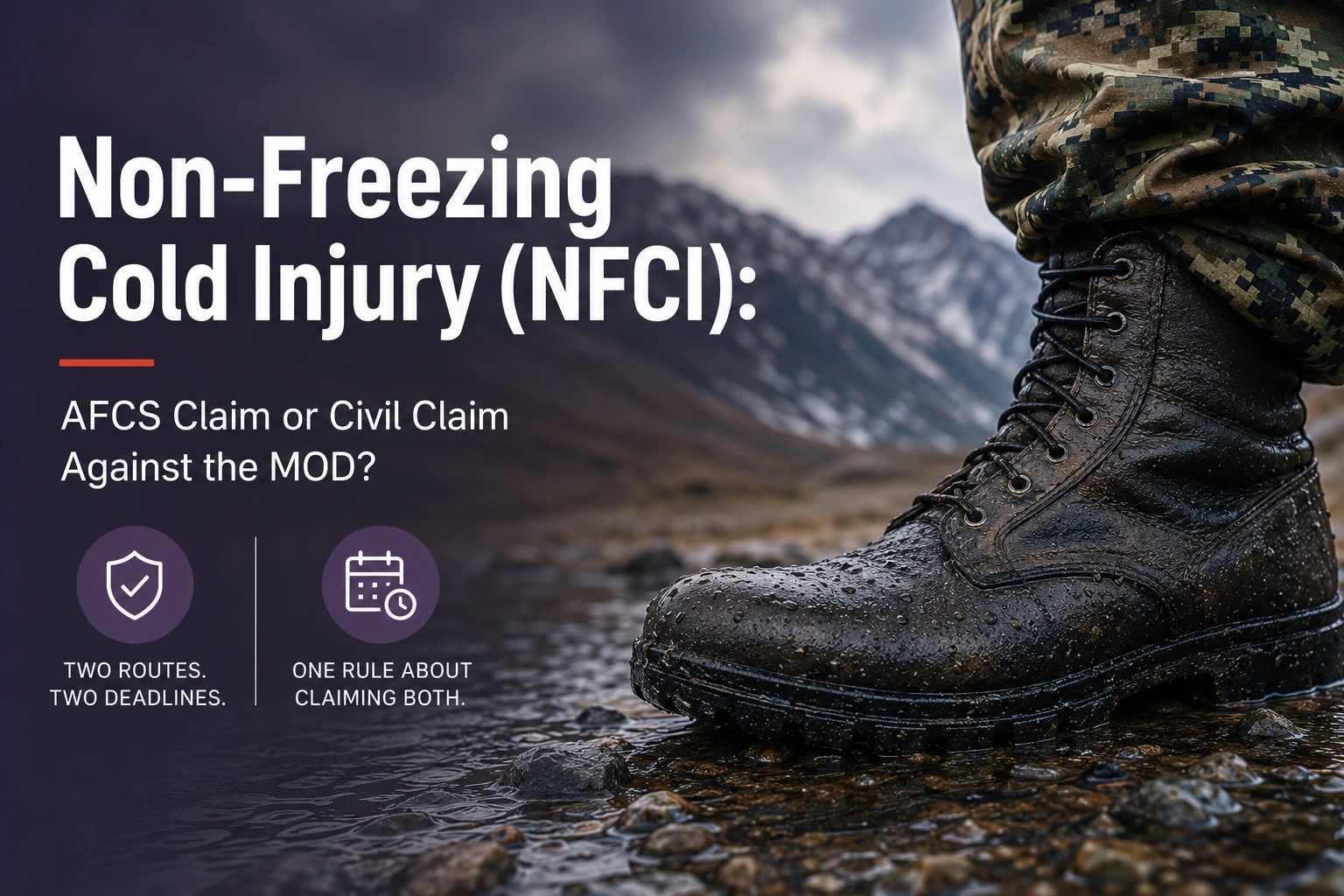

NFCI diagnoses, 2010 to 2022
4,925
regular armed forces personnel
AFCS deadline
£233.90
no fault needed
Civil claim deadline
3 years
rounded up to 20%
Upfront cost
£0
No Win No Fee

Personal Injury Solicitor at Claim Time Solicitors, Birmingham. Handling military and service-related injury claims across England and Wales on a No Win No Fee basis.
Reviewed against the Armed Forces and Reserve Forces (Compensation Scheme) Order 2011, the Limitation Act 1980, the Health and Safety at Work etc. Act 1974, JSP 539, and the Independent Medical Expert Group report on NFCI. For general information only, not legal advice.
A non freezing cold injury is nerve and tissue damage caused by prolonged cold and wet exposure without freezing. If you developed NFCI during service you have two possible routes. The Armed Forces Compensation Scheme is no-fault, administered by Veterans UK, and has a seven-year deadline. A civil claim against the MOD requires proof of negligence and has a three-year deadline. You can use both, but an AFCS award is deducted from civil damages through a process called abatement.
Most people who end up with a non-freezing cold injury did not think anything was wrong at the time. Numb feet after a wet exercise is not remarkable. You dry off, you warm up, you carry on. The problem is that NFCI does not announce itself. It is a gradual injury, and by the point the pain and cold sensitivity become impossible to ignore, the nerve damage may already be permanent.
Between January 2010 and March 2022, 4,925 regular armed forces personnel were diagnosed with a non-freezing cold injury. The real figure is likely higher, because the MOD does not publish annual incidence statistics for NFCI and many cases are only identified after discharge.
This guide covers what NFCI is, why it happens, and the part most guidance skips: the two separate compensation routes, their different deadlines, and what happens if you use both.
What is a non-freezing cold injury?
NFCI occurs when peripheral tissue is damaged by cold exposure but not to the extent of freezing. It usually affects the feet and hands. Trench foot and immersion foot are forms of NFCI. The distinction from frostbite matters: frostbite involves ice crystals forming in tissue, whereas NFCI happens at temperatures above freezing, given enough time and enough moisture.
A non freezing cold injury is often written without the hyphen in searches and general use, but it refers to the same condition. Three conditions combine to cause it: cold, wet, and time. None of them needs to be extreme. Sustained exposure in temperatures well above freezing will produce NFCI if boots and clothing stay saturated and there is no opportunity to dry out and rewarm. Restricted circulation from tight-fitting kit accelerates it.
NFCI has been recognised in a military context for centuries, but it was not a significant disabling condition among UK forces in recent decades until cases began rising from the winter of 2005/06 onwards, with consequences for operational capability, healthcare and compensation. The pattern was concentrated in army recruits undertaking winter training in the UK, particularly in the Brecon Beacons, the North York Moors and Northumbria.
Symptoms and why they get missed
The clinical picture in UK forces today is generally subtler than the severe historical presentations, and that is precisely what makes it easy to miss. A case series of 100 service personnel referred to a military NFCI clinic found 76 were confirmed as NFCI and 24 had alternative diagnoses, which gives some sense of how difficult recognition can be even for specialists.
| Stage | What you notice |
|---|---|
| During exposure | Numbness, loss of dexterity, feet feeling wooden or absent, pale or blotchy skin |
| On rewarming | Redness, swelling, throbbing or burning pain as sensation returns, sometimes hours later |
| Weeks after | Persistent tingling, sharp or burning pain, hypersensitivity to any cold, sweating changes |
| Chronic | Long-term nerve pain, permanent cold intolerance, reduced grip or balance, sleep disruption |
Anyone searching for non freezing cold injury compensation is usually at this point rather than the first. The chronic stage is where NFCI stops being a training inconvenience and starts affecting employment. Cold intolerance is not a minor complaint when it rules out outdoor work, cold stores, early shifts in winter, or anything requiring reliable fine motor control in the cold. Many personnel are medically downgraded or discharged as a result.
Who is most at risk
Cold and wet exposure is the cause, but susceptibility is not evenly distributed. The MOD’s own expert review noted a clear demographic shift. During the Falklands conflict those affected were almost entirely UK-born Caucasian Royal Marines. In the more recent pattern of cases, those affected are typically foreign and Commonwealth troops, British-born Afro-Caribbeans, and Caucasians born and raised in Africa.
This matters legally as well as clinically. Where a known and documented susceptibility exists within a unit, the standard of care expected of those planning and supervising cold-weather training is correspondingly higher. A failure to account for a risk the MOD’s own review group has identified is harder to defend.
This matters legally as well as clinically. Where a known and documented susceptibility exists within a unit, the standard of care expected of those planning and supervising cold-weather training is correspondingly higher. A failure to account for a risk the MOD’s own review group has identified is harder to defend.
The MOD's duty of care and JSP 539
The MOD owes service personnel a duty of care under the Health and Safety at Work etc. Act 1974. It also publishes its own detailed policy on preventing and managing cold injury: Joint Service Publication 539. Where a claim alleges negligence, a departure from the MOD’s own written standard is significant evidence.
JSP 539 covers heat illness and cold injury prevention and management across the services. It sets expectations on planning cold-weather activity, monitoring conditions, providing appropriate equipment, and referring anyone reporting symptoms for medical assessment.
The practical effect in a civil claim is straightforward. A defendant that has written down how a risk should be managed, and then not managed it that way, is in a weaker position than one arguing about what was reasonable in the abstract. Common failures that appear in NFCI cases include:
- No realistic drying provision across multi-day exercises, so boots and clothing stay saturated
- Symptoms reported and not acted on, with personnel returned to the field rather than referred for assessment
- Exercises continued despite conditions and durations that the policy indicates should trigger review
- Inadequate cold-weather equipment, or equipment issued in sizes that restrict circulation
- No briefing on NFCI to personnel or to the officers planning the activity
- Known susceptibility disregarded when planning exposure for a mixed unit
The MOD does not have to have acted maliciously or even carelessly in an obvious way. The question is whether reasonable steps were taken, measured partly against what the MOD itself said should happen.
Two routes: AFCS or a civil claim
These are separate systems with different tests, different administrators, different deadlines and different award structures. Choosing badly, or missing one deadline while pursuing the other, is the most common way people lose out.
| Point of comparison | AFCS | Civil claim against the MOD |
|---|---|---|
| Do you prove fault? | No. No-fault scheme | Yes. Breach of duty and causation must be proved |
| Administered by | Veterans UK, within the MOD | Courts, via negotiation between solicitors |
| Covers injury from | Service on or after 6 April 2005 | No equivalent cut-off; limitation applies instead |
| Deadline | 7 years, with late-onset exceptions | 3 years from injury or date of knowledge |
| How the award is set | Fixed tariff by descriptor and severity | Assessed individually; no tariff ceiling |
| Ongoing payments | Guaranteed Income Payment where the tariff is high enough and you are medically discharged | Future loss of earnings and care claimed as damages |
| Claim while serving? | Yes | Yes |
| Challenging a decision | Reconsideration, then tribunal appeal within 1 year | Litigation, though most claims settle |
The short version: AFCS is faster, easier to access and requires no proof of fault, but is capped by tariff. A civil claim is harder, slower and requires evidence of MOD failure, but is not capped and can reflect the full financial consequences of the injury including future loss of earnings.
If your injury arose from service before 6 April 2005, AFCS does not apply. The War Pension Scheme covers that period instead. It has no time limit, but you cannot claim until you have left service.
Could you have a claim for non-freezing cold injury?
Answer four quick questions to receive clear guidance based on your circumstances.
Deadlines compared, and why one route can close before the other
| Situation | AFCS | Civil claim |
|---|---|---|
| Injury at a known date | 7 years from the incident | 3 years from the incident |
| Condition developed over time | 7 years from when you first sought medical advice | 3 years from date of knowledge |
| Late-onset, diagnosed after discharge | 3 years from becoming aware | 3 years from date of knowledge |
| Pre-6 April 2005 service | Not covered. War Pension Scheme applies, no time limit | 3 years from date of knowledge |
| Exceptional circumstances | Late claims possible, for example where ill health prevented claiming | Court discretion under s.33 Limitation Act 1980 |
Because the AFCS window is longer than the civil limitation period in the standard case, it is entirely possible for the civil route to close while AFCS remains open. It can also work the other way for late-onset conditions. This is the practical reason to get both assessed at the same time rather than sequentially.
For NFCI the three-year civil clock does not necessarily run from the exercise where your feet went numb. It runs from when you first knew, or should reasonably have known, that you had a significant injury attributable to that exposure. If nobody connected the symptoms to service until a diagnosis years later, that diagnosis date may be the start point. Do not assume a claim is out of time without having the dates assessed.
Claiming both: how abatement works
You can pursue an AFCS claim and a civil claim for the same injury. They are not added together. If both succeed, the AFCS award is deducted from the civil damages through a process called abatement, on the principle that you cannot be compensated twice for the same loss.
In practice, where an AFCS award has already been paid, the civil settlement accounts for it. Where the AFCS payment has not been made by the time a civil claim settles, the damages figure is passed to the relevant MOD body so the deduction can be applied at that point.
This is the same principle that governs the recovery of state benefits from personal injury compensation, which we cover in our guide to IIDB and personal injury claims. The mechanism differs, but the logic is identical: the state does not pay twice for one injury.
Two things follow. First, pursuing AFCS does not waste a civil claim, and the AFCS award provides support while the longer civil process runs. Second, the headline figures are not additive, so any comparison between the two routes should be made on the net position rather than by adding one to the other. A solicitor should set that out before you agree to anything.
Evidence you will need
NFCI claims are rarely lost because the injury was not real. They are lost because the link between the injury and service could not be evidenced, or because symptoms were never recorded at the time.
- Medical records confirming the diagnosis, ideally including a specialist NFCI assessment. Records showing when symptoms were first reported are particularly valuable, even if nothing was done about them.
- Service records establishing where you were, when, and in what conditions. Exercise locations, dates and durations matter.
- Evidence of the exposure itself: the nature of the activity, weather conditions, how long kit stayed wet, what drying facilities existed.
- Evidence of MOD failure, for civil claims. Reports of symptoms that were not acted on, briefings that were not given, equipment that was not provided, departures from JSP 539.
- Witness evidence from those who served alongside you, particularly where several people in the same unit developed symptoms.
- Impact evidence: medical downgrade or discharge documents, employment records, and an account of what you can no longer do.
If you are still serving and experiencing symptoms, the single most useful thing you can do is ensure they are recorded in your medical notes now, whatever happens next. A contemporaneous entry is worth considerably more than a recollection years later.If you are still serving and experiencing symptoms, the single most useful thing you can do is ensure they are recorded in your medical notes now, whatever happens next. A contemporaneous entry is worth considerably more than a recollection years later.
What to do now
- Get assessed medically and ask specifically that the cold and wet exposure is recorded as the suspected cause.
- Write down the history while you can: exercises, dates, locations, conditions, when symptoms started, who you told.
- Request your service and medical records. A solicitor can do this for you.
- Do not assume you are out of time. Date of knowledge, late-onset provisions and s.33 discretion all exist.
- Have both routes assessed together, so you are not preserving one deadline while the other quietly expires.
Summary
Non-freezing cold injury is nerve and tissue damage caused by prolonged cold and wet exposure without freezing. Between January 2010 and March 2022, 4,925 regular armed forces personnel were diagnosed with it. It develops gradually, which is why early symptoms are routinely dismissed, and it frequently results in medical downgrade or discharge once chronic cold intolerance sets in.
Two compensation routes exist. The Armed Forces Compensation Scheme is no-fault, administered by Veterans UK, covers service on or after 6 April 2005, and normally carries a seven-year deadline. A civil claim against the MOD requires proof that the duty of care was breached, and carries a three-year limitation period running from injury or date of knowledge. Departures from JSP 539, the MOD’s own cold injury policy, are significant evidence in a civil claim.
Both routes can be pursued, but they are not additive. Abatement means an AFCS award is deducted from civil damages. Because the deadlines differ, one route can close while the other remains open, which is why both should be assessed at the same time.
Key takeaways
- 4,925 regular armed forces personnel were diagnosed with NFCI between January 2010 and March 2022.
- NFCI is not frostbite. It happens above freezing, given enough cold, wet and time.
- Two routes exist: AFCS (no-fault, 7 years) and a civil claim against the MOD (fault required, 3 years).
- Abatement applies if you use both. The AFCS award is deducted from civil damages.
- AFCS is capped by tariff. A civil claim is not, so it can reflect full future loss of earnings and care.
- Pre-6 April 2005 service falls under the War Pension Scheme, which has no time limit but requires discharge first.
- JSP 539 is the MOD’s own policy on cold injury prevention. Departures from it support a negligence claim.
- Susceptibility is documented and uneven. The MOD’s own review group identified which groups are most affected.
- Date of knowledge may be your diagnosis date, not the exercise. Do not assume you are out of time.
- Get symptoms recorded now if you are still serving. A contemporaneous note outweighs later recollection.
Sources & References
- Cold injury compensation claims , Lexology, February 2025: 4,925 regular armed forces personnel diagnosed with NFCI between January 2010 and March 2022; 149 confirmed freezing cold injury cases identified over a 13-year review period.
- Independent Medical Expert Group (IMEG), Report and recommendations on medical and scientific aspects of the Armed Forces Compensation Scheme , March 2015, Topic 3: Compensation aspects of non-freezing cold injury. Ministry of Defence.
- Case series of non-freezing cold injury: the modern clinical syndrome , BMJ Military Health / Defence Medical Services: 100 UK service personnel referred to a military NFCI clinic, 76 diagnosed with NFCI.
- Joint Service Publication 539: Heat illness and cold injury, prevention and management , Ministry of Defence.
- Armed Forces and Reserve Forces (Compensation Scheme) Order 2011 : AFCS eligibility, tariff structure and time limits.
- GOV.UK, Armed Forces Compensation Scheme : administered by Veterans UK; covers service on or after 6 April 2005; seven-year time limit with exceptions.
- Limitation Act 1980, s.11, s.14 and s.33 : three-year limitation, date of knowledge, and court discretion.
- Health and Safety at Work etc. Act 1974 : general duties owed to employees, applying to the MOD.
Frequently Asked Questions
What is a non-freezing cold injury?
Yes. The two are separate and one does not block the other. They are not simply added together though. Under the Social Security (Recovery of Benefits) Act 1997, IIDB already paid is recovered by the DWP and offset against the loss of earnings part of your compensation. Damages for pain, suffering and loss of amenity are protected from that offset.
Can I claim compensation for a non-freezing cold injury?
What is the time limit for an NFCI claim?
Can I claim AFCS and civil compensation at the same time?
It can reduce part of it. Under Schedule 2 of the 1997 Act, IIDB is offset against compensation for earnings lost during the relevant period. Your general damages for pain, suffering and loss of amenity cannot be reduced by benefit recovery. Ask your solicitor for the CRU certificate figure before settling.
Can I claim if symptoms appeared after I left the forces?
There is no fixed limitation period as there is for a personal injury claim, although delay restricts how far payments can be backdated. The personal injury deadline is three years from the accident or from the date you first knew the injury was work-related, and that deadline is strict.
What if my injury was before 6 April 2005?
AFCS does not apply. The War Pension Scheme covers that period, has no time limit, but cannot be claimed until you have left service. A civil claim may still be possible depending on your date of knowledge.
Glossary of Key Terms
Disclaimer: The information on this page is for general guidance only and does not constitute legal advice. AFCS rules, tariffs and time limits are set out in the governing legislation and guidance and are subject to change; confirm current details on GOV.UK or with Veterans UK. Whether any particular claim is in time, and which route is appropriate, depends on individual facts. Claim Time Solicitors is authorised and regulated by the Solicitors Regulation Authority (SRA No. 444171) and is an accredited member of The Law Society. No Win No Fee refers to a Conditional Fee Agreement; the solicitor’s success fee is capped at 25% of compensation recovered. Terms apply.


