

Who usually pays
Employer's
motor insurer
Time limit to claim
3 years
from the accident
Injured & not fully at fault
You may
be able to claim
Upfront cost
£0
No Win No Fee

Personal Injury Solicitor at Claim Time Solicitors, Birmingham. Handling personal injury and child injury claims across England and Wales on a No Win No Fee basis.
Every guide we publish is checked against current UK law and reviewed by a qualified member of our team.
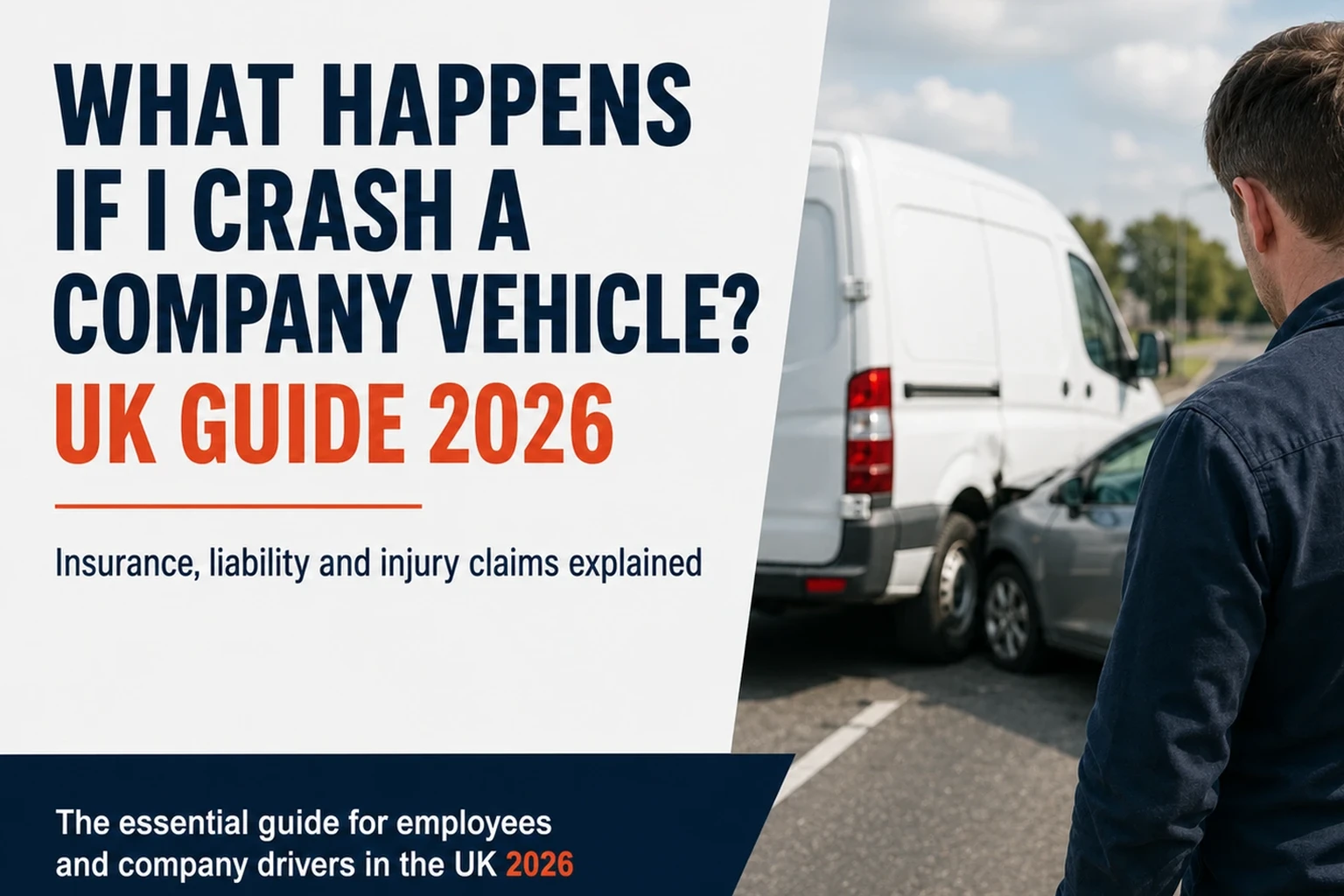
If you crash a company vehicle while driving for work, your employer’s motor insurance usually covers the accident, not you personally. Report it to your manager and the insurer, get any injuries checked, and keep evidence. If you were injured and the crash was not entirely your fault, you may be able to claim compensation, even as the driver. It is worth getting advice before you sign anything or agree to pay for the damage.
Crashing a company vehicle is a worrying moment, and it usually raises more questions than answers. Who pays for the damage? Will it affect your own insurance? Is your job at risk, and can you claim for any injuries? This guide works through each of those in plain English, so you know where you stand before you make any decisions.
Whether you drive a company van, a pool car between sites, or a lorry on a fleet policy, the same basic principle applies. When you are driving for work, the accident is usually dealt with through your employer’s insurance rather than your own. What happens next depends on the circumstances, who was at fault, and whether anyone was hurt.
Below, we walk through each part step by step, starting with what actually counts as a company vehicle crash.
What counts as crashing a company vehicle?
A crash in any vehicle owned, leased or hired by your employer, where the accident happens while you are driving for work.
Definition
Vicarious liability
A legal principle where an employer can be held responsible for things an employee does in the course of their job, including road traffic accidents.
A company vehicle is any vehicle your employer provides for work. That includes pool cars, branded vans, lorries, taxis on a fleet policy and, in some cases, your own car when you use it for work under a mileage scheme. A crash counts as a company vehicle accident when it happens while you are driving in the course of your employment.
- Driving between client sites, depots or branches
- Making deliveries or collections on a work route
- Carrying a colleague or passenger for work reasons
- Parking, manoeuvring or refuelling during a shift
The usual daily commute to and from work does not normally count, unless your role means your working day starts the moment you get behind the wheel. If you are not sure which side of that line your journey falls on, it is worth checking, because it affects who deals with the claim.
What to do straight after the crash
Stop and check for injuries, exchange details, report it to your employer and their insurer, get any injuries looked at, and keep your own record of what happened.
1. Make sure everyone is safe
Check yourself and anyone else involved for injuries and call the emergency services if needed. By law you must stop after an accident and give your details to anyone with reasonable grounds to ask for them.
2. Exchange and record details
Take the names, contact and insurance details of any other drivers, plus the registration numbers of the vehicles involved. Note the time, location and weather, and take photos of the scene and any damage while it is fresh.
3. Report it to your employer
Tell your line manager and your employer’s insurer as soon as you can, ideally in writing. Most company vehicle policies require you to report an accident quickly, so a short, factual account is enough at this stage. Stick to the facts and avoid guessing about blame.
4. Get any injuries checked
Even if you feel fine, some injuries such as whiplash can take a day or two to show. Seeing a GP or attending A&E creates a medical record, which matters if you decide to claim later.
Try not to admit fault at the scene, even out of politeness. Fault is decided later, based on the evidence. A quick “sorry” can be misread as accepting blame, so it is better to stay factual and let the insurers work out responsibility.
Who is liable, and who pays?
When you crash a company car while working, the employer’s motor insurance usually covers the damage and any third party. You are not normally liable personally, unless you were doing something well outside your job.
In most cases, when you crash a company vehicle at work, the employer’s motor insurance policy responds. The vehicle belongs to the business, the business insures it, and you were driving it for work. That is why liability usually sits with the employer’s insurer rather than with you as the driver.
There are limits to this. If you were using the vehicle for something clearly outside your job, driving without a valid licence, or under the influence of alcohol or drugs, your employer or their insurer may treat the situation differently. In those cases it is sensible to take advice quickly.
| Situation | Who usually covers it | Notes |
|---|---|---|
| Driving a company van mid-shift | Employer's motor insurer | Standard work-driving scenario |
| Pool car on a client visit | Employer's motor insurer | Keep your route or diary as evidence |
| Own car used for work (mileage) | Your insurer, sometimes with the employer | Check you have business-use cover |
| Commuting to your usual workplace | Your own insurer | Usually treated as a normal RTA |
| Clearly unauthorised personal use | Potentially you | Speak to a solicitor before responding |
Can my employer make me pay for the damage or the excess?
This is one of the most common worries, and the answer is not always straightforward. An employer can only take money from your wages for accident damage if your contract or a written agreement allows it, or you have agreed to it. Unauthorised deductions from pay are restricted under the Employment Rights Act 1996. Many employers simply claim on their insurance and, at most, ask you to cover the policy excess if the terms allow. If you are being asked to pay a large sum, it is worth getting advice before you agree.
“Being asked to pay for the damage is not the same as being legally required to. Check what your contract actually says before you agree to anything.”
Will it affect my own insurance or no-claims bonus?
A crash in a company vehicle is usually recorded on the employer’s policy, not your personal one, so your own no-claims bonus is not normally affected. You may still need to declare it when you renew or take out personal cover.
Because the accident is dealt with through your employer’s insurance, it does not usually touch your personal car insurance or your no-claims bonus. The claim sits on the company policy.
There is one point worth knowing. Many personal insurers ask whether you have been involved in any accident, in any vehicle, within a set period, often the last five years. So even though the company crash is on your employer’s policy, you may still need to mention it honestly when you renew or apply for personal cover. If you are unsure how to answer a question on a form, check with the insurer rather than guessing.
Can i be disciplined or dismissed for crashing a company vehicle?
An accident on its own is not usually a reason for dismissal. Your employer must follow a fair process, and any action should be reasonable in the circumstances. If you think you have been treated unfairly, you can take advice.
Having an accident does not automatically put your job at risk. Employers are expected to follow a fair and reasonable process before taking any disciplinary action, in line with the Acas Code of Practice on disciplinary and grievance procedures. A genuine accident, where you were driving carefully and simply had bad luck, would not normally justify dismissal.
The picture can change if there is evidence of something more serious, such as dangerous driving, driving under the influence, or repeated incidents. Even then, your employer must act reasonably and follow the correct steps. If you feel you have been dismissed or disciplined unfairly, you may have grounds to challenge it, and whether you can bring an unfair dismissal claim depends on your circumstances, including your length of service. This is a separate area of employment law, so it is worth speaking to an adviser about your specific situation.
Pursuing a personal injury claim after a genuine accident and being disciplined for the accident itself are two different things. Most injury claims are handled through the insurer and are dealt with separately from your day-to-day employment.
What happens if i crash a company vehicle and i am injured?
If you were injured in a company vehicle within the last three years and the crash was not entirely your fault, you may be able to claim compensation.
Being the driver of the company vehicle does not stop you from making a personal injury claim. What matters is whether someone else was wholly or partly responsible for your injuries, for example another driver, or a fault with the vehicle or the road.
You may be able to claim if:
- The crash happened while you were driving for work
- Another person or party was wholly or partly at fault
- You suffered a physical or psychological injury, however minor it seemed at first
- The accident happened within the last three years
Even if you were partly to blame, you may still be able to claim. In that situation the amount of compensation is usually reduced to reflect your share of responsibility, rather than being refused altogether. This is known as contributory negligence.
| Scenario | May be able to claim? | Notes |
|---|---|---|
| Hit by another driver in a company van | Likely yes | Another party at fault |
| Crash caused partly by you, partly by another | Possibly | Award may be reduced for your share |
| Injured due to a vehicle or road defect | Possibly | Depends who is responsible |
| Single-vehicle crash entirely your fault, no injury to others | Usually not | Speak to us to be sure |
How much compensation could i receive?
It depends on your injuries and financial losses. Whiplash injuries from road accidents follow a fixed government tariff, while other injuries are valued using the Judicial College Guidelines. Every claim is assessed on its own facts.
Definition
General and special damages
General damages cover the injury itself, including pain, suffering and the effect on your daily life.
Special damages cover financial losses you can evidence, such as lost earnings, treatment and travel costs.
Compensation is not a single fixed figure. It is built from your injuries and any money you have lost or spent because of the accident. For lower-value whiplash injuries after a road traffic accident, the amount for the injury itself is set by a government tariff. For most other injuries, solicitors and courts use the Judicial College Guidelines as a reference point.
The table below shows the current whiplash tariff for road traffic accidents on or after 31 May 2025. These are the amounts a court may award for the injury itself, before any financial losses are added.
| How long symptoms last | Whiplash only | Whiplash with minor psychological injury |
|---|---|---|
| Up to 3 months | £275 | £300 |
| 3 to 6 months | £565 | £595 |
| 6 to 9 months | £965 | £1,025 |
| 9 to 12 months | £1,510 | £1,595 |
| 12 to 15 months | £2,335 | £2,435 |
| 15 to 18 months | £3,445 | £3,550 |
| 18 to 24 months | £4,830 | £4,975 |
More serious injuries, such as significant back, neck or shoulder injuries and psychological harm, are not covered by the tariff. They are valued individually using the Judicial College Guidelines, now in their 18th edition (2026), together with your financial losses. Because the range is wide and every injury is different, the best way to understand what your claim might be worth is to have it assessed on its own facts.
A very early offer is not always the full picture. It can help to wait until a medical expert has set out your likely recovery, so that any settlement reflects your actual injuries and losses.
Do you have a valid company vehicle accident claim?
Not every crash involving a company vehicle results in a valid compensation claim.
Our free interactive claim-readiness tool helps you quickly understand whether you may be eligible to claim before speaking to a solicitor.
Answer four quick questions to receive clear guidance based on your circumstances.
How long does a claim take?
Timescales vary. Straightforward whiplash claims through the official portal can resolve in a matter of months, while more serious or disputed cases can take longer.
There is no single answer, because it depends on how serious your injuries are and whether the other side accepts responsibility. Simpler, lower-value whiplash claims made through the Official Injury Claim service tend to be quicker. Cases involving serious injury, disputed fault, or a longer recovery usually take more time, because they need fuller medical evidence.
Common mistakes to avoid
The most common slip-ups are admitting fault at the scene, agreeing to pay for damage without checking, missing medical appointments, and throwing away receipts.
If you crash a company vehicle, a strong case can still be made harder by small mistakes in the early weeks.
These are the ones we see most often:
- Admitting fault at the scene, when responsibility is better left for the insurers to assess from the evidence
- Agreeing to pay for the damage or the excess without first checking what your contract requires
- Delaying medical treatment, which can leave gaps in your records and make injuries harder to link to the crash
- Posting about the accident on social media, which insurers may look at
- Throwing away receipts for anything you have paid out, since financial losses need proof
Summary
Crashing a company vehicle can feel serious, but it is usually more manageable than it first seems. When you are driving for work, the accident is normally covered by your employer’s insurance, not your own. Your personal no-claims bonus is not usually affected, and a genuine accident on its own is not typically a reason for losing your job.
If you were injured and the crash was not entirely your fault, you may be able to claim compensation, even as the driver of the company vehicle. The practical steps matter most: report the accident, get any injuries checked, keep your evidence, and take advice before agreeing to pay for damage or accepting an early offer.
Key takeaways
- The employer’s motor insurer usually covers a company vehicle crash, not you personally
- Your own insurance and no-claims bonus are not normally affected, but you may still need to declare the accident when asked
- An accident on its own is not usually a fair reason for dismissal
- If you were injured and not wholly at fault, you may be able to claim
- The general time limit for a personal injury claim is three years from the accident
Frequently Asked Questions
Who pays if I crash a company car?
Do I have to tell my own insurer about a company car accident?
Can I be sacked for crashing a company vehicle?
Can I still claim compensation if the crash was partly my fault?
Often, yes. Your compensation may be reduced to reflect your share of responsibility rather than the claim being refused completely. This is known as contributory negligence.
How long do I have to make a claim?
For most personal injury claims in England and Wales, the general time limit is three years from the date of the accident. Exceptions can apply, including cases involving children or injuries that become apparent later. It is usually better to act early while evidence is still available.
Do I have to pay anything upfront to make a claim?
Most road traffic accident claims can be handled on a No Win No Fee basis, meaning there is usually nothing to pay upfront. The solicitor should explain any fees, deductions and agreement terms before you decide whether to proceed.


