
Claim Deadline
3 years
from date of accident
Whiplash Tariff
£275 – £4830
(SI 2025/615)
Average Claim Time
9
months (MIB average)
Upfront cost
£0
No Win No Fee
Written By

Rizwan Shabir
Every guide we publish is verified against UK statute and current case law before release.
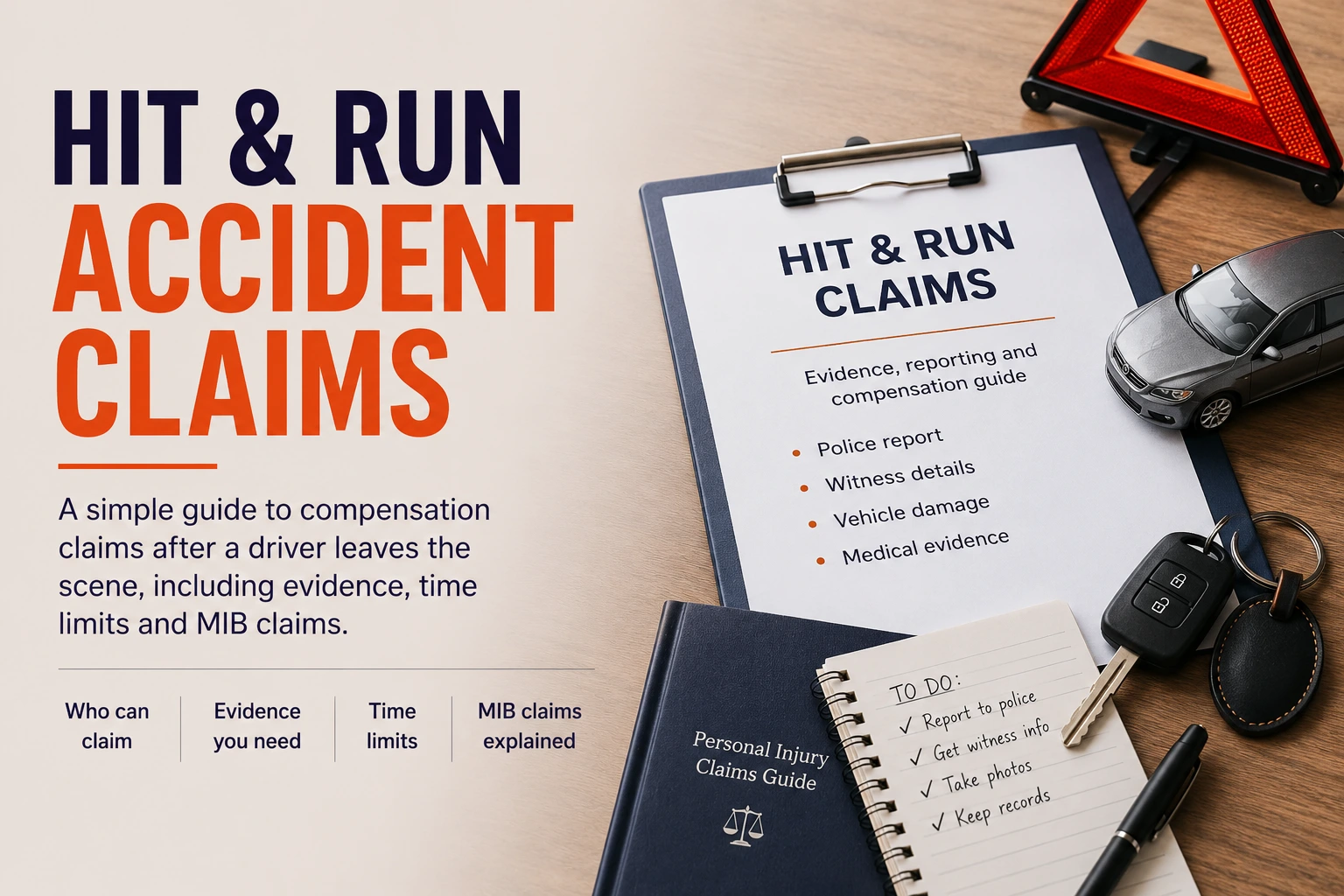
If you’re looking to file for hit & run accident compensation claims after a driver failed to stop, you may entitled to compensation through the Motor Insurers’ Bureau (MIB) rather than the driver’s insurer. You’ll usually need to report the accident to the police within 14 days and submit your MIB claim within three years.
Being hit by a driver who doesn’t stop is frightening, and it can leave you unsure whether you have any right to compensation at all. You do. Hit & run accident compensation claims are usually handled through the Motor Insurers’ Bureau (MIB) rather than an at-fault driver’s insurer, because UK law provides a specific route for cases where the driver cannot be traced.
London alone recorded 7,708 hit-and-run casualties in 2021, more than 21 every day, and the problem has grown rather than shrunk since 2009. If you’re one of them, this guide explains who may be liable, how the MIB process works, what compensation you may be entitled to, and what to do in the days after the accident.
Whether you were driving, cycling, or walking when the driver failed to stop, the same principle applies: not knowing who hit you does not mean you have no claim.
What counts as a hit and run accident?
A hit and run is any road traffic collision where the responsible driver leaves the scene without exchanging details, whether or not you have any information about them or their vehicle.
Definition
Untraced driver
A driver who caused a collision and cannot be identified, even after police enquiries, because they left the scene without giving their details or gave false information.
A hit and run accident happens when the driver responsible for a collision fails to stop and provide their name, address and insurance details, as required by law. This covers a range of situations, not just the classic scenario of being struck and left in the road:
- The other driver drove off immediately after the collision
- The other driver stopped briefly but left before details were exchanged
- You have a partial description, registration or dashcam footage, but the driver still hasn’t been identified
- You have no information at all about the vehicle or driver
If the driver is later identified but turns out to have no valid insurance, your claim moves under the MIB’s separate Uninsured Drivers’ Agreement, which works in a similar way.
Who is liable if the driver can't be found?
The driver who caused the accident remains legally liable even if they can’t be identified. Because you can’t pursue them directly, the Motor Insurers’ Bureau steps in and pays compensation on their behalf.
Liability doesn’t disappear just because the driver fled the scene. MIB makes hit and run compensation claims simple. The MIB was set up by the government and the insurance industry as a fund of last resort, so victims of untraced or uninsured drivers aren’t left without a remedy. The MIB is funded by a levy on every UK motor insurance policy, not public money.
You may be eligible to claim through the MIB if
- You were injured in a road traffic accident caused by another driver
- That driver left the scene and has not been traced
- You reported the accident to the police, generally within 14 days for a personal injury claim
- You cooperate fully with the MIB’s investigation, including police enquiries
- The accident happened in the UK
Claiming through the motor insurers' bureau
You apply directly to the MIB under the Untraced Drivers’ Agreement 2017. There’s no driver to sue, so the MIB investigates the accident itself and, where the claim succeeds, pays compensation directly.
Because there’s no defendant to bring a claim against, the process works differently from a standard road traffic claim. The MIB will check what you and the police did to try to trace the driver, request your medical records, and may ask you to attend an independent medical examination before making a decision.
| Requirement | Detail | Deadline |
|---|---|---|
| Report to police | Personal injury claims | Within 14 days |
| Report to police | Property damage only | Within 5 days |
| Submit claim to MIB | All untraced driver claims | Within 3 years of the accident |
| Dispute a decision | Arbitration, not court | Within 3 months of the MIB's decision |
Sourced from the Untraced Drivers' Agreement 2017 and current MIB claims guidance.
If you are unsure whether your situation meets the threshold for what qualifies as medical negligence, the uncertainty itself is itself a reason to seek legal advice. A specialist solicitor will commission independent expert evidence to assess the standard of care provided, which is the only reliable way to move from uncertainty to a clear answer.
Rizwan Shabir
Compensation you may be entitled to
Whiplash injuries lasting up to two years are valued under a fixed statutory tariff, currently £275 to £4,830 depending on duration. More serious or non-whiplash injuries are assessed individually against the Judicial College Guidelines, 18th Edition.
Definition
General vs. special damages
General damages compensate for the injury itself, including pain, suffering and loss of amenity.
Special damages are financial losses you can evidence with receipts, payslips or invoices.
Whiplash injuries from a road traffic accident lasting up to two years are valued using a fixed government tariff rather than case-by-case assessment. The current tariff took effect on 31 May 2025 under the Whiplash Injury (Amendment) Regulations 2025 (SI 2025/615), an uplift of around 15% on the 2021 figures.[4
| Duration of Injury | Whiplash Only | Whiplash + Minor Psychological Injury |
|---|---|---|
| Up to 3 months | £275 | £300 |
| 3 – 6 months | £565 | £595 |
| 6 – 9 months | £965 | £1,025 |
| 9 – 12 months | £1,510 | £1,595 |
| 12 – 15 months | £2,335 | £2,435 |
| 15 – 18 months | £3,445 | £3,550 |
| 18 – 24 months | £4,830 | £4,975 |
Courts can add up to a 20% uplift in exceptional circumstances. Injuries lasting beyond 24 months, or injuries other than whiplash, fall outside the tariff and are assessed under the Judicial College Guidelines, 18th Edition (April 2026).
Beyond general damages, a successful claim may also allow you to recover:
- Medical treatment and rehabilitation costs
- Loss of earnings while you’re unable to work
- Vehicle damage, where it accompanies a significant injury
- Care and support costs, evidenced where possible
To get an early, no-obligation sense of what your claim might involve, you can use our claim value estimator.
Steps to take after a hit and run
Report it to the police, get medical attention even for minor injuries, gather whatever evidence you can, and notify your own insurer before approaching the MIB.
- 1Report to the PoliceWithin 14 days
Get a crime reference number. This is essential evidence for your MIB application.
- 2Seek Medical AttentionAs soon as possible
Even minor injuries should be checked. Your medical record supports the value of your claim later.
- 3Gather EvidenceFirst few days
Photos, witness details, CCTV or dashcam footage, and any partial vehicle description you have.
- 4Notify Your InsurerPromptly
Some policies require notification of all accidents, even if you don't intend to claim on your own cover.
- 5Speak to a Solicitor Before Applying to the MIBWithin 3 years
A specialist can help ensure your application meets the MIB's evidential requirements the first time.
Checking your own car insurance policy is also worth doing. Many policies include uninsured driver protection that lets you claim without affecting your no-claims bonus, even where the MIB route also applies.
How long does a claim take?
The MIB’s own guidance puts the average untraced driver claim at around 9 months, though straightforward cases can resolve faster and complex ones can take considerably longer.
Untraced driver claims generally take longer than standard insurance claims because the MIB has to investigate the accident itself, including checking what efforts were made to trace the driver and requesting the police report. According to the MIB’s own published guidance, claims can range from a couple of months to several years depending on complexity, with an average claims window of around nine months. Cases involving serious or ongoing injuries typically take longer, since they need fuller medical evidence before a value can be agreed.
Summary
Hit & run accident compensation claims are usually handled through the Motor Insurers’ Bureau, which exists to compensate victims of drivers who can’t be traced or identified. The process is more involved than a standard claim, but it follows a clear structure.
The most important steps are practical: report the accident to the police quickly, get medical attention, gather what evidence you can, and get advice before submitting your MIB application. You have three years from the date of the accident to make your claim, but earlier action almost always means stronger evidence.
Key takeaways
- You may be entitled to compensation through the MIB even if the driver is never identified
- Report the accident to the police, generally within 14 days for personal injury claims
- You have three years from the accident date to submit your MIB claim
- Whiplash claims follow a fixed statutory tariff; other injuries are assessed individually
- MIB claims average around 9 months but vary with complexity
- RoadPeace / Greater London Authority, "Hit and run: The escalating crisis on London roads", January 2024 (2021 casualty data)
- Motor Insurers' Bureau, Untraced Drivers' Agreement 2017
- Motor Insurers' Bureau, MIB claims process guidance, mib.org.uk
- The Whiplash Injury (Amendment) Regulations 2025, SI 2025/615
- Limitation Act 1980, s.11, time limits for personal injury actions
- Solicitors Regulation Authority Handbook
Frequently asked questions
Can I claim if the driver who hit me is never found?
Yes. This is exactly what the Motor Insurers’ Bureau’s Untraced Drivers’ Agreement is for. You claim directly against the MIB instead of the driver, provided you reported the accident to the police and cooperate with their investigation.
How much compensation can I claim for a hit and run?
Whiplash injuries lasting up to two years follow a fixed tariff of £275 to £4,830, depending on duration, under regulations that took effect 31 May 2025. More serious or non-whiplash injuries are valued individually under the Judicial College Guidelines, so figures vary by case.
How long do hit and run compensation claims take?
Who is liable in a hit and run accident?
Do I have to pay anything upfront?
Glossary of Key Terms
Disclaimer: This article provides general legal information about UK clinical negligence law and is not a substitute for tailored legal advice. Outcomes depend on the specific facts of each case. For advice on your circumstances, please contact a member of our team. Information correct as of June 2026. Claim Time Solicitors is regulated by the Solicitors Regulation Authority (SRA No. 444171).