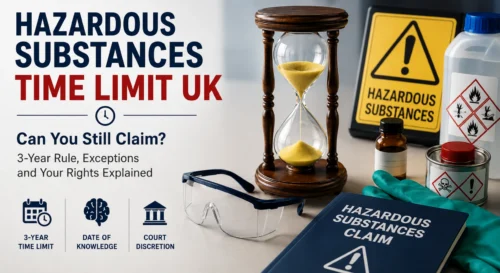
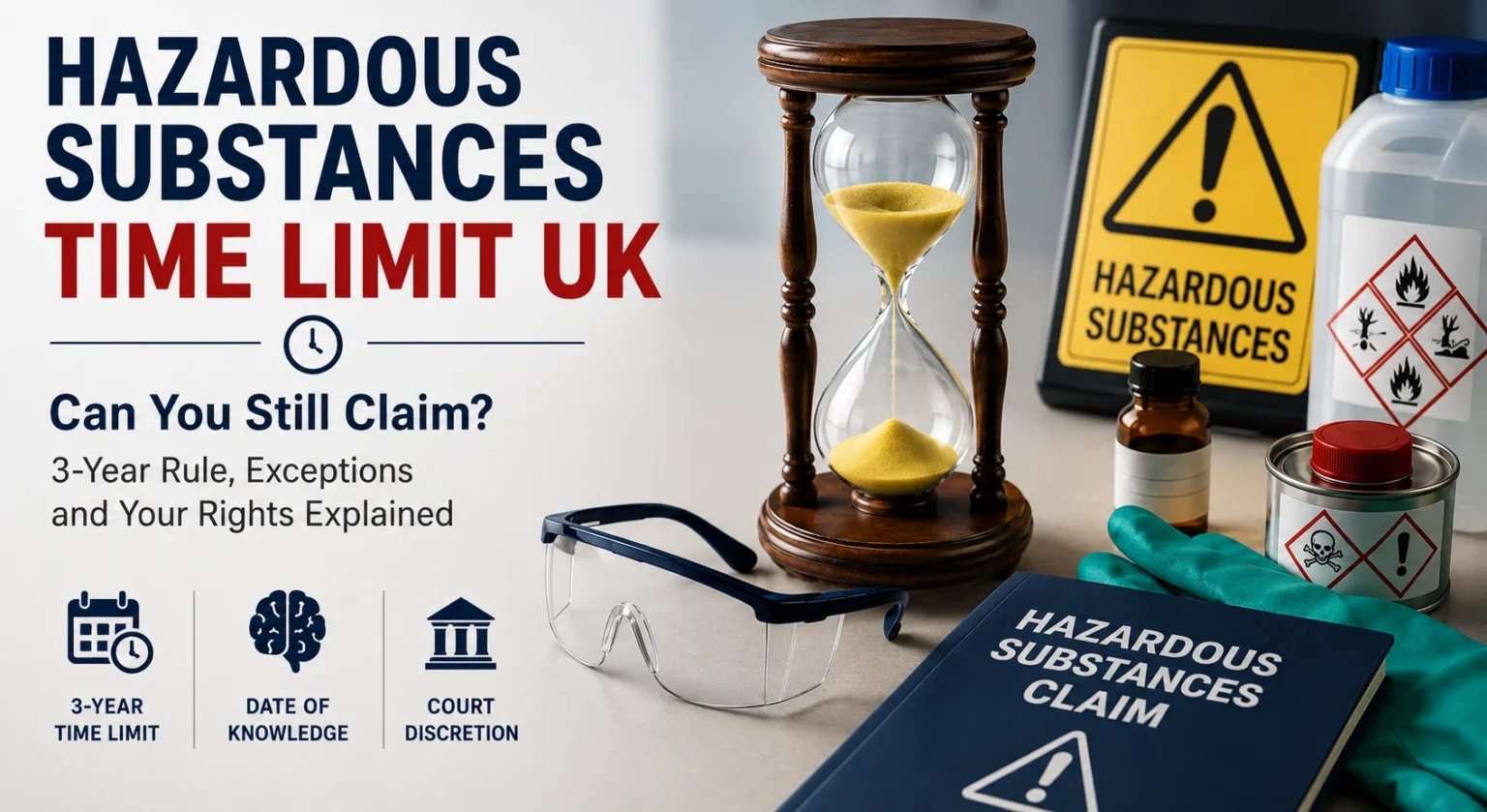

Time limit to claim
3 years
usually from your date of knowledge
Main employer duty
COSHH
Regulations 2002
Cost to start
£0
No Win No Fee available
First step
Free
no-obligation case review
Written by

Rizwan Shabir
Personal Injury Solicitor at Claim Time Solicitors, Birmingham. Handling personal injury and child injury claims across England and Wales on a No Win No Fee basis.
This guide is reviewed against the Limitation Act 1980, Mental Capacity Act 2005, and SRA standards. For general information only.
Hazardous substances at work are chemicals, dusts, fumes, gases and biological agents that can harm your health. Under the Control of Substances Hazardous to Health Regulations 2002 (COSHH), your employer has a legal duty to assess the risk and protect you. If you have been made ill because that duty was not met, you may be able to claim compensation. You usually have three years to bring a claim, and most claims run on a No Win No Fee basis, so there is normally nothing to pay upfront.
If you have been exposed to a harmful substance at work, it is natural to feel worried, and to have questions about what should have happened and what you can do now. This guide explains what hazardous substances are, the rules your employer has to follow, and how a compensation claim works if something has gone wrong.
Work-related ill health is more common than many people realise. The Health and Safety Executive (HSE) estimates that around 1.9 million working people in Great Britain were suffering from a work-related illness in 2024/25, and that roughly 40.1 million working days were lost to work-related ill health and injury in the same period.[1] Substances at work are one part of that picture.
We have set this guide out step by step. It starts with the basics of defining what substances can be hazardous at work, then moves through the law, the health effects, who is responsible, and the practical steps involved in making a claim.
What are hazardous substances at work?
A hazardous substance is any material used or produced at work that can damage your health, including chemicals, dust, fumes, gases, vapours and biological agents such as bacteria.
A hazardous substance is anything used at work, or created by the work itself, that can harm your health if you breathe it in, swallow it, or get it on your skin or in your eyes. Some substances are obviously dangerous, such as strong acids or solvents. Others are less obvious, like the fine dust from cutting stone or the fumes given off during welding.
Definition
Hazardous substance (under COSHH)
COSHH covers substances that are harmful to health, including chemicals, products containing chemicals, fumes, dusts, vapours, mists and gases, and biological agents. It does not cover asbestos, lead or radioactive substances, which have their own separate regulations.[2]
Hazardous substances generally fall into a few broad groups:
- Chemicals: cleaning products, solvents, acids, adhesives and paints
- Dusts and fibres: wood dust, flour dust, cement and silica from stone or concrete
- Fumes and vapours: welding fumes, exhaust gases and solvent vapours
- Biological agents: bacteria, viruses and other organisms found in some workplaces
Common hazardous substances at workplaces in the UK
Hazardous substances turn up in almost every industry, from cleaning sprays in an office to silica dust on a construction site. Exposure is often gradual and easy to miss.
You do not have to work in a factory to be exposed. Harmful substances are part of everyday work in many settings, and the risk depends on how much you are exposed to and for how long.
| Workplace | Common substances | How exposure happens |
|---|---|---|
| Construction sites | Silica dust, cement, solvents, paints | Cutting, mixing, breathing in dust |
| Factories & warehouses | Solvents, adhesives, oils, fumes | Handling, spills, poor ventilation |
| Cleaning & facilities | Bleach, disinfectants, acids | Skin contact, mixing products, splashes |
| Salons & healthcare | Chemicals, disinfectants, biological agents | Regular skin and airborne contact |
| Offices & schools | Cleaning sprays, printer toner | Lower risk, but not risk-free |
Exposure is not always dramatic. Many work-related illnesses build up slowly over months or years, which is why keeping a note of what you handled, and when, can matter a great deal later on.
The law that protects you: COSHH and the 1974 Act
Two main laws protect you: the Health and Safety at Work etc. Act 1974, and the COSHH Regulations 2002. Together they require employers to assess risks from hazardous substances and take steps to control them.
UK law places clear duties on employers when it comes to hazardous substances. The two you are most likely to hear about are the Health and Safety at Work etc. Act 1974 and the Control of Substances Hazardous to Health Regulations 2002, usually shortened to COSHH.
Definition
COSHH (Control of Substances Hazardous to Health Regulations 2002)
The main set of rules requiring employers to prevent or reduce workers’ exposure to hazardous substances. It applies across most industries and is enforced by the Health and Safety Executive.
Under COSHH, an employer is generally expected to:
- Assess the risks from substances used or produced at work
- Decide what controls are needed, and put them in place
- Keep those controls working and in good order
- Provide information, instruction and training
- Provide suitable protective equipment where it is needed
- Monitor exposure and arrange health checks where appropriate
The Health and Safety at Work etc. Act 1974 sits above all of this. It sets the general duty on employers to protect the health, safety and welfare of their workers, so far as is reasonably practicable. When an employer falls short of these duties and someone is harmed as a result, that failure can form the basis of a compensation claim.
Health effects of exposure to hazardous substances
Effects range from short-term problems like skin rashes, headaches and breathing difficulty, to serious long-term conditions such as occupational asthma, dermatitis and certain lung diseases.
The health effects of hazardous substances depend on the substance, the amount and the length of exposure. Some appear quickly. Others take years to develop, which is common with conditions affecting the lungs.
Short-term effects
- Skin rashes, irritation or burns
- Sore or watering eyes
- Headaches, dizziness or feeling sick
- Coughing, wheezing or shortness of breath
Long-term effects
- Occupational asthma and other breathing conditions
- Occupational dermatitis (long-lasting skin damage)
- Chronic obstructive pulmonary disease (COPD)
- Certain cancers linked to specific substances
The HSE estimates that around 11,000 lung disease deaths each year in Great Britain are linked to past exposures at work. Its figures attribute these broadly to COPD, lung cancer and mesothelioma.[3] Because lung conditions often take decades to appear, many of today's cases reflect exposures from years ago.
If you have symptoms you think may be linked to work, see your GP first. A medical record that connects your condition to your working conditions is important for your health, and later for any claim.
Who is responsible? Employer and supervisor duties
Legal responsibility usually sits with your employer. Supervisors and managers carry duties too, but a claim is normally made against the employer, whose insurance is designed to cover exactly this.
A common worry is whether making a claim means blaming a manager or a colleague. In most cases, it does not. The main legal duty for health and safety rests with the employer, and employers are required by law to hold insurance for claims like this.
Supervisors and managers do have their own responsibilities, such as making sure control measures are followed and that workers use the equipment provided. Where a supervisor ignores a known risk, that can be part of the picture. Even so, a personal injury claim is usually brought against the business rather than an individual, because it is the employer who is legally responsible for how the work is organised and managed.
“Making a claim is not about pointing the finger at a colleague. It is about the employer meeting duties that exist to keep people safe, and the insurance that is there for when they are not met.”
Can you claim compensation for hazardous substance exposure?
You may have a claim if you were made ill by a hazardous substance at work and your employer failed in a duty owed to you, for example by not assessing the risk or not providing proper protection. A solicitor can tell you quickly whether it is worth pursuing.
You may have a claim if you were made ill by a hazardous substance at work and your employer failed in a duty owed to you, for example by not assessing the risk or not providing proper protection. A solicitor can tell you quickly whether it is worth pursuing.
Avoid The Mistakes That Could Harm Your Claim
Download our free guide to learn the common mistakes people make after an accident and the simple steps that can help protect your claim.
- Free instant download
- Clear, practical guidance
- No obligation
Not every exposure leads to a claim. Two things generally need to be present: a diagnosed illness or injury linked to a substance at work, and a failure by your employer to do what the law reasonably required. You may be able to claim for exposure to hazardous chemicals or other harmful substances at work if some of the following apply to your situation.
- You have a diagnosis that a doctor links to substances you worked with
- You were not given suitable protective equipment, or it was in poor condition
- There was no proper risk assessment or safe system of work
- You were not trained on how to handle the substances safely
- Ventilation, monitoring or health checks were missing when they were needed
| Your situation | Claim possible? | What usually matters |
|---|---|---|
| Illness diagnosed and linked to work substances | ✓ Often yes | Medical evidence and work history |
| No PPE or training provided | ✓ Often yes | What the employer did or did not provide |
| Symptoms but no diagnosis yet | Speak to us | See a GP first; timing can matter |
| Exposure over three years ago | Depends | The clock often runs from your date of knowledge |
| No diagnosis and no symptoms | Usually no | There needs to be an actual injury or illness |
How compensation is assessed
Compensation is worked out from two parts: the injury or illness itself (general damages) and the financial losses it caused (special damages). Every case is different, and the amount depends on the diagnosis and its effect on your life.
There is no fixed figure for a hazardous substance claim, because the value depends entirely on your condition and how it affects you. What we can explain is how compensation is put together, so you know what goes into it.
Definition
General vs special damages
General damages are for the injury or illness itself, including pain, suffering and the impact on your daily life.
Special damages are financial losses you can evidence, such as lost earnings, care costs, treatment and travel.
When valuing the injury itself, solicitors and courts refer to the Judicial College Guidelines and to awards in similar past cases. The stronger and clearer your medical evidence, the more accurately your claim can be valued. Because ranges vary so widely between, say, a short-lived skin irritation and a long-term lung condition, we do not publish set figures. We would rather give you a realistic view once we understand your diagnosis.
Keep records of anything you have spent or lost because of your illness, including payslips, receipts and travel to appointments. These support the special damages part of your claim.
How to start your claim
Speak to your GP about your symptoms, gather what evidence you can, and contact a solicitor for a free review. Most claims run on a No Win No Fee basis, so there is usually nothing to pay upfront.
Starting a claim is more straightforward than many people expect.
Here is how it usually goes:
- 1See your GP FirstGet your symptoms recorded and, where possible, linked to your work. Your health comes first, and the notes help your claim.
- 2Gather what you can OngoingNote the substances you worked with, dates, what protection you had, and any complaints you raised. Keep receipts and payslips.
- 3Free case review No costContact our team for a no-obligation chat. We will tell you honestly whether you are likely to have a claim.
- 4We handle the legal side On your behalfIf we take your case on, we deal with the medical evidence and correspondence and keep you updated throughout.
Summary
Being made ill by a hazardous substance at work is not something you have to accept in silence. The law is clear that employers must assess the risks from chemicals, dusts, fumes and other harmful substances, and take reasonable steps to protect the people who work with them. When that does not happen and someone is harmed, a compensation claim may follow.
The most useful steps are practical. See your GP so your symptoms are on record, keep a note of what you worked with and what protection you had, and speak to a solicitor while the details are fresh. You usually have three years to act, though for illnesses that develop slowly the clock often starts from the point you connect your condition to your work.
Key takeaways
- COSHH requires your employer to assess and control the risk from hazardous substances
- You may have a claim if a failure by your employer led to your illness
- Responsibility usually sits with the employer, not an individual colleague
- Compensation reflects both your illness and your financial losses
- Most claims run on a No Win No Fee basis
- Health and Safety Executive: Health and safety at work summary statistics for Great Britain, 2024/25 (working days lost and workers with work-related ill health)
- Control of Substances Hazardous to Health (COSHH): COSHH Regulations 2002 and HSE guidance on what COSHH covers
- Health and Safety Executive: Work-related ill health and occupational disease statistics, 2024/25 (occupational lung disease)
- Health and Safety at Work etc. Act 1974: General duties of employers
- Limitation Act 1980: Time limits, including the date of knowledge for disease claims
Frequently Asked Questions
How long do I have to make a claim for exposure at work?
Can I claim if I still work for the employer?
What if I am not sure which substance made me ill?
Do I have to pay anything upfront?
Most hazardous substance claims run on a No Win No Fee basis. That means there is normally nothing to pay at the start, and if the claim is not successful and you have kept to the agreement, you do not pay us for our work. We will explain any deductions clearly before you sign anything.
Is my employer or my supervisor responsible?
Responsibility for health and safety mainly sits with the employer, and a claim is usually brought against the business rather than an individual. Supervisors have duties too, but you are not personally suing a colleague. The employer’s insurance is there to deal with claims like this.
Glossary of Key Terms
Disclaimer: The information on this page is for general guidance only and does not constitute legal advice. Compensation outcomes vary by individual case and depend on the specific facts and evidence. Claim Time Solicitors is authorised and regulated by the Solicitors Regulation Authority (ID No. 444171) and accredited by The Law Society . No Win No Fee refers to a Conditional Fee Agreement; the solicitor’s success fee is capped at 25% of compensation recovered. Terms apply.