

Pedestrian deaths (2024)
409
Great Britain, DfT
Duty to report
24 hrs
if details not exchanged
Maximum sentence
Life
death by dangerous driving
Civil claims paid by
Insurer
in almost all cases
Written by

Rizwan Shabir
Personal Injury Solicitor at Claim Time Solicitors, Birmingham. Handling personal injury and child injury claims across England and Wales on a No Win No Fee basis.
Every guide we publish is checked against current UK statute and official statistics before release.
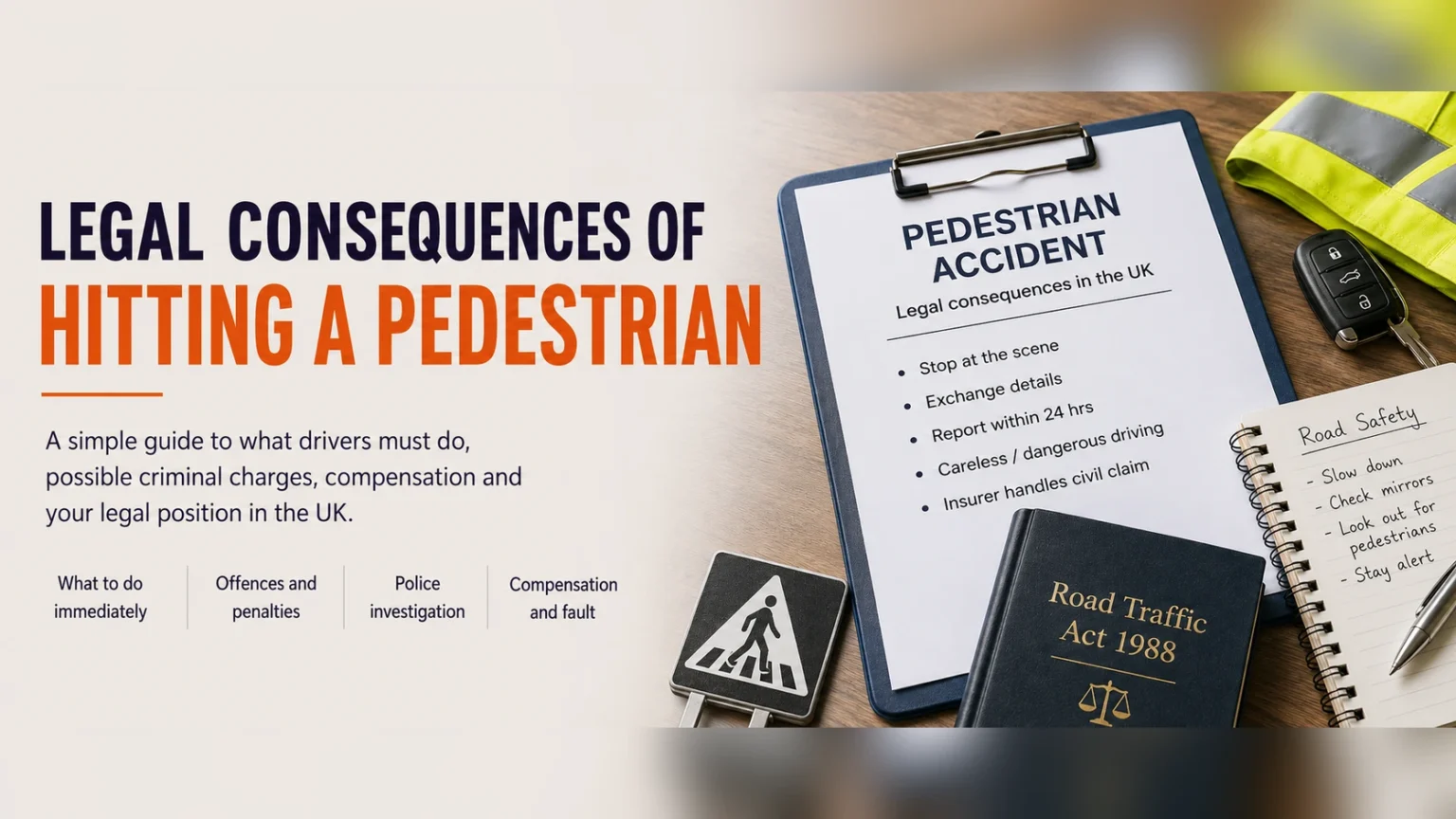
There can be severe legal consequences of hitting a pedestrian in the UK. So, if you hit a pedestrian accidentally, or by being negligent, you must stop at the scene, exchange details and report the accident to police within 24 hours if you could not do so at the time. Consequences range from no further action to penalty points, fines, disqualification or imprisonment, depending on how you were driving. Any compensation claim by the pedestrian is a separate civil matter, normally handled by your insurer.
Hitting a pedestrian is one of the most distressing things that can happen to a driver, and the legal consequences of hitting a pedestrian are rarely explained clearly. Whether anyone was hurt, how you were driving, and what you did immediately afterwards all shape what happens next.
In 2024, 409 pedestrians were killed on Great Britain’s roads, and 5,823 were seriously injured, according to the Department for Transport’s pedestrian factsheet. Most collisions involve ordinary drivers on ordinary roads, not extreme behaviour.
This guide explains your legal duties at the scene, the offences that can apply, how police investigate, what happens in fatal cases, and how civil compensation claims work. It also covers what to do if you were the pedestrian who was hit.
What must you do immediately after hitting a pedestrian?
Stop, check for injuries, call 999 if anyone is hurt, and exchange details. If you cannot exchange details at the scene, you must report the accident to police within 24 hours. These duties apply even if the pedestrian seems unhurt or walks away.
Definition
Duty to stop and report
Section 170 of the Road Traffic Act 1988 requires any driver involved in an injury accident to stop and give their name, address and vehicle details, and to report the accident to police within 24 hours if details were not exchanged at the scene.
At the scene, stick to facts when speaking to police. Do not speculate about speed, visibility or blame. Investigators establish responsibility from evidence, not from what a shaken driver says in the first ten minutes.
Failing to stop or failing to report is a criminal offence in its own right, carrying up to six months’ imprisonment, five to ten penalty points and possible disqualification. Drivers are sometimes convicted of this offence even where the collision itself was not their fault.
If the accident was serious, it is sensible to get legal advice early. That is not about avoiding responsibility. It is about understanding your position before you are interviewed.
What offences can you be charged with?
It depends on the standard of your driving, not on the outcome alone. If your driving was careful and the collision was unavoidable, you may face no charge at all. If it fell below the required standard, charges range from careless driving to causing death by dangerous driving.
| Offence | Law | Maximum penalty |
|---|---|---|
| Careless driving | s.3 RTA 1988 | Fine, 3 to 9 points, possible disqualification |
| Dangerous driving | s.2 RTA 1988 | 2 years' imprisonment, disqualification |
| Causing serious injury by careless driving | s.2C RTA 1988 | 2 years' imprisonment |
| Causing serious injury by dangerous driving | s.1A RTA 1988 | 5 years' imprisonment |
| Causing death by careless driving | s.2B RTA 1988 | 5 years' imprisonment |
| Causing death by dangerous driving | s.1 RTA 1988 | Life imprisonment |
| Failing to stop or report | s.170 RTA 1988 | 6 months' imprisonment, 5 to 10 points |
Maximum penalties reflect the uplifts introduced by the Police, Crime, Sentencing and Courts Act 2022. Sentences in practice depend on the facts of each case.
Driving under the influence of alcohol or drugs is treated as a serious aggravating factor and carries its own parallel offences with higher sentencing outcomes.
The law punishes the driving, then scales the sentence by the harm. The same momentary lapse can mean a fine if nobody is hurt and a prison sentence if someone dies.
Could you go to prison for hitting a pedestrian?
Yes, but only where the driving itself was careless or dangerous, or where you failed to stop. A driver who was driving carefully and could not have avoided the collision does not commit an offence, however serious the injury. Most prison sentences in pedestrian cases involve death or serious injury combined with clearly substandard driving, excess speed, drink or drugs, or leaving the scene.
What happens if a pedestrian dies?
Fatal cases trigger a specialist police investigation, a coroner’s inquest, and a charging decision by the Crown Prosecution Service. The process is thorough and usually takes months.
A fatal collision is investigated by a specialist collision investigation unit. The road is closed, vehicles are examined forensically, and reconstruction experts model speed and sightlines. The coroner opens an inquest to establish how the person died, which runs separately from any criminal case. The CPS then decides whether the evidence supports a charge.
For the driver, this period is long and uncertain. You may be interviewed under caution, and your vehicle may be held for months. Legal representation before any interview is strongly advisable.
“The criminal case asks how the driver drove. The civil claim asks what the loss was worth. They run on separate tracks and can reach different answers.”
For the family of the person who died, a civil claim can be brought regardless of whether anyone is prosecuted. We have separate guidance for families after a fatal road accident.
How is the accident investigated?
Police build the picture from CCTV and dashcam footage, witness accounts, vehicle data, tyre and debris marks, and formal reconstruction reports. Weather, lighting and road layout all feed in.
Initial findings can come within days. Full investigations, particularly fatal ones, commonly take several months, and complex cases longer. Nothing about a slow investigation implies guilt. Thoroughness is the point.
If the pedestrian claims and you are found liable, compensation is normally paid by your insurer, not by you personally. Your premium may rise, but a civil claim is not a fine.
There is an exception, and it is the one most drivers have in mind. Where a pedestrian suddenly moves into the path of an oncoming vehicle, a majority finding against them becomes possible. In Belka v Prosperini a pedestrian was held around two thirds responsible on facts of that kind. But it is the exception rather than the rule, and the court still has to be satisfied that the driver could not reasonably have avoided the collision.
Is the driver always at fault when a pedestrian is hit?
No, but the two sides do not start level. Courts treat the harm a vehicle is capable of causing as part of the driver’s share, and a pedestrian is seldom held the more responsible of the two.
The criminal question is about your driving, not the outcome. If your driving met the standard of a competent and careful driver and the collision could not reasonably have been avoided, you commit no offence, however badly the pedestrian was hurt. A pedestrian stepping out from between parked cars into the path of a car being driven properly is not a crime by the driver. The injury does not create the offence; substandard driving does.
The civil question is about who bears the loss, and it is decided on a lower standard. Civil liability is established on the balance of probabilities rather than beyond reasonable doubt, which is why a driver can be acquitted of any offence and still be found civilly liable, and why a driver can be prosecuted and still face no successful claim.
In the civil claim the pedestrian’s own conduct is accounted for through contributory negligence. Where a pedestrian was partly responsible their compensation is reduced by their share of the blame rather than refused. Where a pedestrian was wholly responsible, a claim does not succeed at all.
What the courts actually do with the percentages
The starting point is not an even split, and the Court of Appeal has explained why. A car, as Lady Justice Hale put it in Eagle v Chambers, “can do so much more damage to a person than a person can usually do to a car”, and that disparity is treated as an aspect of the driver’s blameworthiness rather than as a separate calculation. In Lunt v Khelifa the court described a car as “potentially a dangerous weapon”. The consequence, in Hale LJ’s words, is that “it is rare indeed for a pedestrian to be found more responsible than a driver”.
What commonly counts against a pedestrian
- Stepping out from behind a parked vehicle or other obstruction
- Crossing against a red figure
- Crossing while looking at a phone
- Walking in the carriageway where a footway was available
- Being significantly affected by alcohol
None of those makes the driver blameless. Drivers are held to a high standard around pedestrians, and a higher one again around children and older people, whose behaviour near roads is less predictable and is expected to be anticipated.
What happens if a cyclist hits a pedestrian?
On the criminal side, the cycling offences carry fines rather than imprisonment. Dangerous cycling carries a maximum fine of £2,500. Careless or inconsiderate cycling, and cycling while unfit through drink or drugs, each carry a maximum of £1,000. None of the three carries a power of imprisonment. Where a cyclist causes bodily harm, prosecutors have long relied on a Victorian offence instead: wanton or furious driving, under section 35 of the Offences Against the Person Act 1861, which applies to anyone having charge of a carriage or vehicle and carries up to two years.
On the civil side, the difference that matters is insurance. A cyclist is not required by law to hold any. Where a driver hits a pedestrian there is almost always a motor insurer behind the claim, and where there is not, the Motor Insurers’ Bureau schemes apply. Neither is true of a cycle, because a pedal cycle is not a motor vehicle and falls outside those schemes. A claim against a cyclist is a claim against that person individually, and whether anything is recoverable depends on whether they hold cover of some kind, often through home insurance or a cycling club membership.
Can the pedestrian be at fault?
Definition
Contributory negligence
A reduction in compensation reflecting the injured person’s own share of responsibility for the accident.
Yes, wholly or partly. Courts routinely apportion responsibility. A pedestrian who stepped out from between parked cars, crossed against a red figure, or was looking at a phone may be found contributorily negligent, which reduces any compensation by their share of the blame. Drivers are still held to a high standard around pedestrians, particularly children and older people, so shared fault is more common than complete pedestrian fault.
You do not need the driver to be prosecuted. A compensation claim runs on its own track and on a lower standard of proof. Drivers are frequently not charged in collisions where the injured pedestrian goes on to recover in full.
If you were the pedestrian who was hit
Almost nothing above decides your case. You do not need the driver prosecuted, you do not need insurance of your own, and a driver who was uninsured or drove off does not end it.
You can still claim if the driver was uninsured, or was never traced. The Motor Insurers’ Bureau operates a scheme for each situation. A hit-and-run where the driver is never identified does not close the door, and this is the single thing injured pedestrians most often assume wrongly.
Your own insurance is irrelevant. Walking carries no insurance requirement, and no part of the process asks what cover you hold. The claim is against the driver, and in practice it is handled and paid by their motor insurer.
Being partly at fault does not end it. If you stepped out, or were crossing where you should not have been, your compensation is reduced to reflect your share of the responsibility rather than refused. People talk themselves out of valid claims on this point more than on any other.
Get medical attention and make sure the collision is recorded in your clinical notes as the cause. Report it to the police if nobody has, and keep the incident reference. Take the driver’s details and their insurer’s if you can, and photograph the scene, the vehicle and your injuries.
Identify any witnesses while they are still there, and note any nearby CCTV or dashcam sources quickly. Footage is routinely overwritten within days, and it is the evidence most often lost before anybody thinks to ask for it.
Summary
Almost nothing above decides your case. You do not need the driver prosecuted, you do not need insurance of your own, and a driver who was uninsured or drove off does not end it.
The legal consequences of hitting a pedestrian turn on two separate questions. The criminal question is whether your driving fell below the required standard, and the answer decides whether you face anything from a fine to imprisonment.
The civil question is whether the pedestrian suffered loss you are liable for, and that claim is normally met by your insurer whatever happens in the criminal case.
Key takeaways
- Stopping and reporting are legal duties. Leaving the scene is an offence even if the collision was not your fault
- Charges depend on the standard of driving. Careful driving that could not avoid the collision is not a crime
- Fatal cases involve police investigation, a coroner’s inquest and a CPS charging decision, usually over months
- Civil compensation is separate from criminal charges and is normally met by the driver’s insurer
- Injured pedestrians may be able to claim whether or not the driver is prosecuted
That makes identifying the cyclist, and establishing whether they are covered, the first practical step rather than an afterthought.
You may have seen reports that cyclists now face life imprisonment for causing death. Parliament has legislated for four new offences, covering causing death or serious injury by dangerous cycling and by careless or inconsiderate cycling, with a maximum of life for the most serious.
They are not in force. The provision is marked as prospective, it did not commence on Royal Assent, and it was not included in the first commencement regulations. Until it is brought into force by further regulations, the penalties above are the ones that apply.
Sources & References
- Department for Transport, Reported road casualties in Great Britain: pedestrian factsheet 2024 (GOV.UK, 25 September 2025).
- Road Traffic Act 1988, sections 1, 1A, 2, 2B, 2C, 3 and 170.
- Police, Crime, Sentencing and Courts Act 2022.
- Sentencing Council, motoring offence sentencing guidelines.
- Motor Insurers’ Bureau, uninsured and untraced driver schemes.
Frequently Asked Questions
What if the accident was not my fault?
Can I be sued after a fatal pedestrian accident?
How long does the legal process take?
Will I lose my licence?
It depends entirely on what, if anything, you are convicted of. Careless driving carries three to nine penalty points and the court may disqualify. Dangerous driving and the causing-death offences carry mandatory disqualification and an extended retest before you can drive again. If no offence is proved there is no effect on your licence at all. The injury to the pedestrian, however serious, does not by itself put your licence at risk.
Does my insurance cover compensation to the pedestrian?
Yes. Compulsory motor insurance exists to cover injury to third parties, so where you are found liable it is the insurer that pays the pedestrian rather than you personally. Two things are worth knowing. Notify your insurer promptly even if you believe you were not at fault, because late notification can affect cover. And notifying is not an admission of liability; it is a condition of your policy.
Do I need to tell my insurer if I hit a pedestrian?
Yes, and the point is often misunderstood. Motor policies require you to notify the insurer of any incident that could lead to a claim, whether or not you were at fault and whether or not you intend to claim yourself. Reporting it is not an admission of anything. What it does is keep your cover intact at the moment you are most likely to need it, which is the opposite of what people are trying to achieve by staying quiet.


